Chicago stands on the south-western shore of Lake Michigan, a city of some 2.7 million people at the centre of a metropolitan area of about nine and a half million. It is the third largest city in the United States, and it is the one where the modern tall building was invented — which is why, of all the American cities, it is the one that most rewards looking up.
The weather, which is the thing to plan around
Chicago has a genuinely severe winter, and it is the single thing most underestimated by visitors from a maritime climate. January averages a high of about -1°C and a low of -9°C, with long spells below freezing, snow and the occasional blizzard. The wind coming across the lake makes the air feel considerably colder than the figure suggests, and the exposed lakefront is the coldest part of the city.
Summer is the opposite: July averages a high near 29°C with high humidity and heavy thunderstorms, though the lake breeze keeps the shore cooler than the interior streets.
The best month is September — warm, relatively dry and past the worst of the crowds. October is still reasonable, and holds the marathon. Late spring is pleasant but is also the wettest part of the year. Rainfall is spread fairly evenly, at a little over 900 millimetres annually, so there is no dry season to aim for.
Getting about
- The 'L' — the elevated railway, which is the city's defining piece of infrastructure as much as its transport system. Eight colour-coded lines, and the Loop, which gives the central business district its name, is the ring of track the lines run around.
- Fares are paid with a Ventra card or by tapping a contactless bank card or phone at the gate, on trains and buses alike.
- The airports. O'Hare is reached on the Blue Line, which runs around the clock; Midway, which is closer in and used mostly for domestic flights, is on the Orange Line. Both are considerably cheaper by train than by taxi.
- The suburbs — Oak Park and Brookfield among them — are reached on the CTA or on Metra commuter rail from the downtown terminals.
- Walking is practical in the centre in a way it is not in most American cities, and the Riverwalk along the south bank of the Chicago River is now a continuous route through downtown.
What has changed
Anything written about Chicago before about 2010 is describing a different city in several specific respects:
- The Obama Presidential Center opened on 19 June 2026 in Jackson Park, on the South Side — a museum tower, a forum building and a public library branch on a campus of some nineteen acres. It is the newest major thing to see in the city and appears in no older account.
- Marshall Field's became Macy's in September 2006. The State Street store is still there and still worth entering for the Tiffany mosaic ceiling, but guides that describe Field's as a home-grown Chicago institution are describing a shop sign that came down twenty years ago.
- The John Hancock Center was renamed 875 North Michigan Avenue in 2018, and the Signature Room restaurant near the top closed permanently in September 2023.
- Navy Pier's Ferris wheel was retired in 2015 and replaced the following year by the taller Centennial Wheel.
What there is to do
- Architecture. The river cruises run by the Chicago Architecture Center are the best single introduction to the city, and the usual advice — that they are worth doing first rather than last — is sound.
- Art. The Art Institute of Chicago holds one of the strongest collections anywhere, particularly of French Impressionism and of American painting.
- Museums. The Field Museum, the Griffin Museum of Science and Industry and the Shedd Aquarium, the last two of which are among the largest of their kind in the world.
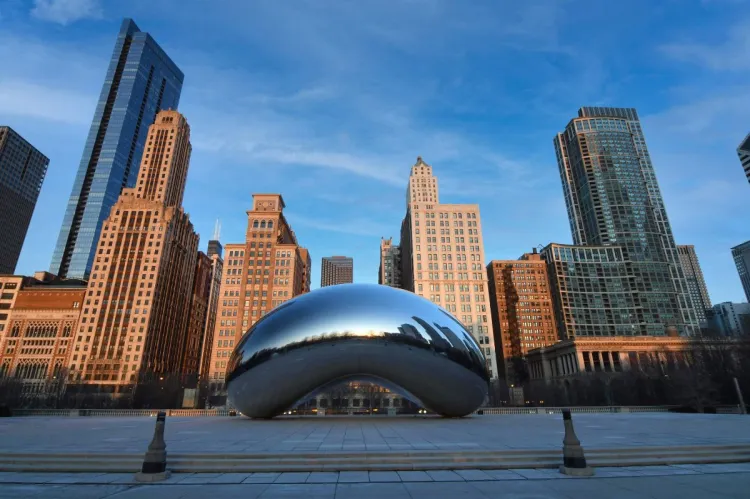
- Parks. Millennium Park, which opened in 2004, holds Cloud Gate — the mirrored sculpture universally called the Bean, and the most photographed object in the city. The lakefront parks run almost the full length of the shore. More under Chicago's parks.
- Theatre. A substantial theatre district, and a comedy tradition that has supplied several generations of American film and television performers.
- Views. Observation decks near the top of the Willis Tower and of 875 North Michigan Avenue — the building almost everyone still calls the Hancock.
- Shopping. The Magnificent Mile, the stretch of North Michigan Avenue above the river, and Navy Pier out on the lake.
- Out of the city. The Frank Lloyd Wright Home and Studio is in Oak Park and Brookfield Zoo Chicago is in Brookfield — both suburbs rather than city districts, and both worth the journey.
- Food. The deep-dish pizza is the export, but it is a minority taste locally; the thin, square-cut tavern style is what Chicagoans actually eat most of, alongside the Italian beef sandwich and a hot dog served, by firm convention, without ketchup.
The two nicknames, both misunderstood
Second City has nothing to do with the theatre district, although the comedy troupe took its name from the phrase. It reflects the fact that Chicago was the second largest city in the United States for most of a century, and it stuck because A. J. Liebling, a New Yorker writer who spent time there in the late 1940s, collected his rather unflattering essays about the place under the title Chicago: The Second City. The city took the insult and kept it. Los Angeles overtook Chicago in 1990, so the name is now historical twice over.
The Windy City is usually explained as a jibe from New York newspapers about the hot air of Chicago politicians during the bidding for the 1893 World's Fair. That story is a myth: the nickname is in print by 1876, in a Cincinnati paper reporting a tornado, and so predates the fair entirely. The wind off the lake is real enough, but it is not where the name came from.
Before travelling
British citizens visiting under the Visa Waiver Programme need an approved ESTA before boarding, applied for online through the official site, esta.cbp.dhs.gov. It requires an e-passport with a chip, it does not cover British Subject, British Overseas Citizen or British National (Overseas) passports, and it should be applied for as soon as travel is planned and at the very least seventy-two hours before departure. Third-party sites charge extra to forward the same application.
The pages in this section cover the towers, the museums, the lakefront, the parks and the shopping.
Chicago is the American city that most rewards looking up.