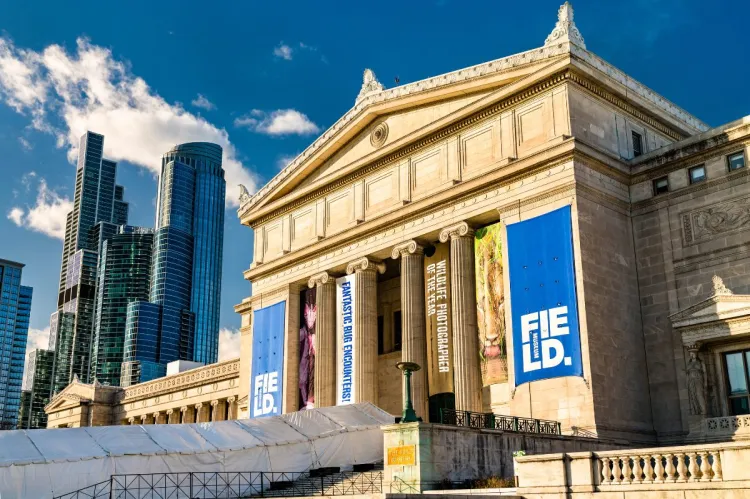
Where SUE is, and what stands in the main hall now
SUE went on show in May 2000 in Stanley Field Hall, the great room inside the entrance, and stood there for eighteen years. In February 2018 the skeleton was taken apart and reinstalled in a gallery of its own inside the Griffin Halls of Evolving Planet, reopening in the spring of the following year. The mount there is better: the ribs and gastralia are arranged as they would have sat in the living animal, which was not possible in the open hall.
Stanley Field Hall is now occupied by Máximo, a cast of Patagotitan mayorum, a titanosaur from Argentina some 122 feet long — far larger than SUE, and the first thing anyone sees on walking in. Visitors who come looking for the Tyrannosaurus in the main hall and find a long-necked herbivore instead are not lost; they need the upper level.
Two notes on SUE. The museum writes they rather than she, because the specimen's sex is not known — the name comes from Sue Hendrickson, who found it in South Dakota in 1990. And on size, the careful claim is the most complete T. rex ever found. "The world's largest" has been standard for years and the museum has used it, but a Saskatchewan specimen known as Scotty has since been argued to be the bigger animal, so completeness is the claim that holds.
The lions, which are the other thing worth crossing the city for
The two male lions shot in 1898 at Tsavo, in what is now Kenya, after they killed a number of workers building a railway bridge, are here, mounted and on display. They are smaller than their reputation and they have no manes, which is characteristic of lions from that region and was part of what made them so frightening to the men hunting them.
The museum's scientists have kept working on them: analysis of hair recovered from cavities in their teeth has been used to establish what the animals had actually been eating. The bodies arrived as skins used as floor rugs for a quarter of a century before they were mounted, which is why the taxidermy is as it is.
Nearby is Bushman, the lowland gorilla who lived at Lincoln Park Zoo and was for a time among the best-known animals in America.
Evolving Planet
The permanent exhibition that opened in 2006 runs through four billion years of life on earth in sequence, from single cells to the arrival of humans, with the dinosaur halls and SUE set into their proper place in the chronology rather than standing apart as a spectacle. It is the best-organised thing in the museum and it rewards being walked in the intended direction.
The rest of it
- Inside Ancient Egypt, built around a reconstructed tomb that descends through two levels, with mummies and burial goods.
- The Grainger Hall of Gems, which holds its own against the equivalent halls in New York and Washington, and the Hall of Jades next to it.
- The habitat dioramas — birds, mammals and marine life posed in painted settings. They are a century-old way of displaying animals and have come back into fashion as artefacts in their own right.
- Plants of the World, in which everything on show is a model, and convincingly so.
Temporary exhibitions and the smaller permanent ones change more often than a page like this can follow, so the museum's own listing is the place to check what is open on the day.
Position
At 1400 South Lake Shore Drive, on the museum campus with the Shedd Aquarium and the Adler Planetarium. The official site is fieldmuseum.org. General practicalities for the city are on the Chicago page.