The name, and why it changed
John Hancock Insurance had held no naming-rights agreement on the building since 2013, and in February 2018 it asked for its name and logos to be taken down. The building was renamed for its street address.
Nobody in Chicago says 875 North Michigan Avenue. The building is the Hancock, or Big John, and the official name is the one that appears on letterheads. It is the third such renaming on this skyline — the Sears Tower became the Willis Tower in 2009, and the Museum of Science and Industry became the Griffin Museum of Science and Industry in 2024 — and in all three cases the local population has declined to follow.
The structure, which is the point of it
Completed in 1969, it rises 1,128 feet — about 344 metres — to the roof, and 1,500 feet to the tips of the antenna masts, across a hundred storeys.
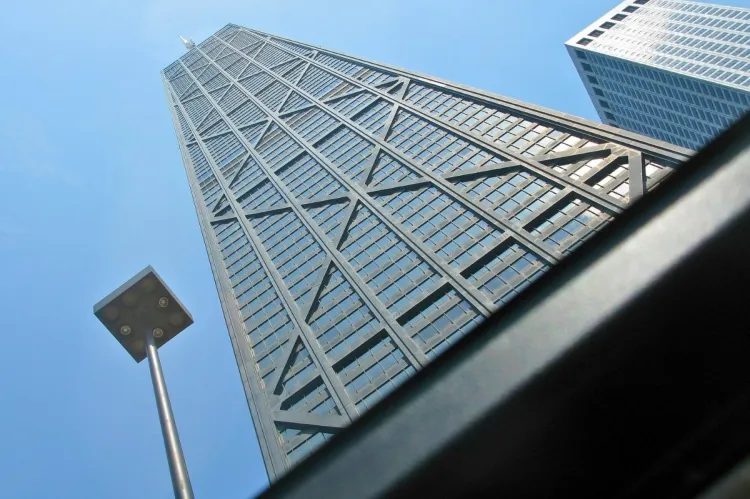
The X-braces are not decoration. They are the structure. Fazlur Rahman Khan, the structural engineer at Skidmore, Owings & Merrill, developed what he called the trussed tube for this building: the bracing goes on the outside so that the skin of the tower carries the wind load, which leaves the floors inside free of the columns that would otherwise be needed. Bruce Graham was the architect. The pairing went on to build the Willis Tower, on a different system again.
One detail belongs here, because it is rarely told. While working on this building in 1965, Khan set up a rotating platform at the Museum of Science and Industry to find out how much movement people could feel in a tall building before it troubled them. The answer shaped how the tower was designed to behave in wind, and the experiment ran in a museum that stands a few miles south.
360 Chicago, and what it replaced
The observation deck is on the 94th floor, at 1,030 feet, and has been called 360 Chicago since it was rebranded from the John Hancock Observatory. Older accounts describe a photographic wall and a display called Windows on Chicago; the fittings have been changed more than once since, and the deck is being extended again.
The deck's distinguishing feature is TILT, added in the summer of 2014: a set of floor-to-ceiling windows that tip outward to thirty degrees, leaving visitors leaning out over Michigan Avenue. It is charged separately from admission.
The Signature Room, which has gone
The restaurant on the 95th floor and the lounge above it ran from 1993 until September 2023, when they closed, citing economic hardship following the pandemic. The observation deck's operator bought the floors in June 2024 and intends to expand into them. It is not becoming a restaurant again, so any guidance that recommends dinner at the top is pointing at something that no longer exists.
The pool, which is not for visitors
There is a swimming pool on the 44th floor, in the residential part of the building, often described as the highest pool in the United States measured by height above the ground. It belongs to the residents. Accounts that invite visitors to take a dip have never been right.
The scaffold, 2002
On 9 March 2002 gusts of around sixty miles an hour tore part of a maintenance scaffold loose from the upper floors. It fell forty-three storeys into Michigan Avenue and crushed several cars. Three people were killed. Accounts that mention the cars and not the deaths give a misleading impression of what happened.
And the wind
The deck has a mesh panel through which the wind at that height can be felt, and it is generally presented as a demonstration of how Chicago came to be the Windy City. It is not. The nickname was in print by 1876 and has nothing to do with the breeze at the top of a building finished ninety years later. The wind is real; the explanation is folklore, and the Chicago page sets out where the name actually came from.
Position
On the Magnificent Mile, towards its northern end, with the entrance to the observation deck below street level. General practicalities for the city are on the Chicago page.