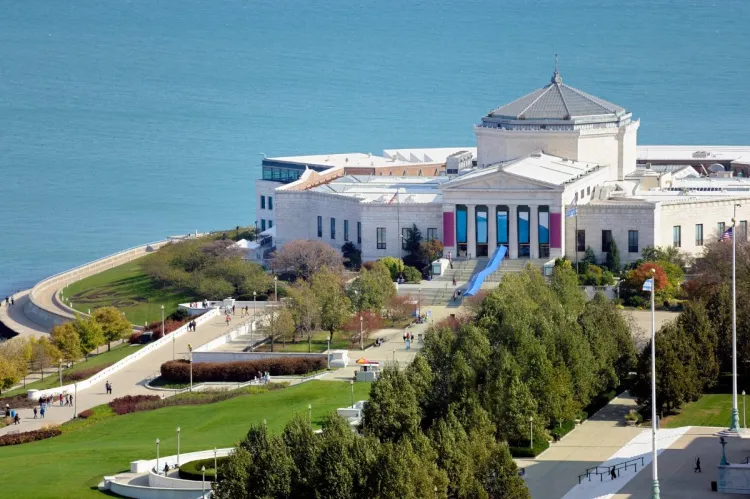
What is open, and what is not
The programme of rebuilding under way is the largest in the aquarium's history and is phased across several years to the 2030 centenary. The aquarium remains open throughout, which means that at any given moment some galleries are shut and others are new. Anything written about the Shedd in the past few years is describing a building mid-alteration, and the aquarium's own site is the only reliable guide to what can be seen on the day.
The Oceanarium
Opened in 1991 and named the Abbott Oceanarium in 2010, this is the part most visitors come for: about three million gallons in total, which makes it the largest indoor marine mammal facility in the world. The glass wall at the far end is set against the lake, so that the water inside appears to run straight into Lake Michigan.
It holds a group of beluga whales, a small number of Pacific white-sided dolphins, sea otters, and southern rockhopper and magellanic penguins.
A correction worth making, because it changes what to expect. The amphitheatre seats around a thousand and the presentation given there is now an educational one about how the animals live and how they are cared for. Older accounts describe a performance — dolphins putting on a show, seats to be fought over half an hour in advance, gates closing before curtain. That is not what happens now, and arriving early to secure a seat for a spectacle is preparing for the wrong thing.
Wild Reef
Opened in 2003, two levels below the main floor, and holding some 525,000 gallons built around a Philippine reef. The sharks are here, in a tank that curves overhead so that they pass above as well as in front. For many visitors it is the best thing in the building.
Amazon Rising
A walk-through reconstruction of a flooded Amazon forest across two galleries, following the river through its seasons as the water rises and falls. Snakes, poison frogs, piranhas and a startling number of catfish species. The light is deliberately low and flash photography is not allowed, which is worth knowing before pointing a camera at anything.
The Caribbean Reef, which has gone
The circular tank of 1971, with its diver feeding the fish by hand and talking to the crowd through a microphone, was for fifty years the first thing visitors met under the rotunda. It closed in 2023.
What replaces it is a Caribbean tunnel some forty feet long, with spotted eagle rays and a rescued green sea turtle. Guidance that sends visitors to the circular tank and the diver is describing the aquarium as it was, not as it is.
Granddad
An Australian lungfish arrived at the Shedd in 1933, shipped from Sydney for the Century of Progress exposition, and stayed for eighty-four years. Known as Granddad, he died in 2017 at a claimed age of a hundred and nine, and was by the aquarium's reckoning the oldest fish in any aquarium in the world.
Older accounts list an Australian lungfish among the exhibits without saying which one it was. It was him, and he is no longer there — which is a small thing, except that for several generations of Chicago schoolchildren he was the animal they remembered.
Position
On the museum campus on South Lake Shore Drive, between the Field Museum and the lake, and walkable from the Loop in about twenty minutes along the shore. The official site is sheddaquarium.org. General practicalities for the city are on the Chicago page.