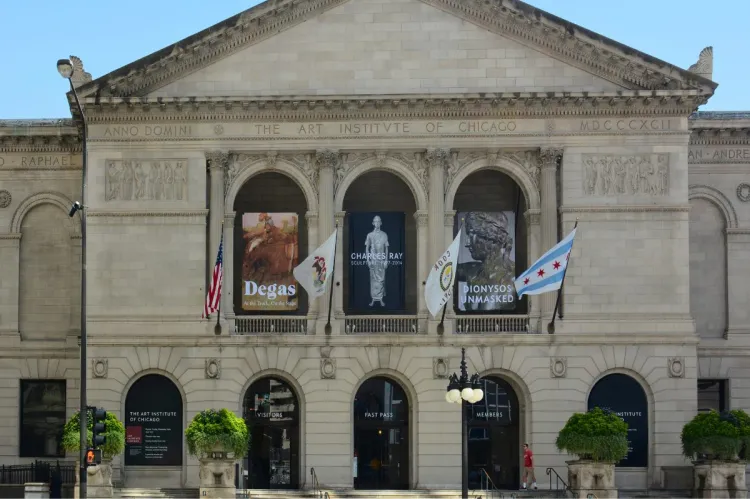
The Modern Wing, which older accounts predate
The largest addition in the museum's history opened in 2009: a wing of some 264,000 square feet designed by Renzo Piano, which increased the museum by roughly a third and gave the modern and contemporary collections, the photography and the architecture and design galleries proper homes of their own.
It also changed how people arrive. The Nichols Bridgeway, a footbridge by the same architect, carries visitors from Millennium Park across Monroe Street and into the Modern Wing's third floor, so it is now possible to walk in from the park rather than up the Michigan Avenue steps. Any account written before 2009 describes a museum with one entrance.
What to see, since the collection is far too large for one visit
Descriptions of the Art Institute tend to list departments and object counts without naming a single work, which is precisely the wrong way round for anyone with an afternoon. The paintings people come for:
- Georges Seurat, A Sunday on La Grande Jatte — the vast pointillist canvas of Parisians on an island in the Seine, and the single most famous thing in the building.
- Grant Wood, American Gothic — smaller than almost everyone expects.
- Edward Hopper, Nighthawks.
- Gustave Caillebotte, Paris Street; Rainy Day.
- Pablo Picasso, The Old Guitarist, from the blue period.
- Vincent van Gogh, The Bedroom — the Chicago version; Van Gogh painted the room three times and the three canvases are in three countries.
- Marc Chagall's America Windows, a set of stained-glass panels made for the museum, which are a reason in themselves to walk through the lower level.
The nineteenth-century French holdings are strong enough to bear comparison with the Musée d'Orsay, which is not a claim many museums outside Paris can make.
The architecture, which is the local subject
Chicago invented the tall building, and the museum reflects it. The Ernest R. Graham Study Center holds well over a hundred thousand architectural drawings, a great many of them from the hands of the architects themselves.
Better than the drawings, though, is a room. When Louis Sullivan and Dankmar Adler's Chicago Stock Exchange was demolished in the 1970s, its trading room was salvaged and rebuilt inside the museum — stencilled, gilded and lit as it was, a complete Sullivan interior that can be walked into. It is one of the few places in the city where that is possible.
Two things people miss
- The Thorne Miniature Rooms, a set of model interiors built to a scale of an inch to the foot, furnished down to the books on the shelves. Children are transfixed and so, generally, is everyone else.
- The staircase from Ferris Bueller's Day Off. The museum has made peace with this and even publishes a tour following the film's route through the galleries, which ends in front of the Seurat.
The school
The School of the Art Institute began alongside the museum and remains one of the more serious art schools in the country. Georgia O'Keeffe studied there, as did Walt Disney, briefly.
Position
At 111 South Michigan Avenue, on the western edge of Grant Park, with the Modern Wing entrance round the corner on Monroe Street and the bridge in from Millennium Park. The official site is artic.edu. General practicalities for the city are on the Chicago page.