The name
Sears commissioned the building to gather several thousand staff from offices across the city into one place. The company sold it and moved out in 1988, and the Sears name nevertheless stayed on it for another twenty-one years.
It became the Willis Tower on 16 July 2009, when Willis Group Holdings — a London insurance broker — took space in the building with fifteen years of naming rights attached. A great many Chicagoans still call it the Sears Tower, as they still call 875 North Michigan Avenue the Hancock.
The structure
Ground was broken in August 1970 and the tower was finished in May 1973. Tenants moved in that year and the work was wrapped up in 1974, which is why sources give both dates.
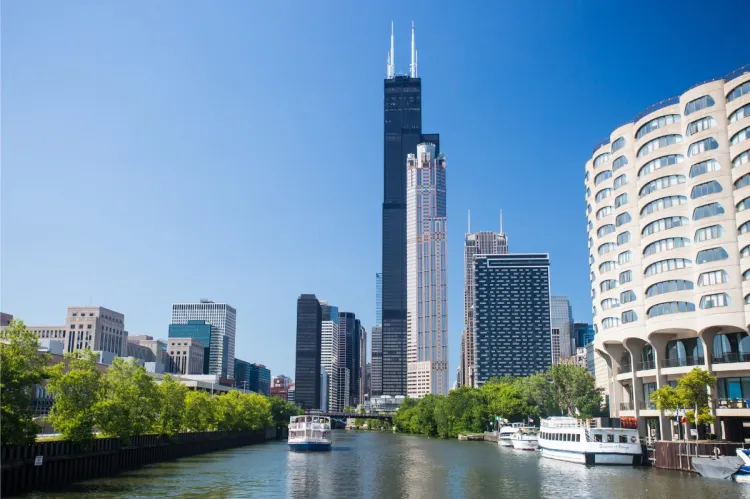
It is built as nine square tubes bundled together, each capable of standing on its own. All nine rise to the fiftieth floor, and above that they drop away in stages, which is what gives the tower its stepped profile and its distinctive silhouette from a distance. Varying the heights breaks up the airflow and reduces the sway, and the whole arrangement needs less steel than a single tube of the same height.
The design is the bundled tube, developed by Fazlur Rahman Khan, with Bruce Graham as architect — the same Skidmore, Owings & Merrill pairing responsible for the Hancock, where Khan had used an entirely different system.
It would have been taller. The Federal Aviation Administration objected, on account of the flight paths into O'Hare.
The Skydeck and the Ledge
The Skydeck occupies the 103rd floor and is entered from Jackson Boulevard. The Ledge, which came with a refurbishment in 2009, is the reason most people now go: glass boxes cantilevered out from the side of the building, with transparent floors, roughly 1,350 feet above Wacker Drive.
Older accounts of the deck describe cut-out windows for children, interactive displays and telescopes, and make no mention of the Ledge at all. It is the single largest omission in anything written about the building before 2009.
On a clear day the view takes in parts of Indiana, Michigan and Wisconsin as well as the city. The frequent claim that the wind keeps the sky clear is not how the weather here works — the clearest air tends to follow a cold front rather than a windy day.
Catalog, which replaced the food court
The lower floors have been rebuilt as a five-level retail and dining development called Catalog, with a new entrance on Jackson Boulevard. The food court that older accounts list — a New York-style delicatessen, an Italian counter, a Mexican one — has gone, as has the four-storey atrium on Wacker Drive that was put up to relieve the bareness of the plaza.
Practicalities
Queues for tickets and for the lifts in both directions can be long, and the deck is at its worst in the middle of the day in summer. Early morning and the last hour of the evening are quieter, and a timed ticket bought in advance avoids most of the waiting.
Position
In the Loop, on South Wacker Drive, a few minutes' walk from the 'L'. General practicalities for the city are on the Chicago page.