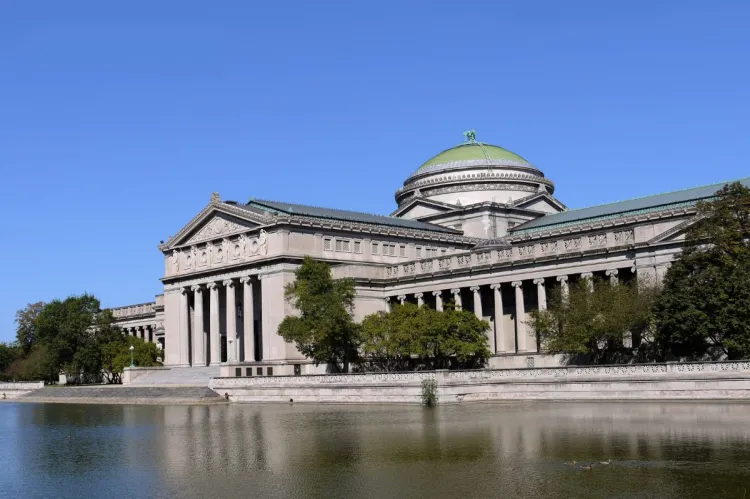
The building, which outlived the fair
It was built as the Palace of Fine Arts for the 1893 exposition, designed by Charles B. Atwood for D. H. Burnham and Company. The fair's White City was plaster over timber framing and was meant to be pulled down afterwards — but this building had to hold borrowed artworks that could not be risked in a fire, so it was given a brick structure under the plaster skin. That decision is the only reason it is still there.
It housed the Field Museum's collections until they moved to the lakefront in 1921, after which it stood empty and decaying for several years.
Rosenwald, and the name on the door
Julius Rosenwald, the president of Sears, Roebuck, founded the museum organisation in 1926, pledged three million dollars towards converting the palace and in the end gave more than five. He declined to have his name put on the building.
The museum opened in stages between 1933 and 1940, the first ceremony falling during the Century of Progress exposition.
In October 2019 Kenneth C. Griffin gave a hundred and twenty-five million dollars, and on 19 May 2024 the museum was renamed after him. There is a certain irony in the building taking a donor's name almost a century after the donor who made it possible refused the same honour — and, as with the Sears Tower and the Hancock, the city has carried on using the old name regardless.
What has been there longest
- The Coal Mine, which opened with the museum in 1933 and is its oldest exhibit: a deep-shaft mine reconstructed underground using original equipment from a mine at Johnston City that had closed ten years earlier. It takes about half an hour and is charged separately.
- U-505, one of only a handful of German submarines captured during the Second World War. It arrived in 1954 and stood outdoors for fifty years. In 2004 a hall was excavated and built around the boat where it lay — it was not moved — and the indoor exhibit opened in June 2005. Any account that has visitors walking round it in the open air is describing the first half of its time here.
- Colleen Moore's Fairy Castle, on show since 1949. A miniature house built for a silent-film actress, with running water and electric light in rooms a few inches high.
- The Foucault pendulum, and the caryatids salvaged from the 1893 building itself.
The rest of it
- The Henry Crown Space Center, which holds the Apollo 8 command module — the craft that carried the first human beings around the moon — alongside a Mercury capsule.
- The Great Train Story, a model railway of some 3,500 square feet running an embellished version of the route from Chicago to Seattle.
- The walk-through heart and the chick hatchery, both of which have outlasted several generations of more fashionable exhibits.
Temporary exhibitions, and why none are named here
The museum takes large touring shows, and they are gone within a year or two. Older accounts of the place recommend a forthcoming Star Wars exhibition, a show of plastinated human bodies and a forensics one built around a television series. All three closed long ago. The museum's own listing is the only thing worth consulting on what is on.
Position
At 57th Street and South Lake Shore Drive, in Hyde Park on the South Side. It is the furthest out of the big museums and it is not on the museum campus with the Field Museum and the Shedd — a common and tiring mistake to make on foot.
The Obama Presidential Center opened in Jackson Park next to it in June 2026, which makes a day on the South Side a more obvious proposition than it used to be. The official site is msichicago.org. General practicalities for the city are on the Chicago page.