Montgomery Ward, and why there is a park there at all
Grant Park exists in its present form because Montgomery Ward, who built the mail-order business, brought a series of lawsuits against the city over some twenty years to stop it putting buildings on the lakefront. He won, repeatedly, and was thoroughly disliked for it at the time — he was obstructing civic projects that respectable people wanted. The open ground between Michigan Avenue and the lake is the result.
Millennium Park
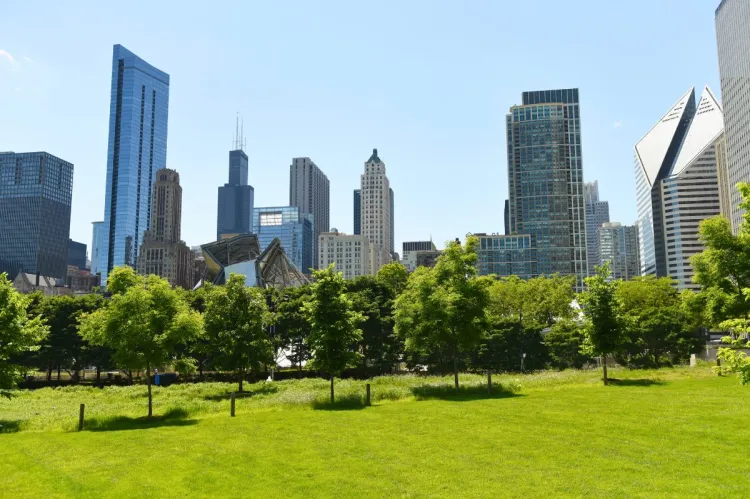
Opened on 16 July 2004, four years behind schedule, on 24.5 acres of former railway yards and car parks at the north-western corner of Grant Park. Older accounts tend to describe it as a recent addition offering grassland, modern art and a view, and name none of what is actually in it:
- Cloud Gate, Anish Kapoor's seamless mirrored form, which everyone calls the Bean. It was shown unfinished at the opening and formally dedicated in May 2006, and it is the most photographed object in the city.
- Crown Fountain, by Jaume Plensa — two glass towers showing video portraits of Chicago residents, who spout water at intervals. Children treat it as a paddling pool in summer, which is the intention.
- The Jay Pritzker Pavilion, Frank Gehry's bandshell, with four thousand fixed seats and lawn for several thousand more. The summer concert programme there is free.
- The BP Bridge, Gehry again, curving over Columbus Drive to Maggie Daley Park.
- The Lurie Garden, planted by Piet Oudolf, which is the quietest corner and the one most visitors walk past.
Grant Park and Buckingham Fountain
The fountain was built in 1927 and is still among the largest of its kind anywhere. Its four pairs of sea horses stand for the four states that border Lake Michigan, and the central jet throws water some 150 feet. The main display runs for twenty minutes at the top of each hour through the season rather than continuously, so it is worth timing an approach.
Lincoln Park
It began as a public cemetery in the 1850s. A sixty-acre section was turned into a park in 1860 and renamed for Abraham Lincoln after his assassination in 1865, and by 1950 it had reached 1,208 acres, which makes it the largest in the city. It carries beaches, harbours, a conservatory, a boat club and a great deal of sport.
Lincoln Park Zoo is inside it, is one of the oldest zoos in the country, and is free — which distinguishes it sharply from Brookfield Zoo Chicago out in the western suburbs.
Two names that mislead
- Hyde Park is a neighbourhood on the South Side, not a park. It holds the University of Chicago and Frank Lloyd Wright's Robie House, which is now a house museum rather than university offices — see the Frank Lloyd Wright Home and Studio.
- Oz Park is a separate park of its own, in the neighbourhood called Lincoln Park rather than inside Lincoln Park itself, roughly a mile to the west. Its statues of the Tin Man, the Scarecrow, the Cowardly Lion and Dorothy are there because L. Frank Baum lived nearby and wrote The Wonderful Wizard of Oz in Chicago. Accounts that put the Tin Man inside Lincoln Park are one park out.
Jackson Park
South of the centre, and the site of the 1893 World's Columbian Exposition — which is why the Griffin Museum of Science and Industry stands at its edge in the fair's last surviving building. The Obama Presidential Center opened in the park in June 2026, which has changed the case for coming this far south.
Two newer additions
- Maggie Daley Park, opened in 2015 across the BP Bridge from Millennium Park: climbing walls, a skating ribbon that loops rather than circles, and the best playground downtown.
- The 606, also 2015 — a disused railway embankment on the north-west side converted into an elevated path and linear park, named for the city's shared postcode prefix.
Position
Grant Park and Millennium Park are downtown and walkable from anywhere in the Loop. Lincoln Park runs north along the shore and is reached on the 'L' or by bus up Clark Street. Jackson Park is on the South Side, served by Metra Electric. General practicalities for the city are on the Chicago page.