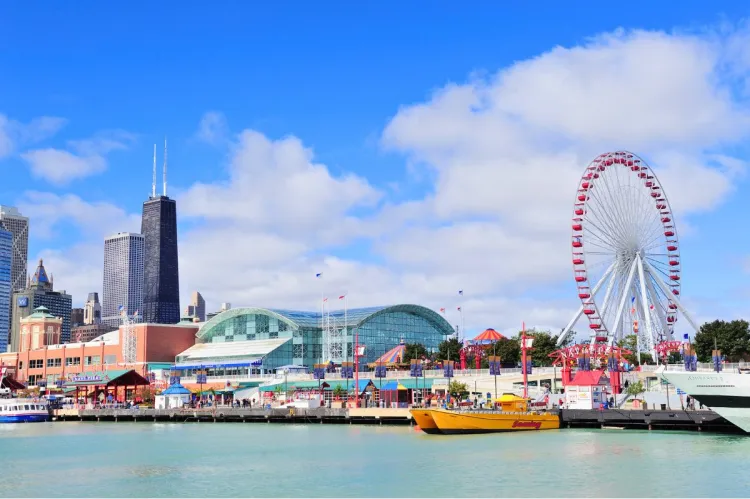
The wheel, and the two before it
The original Ferris wheel — the first of its kind anywhere — was built for the World's Columbian Exposition held in Chicago in 1893, several miles south of here. Every wheel on this pier has been an acknowledgement of it.
The wheel installed with the 1995 redevelopment ran until the autumn of 2015. Its replacement, the Centennial Wheel, opened the following year for the pier's hundredth anniversary: close to two hundred feet, and fitted with enclosed, heated gondolas, which is what makes it usable in a Chicago January. One gondola has a glass floor.
A note on a confusion that runs through older accounts. The wheel is sometimes described as being forty-odd feet high and carrying three dozen hand-painted animals. That is the carousel, which is a separate ride a short distance away in Pier Park. The two have been merged into one in a good deal of what has been written about the pier.
What is there now
- Pier Park, the fairground at the centre of the pier: the Centennial Wheel, the carousel, a wave swinger, a drop tower and the usual smaller rides.
- FlyOver Chicago, a suspended-seat flight simulator over a screen, which did not exist when most accounts of the pier were written.
- Polk Bros Park, the entrance plaza laid out in 2016, with a fountain of more than a hundred and fifty jets programmed to move in waves, and two performance lawns. It replaced the older arrangement at the pier head.
- Chicago Shakespeare Theater, which is a serious producing house rather than a tourist attraction, and which added a second auditorium called The Yard — nine movable towers of seating that can be reconfigured for each production.
- The Chicago Children's Museum, aimed at under-tens, with a dinosaur dig, a three-storey schooner to climb and a water playground.
- The Butterfly House, mini-golf and an indoor funhouse maze.
What has closed
- The Smith Museum of Stained Glass Windows opened in 2000 and closed in October 2014. It held more than a hundred and fifty pieces in four galleries, and it is the single most-missed thing on the pier. Not all of it vanished: twenty-two windows were installed in the Chicago Pedway, the underground walkway system beneath the Loop, in 2013, and they are still there.
- The IMAX cinema has closed.
- The shops and restaurants that older accounts name — a stained-glass gift shop, a toy shop, a games shop, a make-a-teddy workshop, a shrimp restaurant tied to a film, a Cajun place and an ale house with seventy beers — have gone, almost without exception.
Eating, and why no list is given here
The pier's tenants turn over faster than anything else about it, and a list of them dates within a year or two. Two have proved durable: a branch of the Billy Goat Tavern, and a deep-dish pizza restaurant of the kind the city is known for. There is also a rooftop bar above Festival Hall with a view back at the skyline, a seasonal beer garden and a run of counter-service outlets.
What is worth knowing rather than which: the food on the pier is priced for a captive audience, and better eating is a short taxi ride away in River North or Streeterville.
Position
At the foot of Grand Avenue, east of Lake Shore Drive. It is a longer walk from the 'L' than the map suggests, and the free trolley from Streeterville and the water taxis along the river both serve it. The skyline view back from the far end of the pier, and from the wheel, is the best reason to come. General practicalities for the city are on the Chicago page.