What happened to the shopping
In the middle of the last decade the vacancy rate along North Michigan Avenue sat in low single figures. By 2025 roughly a third of the frontage stood empty. Through 2026 it has come down to around a quarter and is still falling, and the local commercial press has started using the word recovery.
The departures were not all pandemic-related, and they came in waves: the large-format chains went first, then the department store that anchored Water Tower Place, then the mobile-telephone flagships. What is replacing them is a different mix — clothing and athletic brands, and attractions built around an experience rather than a shop.
Two consequences follow for anyone planning a visit. A guide that lists particular shops is worth less here than anywhere else in the city. And Water Tower Place, the shopping centre that was the street's anchor, is in the middle of a redevelopment of its lower floors, so what is open inside it changes.
The buildings, which are the better reason to walk it
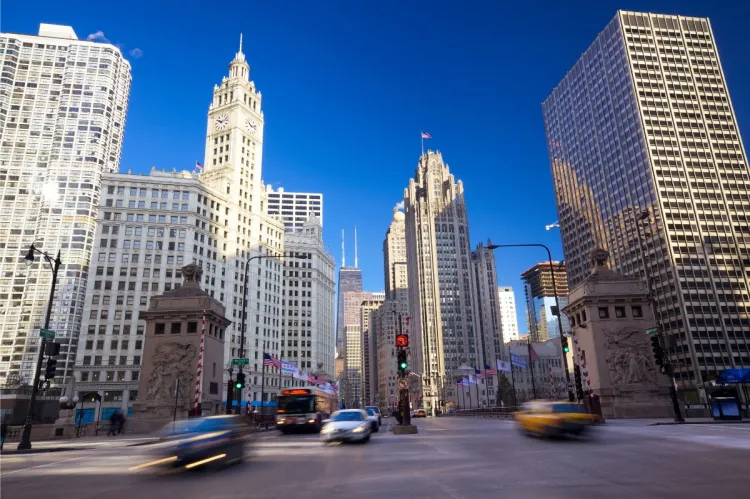
- The Wrigley Building of 1921 and the Tribune Tower of 1925 face each other across the street at the river end, and between them make the best-known view in the city after the skyline itself.
- The Tribune Tower's walls are worth a slow look. Set into the lower stonework are fragments brought back by the paper's correspondents from famous buildings around the world, each one labelled. The newspaper has moved out and the building has been converted into private residences, but the stones are still in the wall and still free to look at.
- The Water Tower and the Pumping Station, facing each other at Chicago Avenue, are the landmarks at the northern end and the best-known buildings in this part of the city to have survived the fire.
- 875 North Michigan Avenue, the tower almost everyone still calls the Hancock, stands at the top end with its observation deck.
- The Museum of Contemporary Art, a short way east on Chicago Avenue — painting, sculpture, photography, film and a performance programme.
The fire, which was in 1871
The Great Chicago Fire burned on 8 to 10 October 1871, not around the turn of the twentieth century as is sometimes written — an error of some thirty years that turns up in a surprising number of accounts of the Water Tower.
Nor is the Water Tower the only thing left standing from it. It is the most famous survivor, and the most visible, but several churches and the Pumping Station across the road came through as well.
Position
The street runs about a mile north from the river. The south end is a few minutes from the Loop on foot across the bridge; the north end is at Oak Street, where the shopping turns from chains to designers and the beach begins a block further on. Navy Pier is a walk east from the middle of it. General practicalities for the city are on the Chicago page.