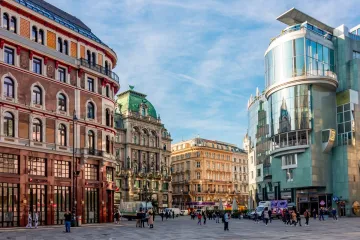
Vienna is more than just a city; it's a grand stage where history, art, and modern life perform a captivating waltz. Once the heart of the Habsburg Empire, its streets echo with the genius of Mozart and the ideas of Freud. But what truly makes Vienna special? Perhaps it's the way a grand imperial palace can sit just a short ride away from a wonderfully bizarre apartment block, or how the aroma of coffee and cake drifts from centuries-old coffee houses. Let's explore some of the most compelling experiences this remarkable city has to offer.
Most of The Rocks was destroyed long before the famous rescue — by resumptions after the plague of 1900, then the Harbour Bridge approaches, then the Cahill Expressway. The green ban of November 1971 saved what was left, and the authority that had proposed the towers reviewed its own scheme in 1974 and spent twenty-five years conserving the place instead.
This is the ground of the colony's first farm, and the crop failed. The garden that followed in 1816 is the oldest in Australia — a claim Tasmania's own botanical gardens concede. Two things older accounts promise are no longer there: the flying-foxes were driven out in 2012, and the Tropical Centre's pyramid glasshouse was demolished in 2015.
Three of the best things on Observatory Hill are routinely mis-told. The transit circle is a telescope, not a clock. The time ball has not stopped — it still drops daily at one o'clock, as it has since 1858. And this is not Australia's oldest astronomical centre, a claim the Observatory itself never makes.
Ronda, split by the Tajo gorge and spanned by the Puente Nuevo of 1793, with Arab baths, a water mine cut inside the rock and one of the oldest bullrings in Spain.
The capital of Andalucia: the largest Gothic cathedral in the world, the Giralda, the Alcazar that is still a working royal palace, and a city centre closed to traffic since 2006.
Granada, capital of the last Muslim-ruled state in Iberia, holds the Alhambra, the Royal Chapel where Isabella and Ferdinand are buried, and the Albaicin on the hill opposite.
Holy Week in Andalucia commemorates the Passion and took its modern shape in the sixteenth and seventeenth centuries. A guide to the brotherhoods, the terms, the hood and the practicalities.
Malaga is no longer just the airport: a Roman theatre, the Alcazaba and the Gibralfaro, six museums opened since 2003, and a cathedral whose roof is finally being built.
Cordoba beyond the Mezquita: the Alcazar of the Christian Monarchs, the old Jewish quarter and its synagogue, the Roman bridge, and Medina Azahara outside the city.
The classical riding school at Jerez and its performance of How the Andalusian Horses Dance, which runs on set days rather than daily, with the carriage museum and the sherry town around it.