The city in figures
Vienna had 2,042,036 residents on 1 January 2026, on Statistics Austria's provisional count — a rise of 13,747 on the year, and close to a quarter of the population of Austria. It passed two million in 2023, for the first time since the years before the First World War, when it was the capital of an empire of some fifty million people.
It is both a city and a federal state, and it is divided into 23 districts, numbered roughly in a spiral outwards from the centre. The first district, the Innere Stadt, is the old walled city; districts two to nine surround it, and the remainder lie beyond the outer ring road known as the Gürtel. The number of the district is the middle two digits of the postcode, so 1010 is the first district and 1070 the seventh.
The language is German, in an Austrian form with a vocabulary of its own, and the currency is the euro.
How the city is laid out
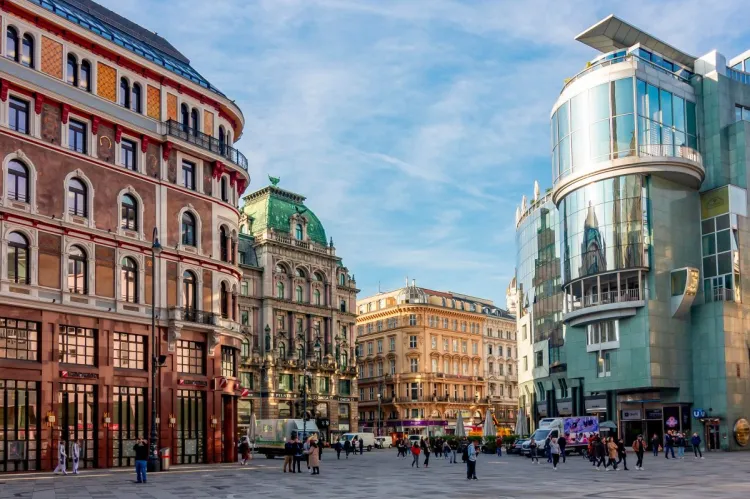
The Innere Stadt is small: it can be crossed on foot in about twenty minutes. Around it runs the Ringstrasse, the boulevard laid out from 1857 on the line of the demolished city walls and lined with the great public buildings of the late nineteenth century — the State Opera, the Parliament, the City Hall, the university and the two court museums.
The Danube itself does not run through the centre. The old town stands on the Danube Canal, a regulated arm of the river; the main stream, the long artificial Danube Island and the modern district around the United Nations buildings lie to the north-east. To the west the city rises into the Vienna Woods, and vineyards within the city limits cover about 600 hectares.
Two of the main sights stand outside the centre: Schönbrunn, the Habsburg summer palace, about five kilometres to the south-west, and the Belvedere, just south of the Ring.
World Heritage, and the list Vienna has left
Vienna has two World Heritage properties. The Palace and Gardens of Schönbrunn were inscribed in 1996, and the Historic Centre of Vienna in 2001.
The historic centre was placed on the List of World Heritage in Danger in 2017, because of a high-rise development proposed at the Heumarkt, on the edge of the protected area. It stayed there for nine years. On 27 July 2026, at its session in Busan, the World Heritage Committee removed it from the list, after the planned tower had been reduced from 73 metres to just under 50. Press reports of the decision record that UNESCO's advisory body had recommended keeping Vienna on the list, and that the project itself still awaited an environmental assessment.
Seasons
Vienna recorded 20,065,000 overnight stays in 2025, six per cent more than in 2024 and the highest figure in its history, and the visitors are not spread evenly through the year.
- Mid-November to late December is the season of the Christmas markets, and one of the busiest periods of the year.
- January and February are the ball season, with several hundred balls. It passes largely unnoticed by foreign visitors until they look for a room.
- July and August are warm and crowded, and the main musical institutions are closed: the State Opera season runs from September to June, and the Vienna Boys' Choir sings at the Hofburg chapel from mid-September to the end of June.
- Spring and early autumn have the mildest weather and the full musical calendar.
Sundays and public holidays
Most shops in Austria, supermarkets included, are closed on Sundays and public holidays. Restaurants, coffee houses and museums are open, and a small number of food shops in the main railway stations trade on Sundays.
Water
Vienna's tap water comes from springs in the Alps of Lower Austria and Styria, carried to the city by two long-distance pipelines, the first of which opened in 1873. It is drinkable everywhere, and public drinking fountains stand throughout the city.
Entry
Austria is in the Schengen area. British citizens may visit for up to 90 days in any 180-day period without a visa, a limit that counts time spent in all Schengen countries together. A British passport must have been issued less than ten years before the day of entry and be valid for at least three months after the day of departure.
The European Entry/Exit System has been fully in operation since 10 April 2026. Travellers from outside the European Union have their fingerprints and a photograph taken at the border on their first entry, and their entries and exits are recorded electronically in place of passport stamps.
The separate travel authorisation known as ETIAS is not in operation. Its official website withdrew the launch window of late 2026 that it had previously given, and by September 2026 no new date had been published. Any website offering to take an ETIAS application before the scheme opens is not an official one. The position is set out in the British government's travel advice for Austria.
The emergency number is 112.