It's a cold night in early November. There's a thump, a pause, and then the sky fills with red. Another thump, and it's green. Then a shower of gold that crackles all the way down. You might wonder why fireworks come in exactly those colours. And if you watch closely, you might notice something else: you rarely see a really deep, rich blue.
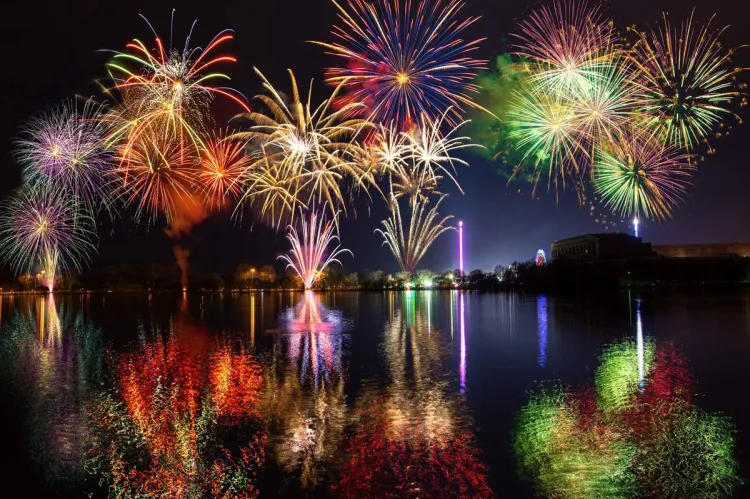
Both puzzles have the same answer, and it isn't paint or dye. Every colour in a firework display is a chemical element giving off its own light. What you're watching is chemistry you can see from across a field.
For centuries, fireworks came in one colour
Here's a surprise. For most of their history, fireworks were gold, and only gold. Gunpowder, the basic fuel, burns with a warm orange-gold glow, and that was the whole palette. When people first lit bonfires and set off fireworks to mark the failed Gunpowder Plot of 1605, the sky would have looked far plainer than it does today.
Colour arrived much later, thanks to chemists. In 1787 the French chemist Claude Louis Berthollet discovered potassium chlorate, a substance that releases oxygen very quickly and makes things burn fiercely. In the 1830s, Italian firework makers found that adding it to their mixtures pushed the burning temperature up from about 1,700°C to around 2,000°C. That extra heat was the key. It meant they could add new ingredients that only show their colours when they're very hot.
What's actually glowing
The colour in a firework comes from small pellets packed inside the shell. Firework makers call them stars, and they're the bright dots that scatter across the sky when the shell bursts. Each star contains a fuel, something to supply oxygen, and a pinch of a particular metal compound that decides its colour.
When a star burns, the heat gives the particles inside it a burst of extra energy. They can't hold on to it for long. Almost immediately, they let it go again as a tiny flash of light. Here's the clever part: each element releases its energy in a step of one particular size, and the size of that step decides the colour. A small step makes red light. A bigger step makes green. A bigger one still makes blue.
Think of it as each element having its own voice. You could recognise a friend singing in a crowded room, and in the same way, a chemist can recognise strontium or barium by its light alone. It doesn't matter whether that light comes from a firework, a lab, or a star on the far side of the galaxy.
There's one small twist. The metal often doesn't glow on its own. In the heat of the flame, it pairs up with chlorine from other ingredients, and it's that pair that shines. Firework makers add chlorine on purpose for exactly this reason.
| Colour | Element behind it |
|---|---|
| Red | Strontium |
| Orange | Calcium |
| Yellow | Sodium, the same element as in table salt |
| Green | Barium |
| Blue | Copper |
| Purple | Strontium and copper together |
| Silver and white | Very hot magnesium, aluminium or titanium |
Silver and white work differently from the rest. They don't come from an element's colour signature at all. They come from tiny flakes of metal heated until they're white-hot, glowing the way the filament of an old light bulb does. So a firework display uses two kinds of light at once: the pure colours of particular elements, and the plain glow of something extremely hot.
The trouble with blue
So why is deep blue so rare? The chemical that makes it, a pairing of copper and chlorine, is fragile. It breaks apart at around 1,200°C, but fireworks burn hotter than that, often somewhere between 1,500°C and 2,000°C. If the star runs too hot, the blue-making chemical falls to pieces before it can shine, and the colour washes out to a pale, whitish glow. If it runs too cool, the star doesn't burn properly at all.
A good blue firework has to burn hot enough to light up the sky, but cool enough not to destroy its own colour.
That's why firework makers treat a rich, deep blue as a mark of real skill. Every other colour gives them more room for error.
How we know
The idea that each element has its own colour isn't just a firework maker's rule of thumb. It's one of the most powerful tools in science.
In the 1850s, the German chemist Robert Bunsen was studying the colours that different substances give to a flame. This is known as a flame test: you hold a sample in a flame and see what colour it turns. He designed his famous Bunsen burner partly for this job, because its hot flame is almost colourless and doesn't get in the way. His colleague Gustav Kirchhoff suggested passing the coloured light through a prism, which spreads it into separate lines, like a barcode for each element.
In 1860 the pair spotted lines that didn't match anything known. They had found two brand-new elements. They named one caesium, from the Latin for "sky blue", and the other rubidium, from the Latin for "dark red", after the colours that gave them away. Astronomers soon borrowed the method to work out what the Sun and other stars are made of. Helium was first spotted this way, as an unexplained yellow line in sunlight, years before anyone found it on Earth.
So what?
Next time you stand in a cold field watching the sky, you can name the elements as they bloom. Red is strontium. Green is barium. That crackling gold is the oldest firework colour of all. And when you spot a really good blue, you'll know someone worked hard for it.
The chemistry also leaves a trace. After one festival in Spain, scientists measured strontium in the air at 86 times its normal level. Very little else releases strontium, so it works as a fingerprint for firework smoke. That's one reason chemists are searching for cleaner recipes. Some colours have proved easier than others: in recent years, researchers found new ways to make green and blue without the usual problem ingredients, but nobody has yet found a good replacement for strontium. Red, once the easiest colour to make, is now the hardest one to make cleanly.
In short
Every colour in a firework is a chemical element giving off its own light: strontium for red, barium for green, copper for blue. Fireworks only gained their colours in the 19th century, once chemists learned to make them burn hotter. Blue stays rare because the chemical behind it falls apart in the very heat it needs to shine.
Changed