What is a shooting star actually made of?
Somewhere behind you, on some warm night, you've seen one: a streak of light slicing across the dark, gone before you could point at it. Maybe you made a wish. It's worth knowing what you wished on. It wasn't a star. It almost certainly wasn't even a rock in any meaningful sense. In all likelihood, it was a speck of comet dust the size of a grain of sand — shed by its parent comet around a thousand years ago, travelling at roughly 59 kilometres per second, and visible to you from about a hundred kilometres away.
A grain of sand, outshining everything else in the sky. How that's possible is a better story than the wish.
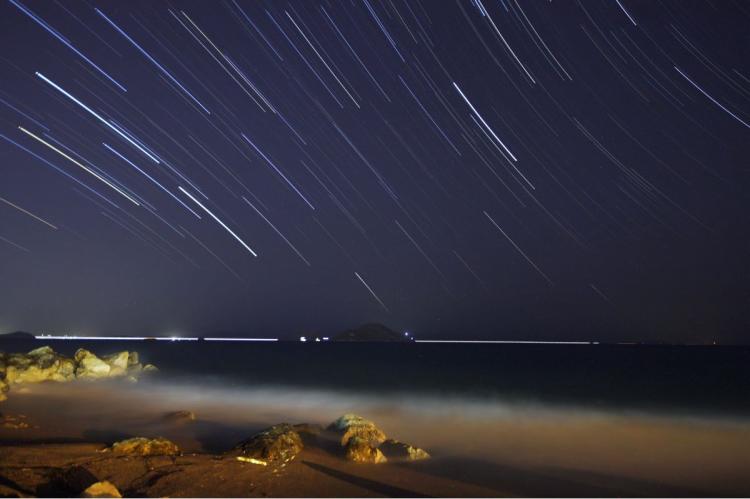
During the Perseids' mid-August peak, a dark sky can deliver up to a hundred meteors an hour.
The road is littered
Space looks empty. It isn't — not along Earth's path, anyway. Our planet's orbit is a road, and the road is strewn with debris: dust, grit, and fragments of ice shed by comets and asteroids that passed this way before us. Sand-grain-sized particles strike the atmosphere constantly — in any given region of the upper atmosphere, one arrives every few seconds. Shooting stars aren't rare events. They're the visible fraction of a permanent, silent rain that never stops falling. Most go unseen, burning up over oceans, deserts, and daylight.
A meteor shower is what happens when the road passes through a rubbish tip. When a comet swings around the Sun, solar heat boils dust and grit off its surface, and that debris spreads slowly along the comet's entire orbit — a dirty trail millions of kilometres long, marking where the comet has been. If that orbit happens to cross Earth's, then once a year, on schedule, our planet ploughs through the trail at full speed. The result is a predictable, dramatic spike in meteors, appearing to pour from the same region of sky, on the same dates, every year.
The Perseids — the shower that fills August nights — are the debris of a comet called Swift-Tuttle, named for the two astronomers who spotted it independently in 1862. Swift-Tuttle is enormous by comet standards: its nucleus is about 26 kilometres across, roughly twice the size of the object believed to have ended the dinosaurs. It takes 133 years to complete one orbit of the Sun. It last passed through the inner solar system in 1992, and it won't be back until 2126. But its litter remains, spread along its lane — and every August, the Earth drives through it.
Most of the particles Earth sweeps up each August have been drifting in the Perseid trail for around a thousand years. The flash you see tonight left its comet around the time the great medieval cathedrals were being built. It has been travelling ever since, waiting for a planet to arrive.
The glow is not what you think
Ask almost anyone why a meteor glows and you'll get the same answer: friction. The little rock rubs against the air and burns up. It's a perfectly reasonable answer, and it's essentially wrong — and the real mechanism is better.
At 59 kilometres per second, a particle doesn't rub against the air. It hits the air so fast that the air can't get out of the way. The atmosphere piles up in front of the particle and is violently compressed — and compressing a gas heats it. You've felt a small version of this: a bicycle pump grows warm as you force air into a tyre. Scale that compression up to hypersonic speed and the temperature in front of the particle soars to thousands of degrees in a fraction of a second. The grain of dust vaporises. But here's the elegant part: most of the light you see isn't the burning particle at all.
The violence of the entry strips electrons off atoms — both the vaporised material of the particle and the atmospheric gases around it — creating a glowing column of electrically charged gas called plasma. As those electrons snap back into place, they release light. What you're watching from the ground is mostly luminous air: a tube of glowing atmosphere, kilometres long, drawn in a fraction of a second by a speck too small to see. It's less like a fire and more like a neon sign — and like a neon sign, its colour is chemistry. Sodium in the particle glows yellow-orange, magnesium blue-green, iron yellow. Every meteor is a one-second chemical analysis, performed a hundred kilometres overhead, legible to the naked eye.
A star falling
| WHAT WE ASSUME | WHAT IT ACTUALLY IS | THE NUMBER THAT MAKES IT VIVID |
|---|---|---|
| A speck of comet dust entering the atmosphere | Typically the size of a grain of sand | |
| A rock burning | Mostly glowing air — a plasma trail of ionised atmosphere | Visible from ~100 km away; glows at 75–120 km altitude |
| Friction heating | Violent air compression ahead of the particle, plus ionisation | Entry at ~59 km per second — over 200,000 km/h |
Speed, not size, is what makes a meteor bright. A fast grain of sand can outshine a slow pebble, because the energy of the impact grows dramatically with velocity. The Perseids are among the faster showers, which is why they're famous for bright, quick streaks rather than slow, lazy ones.
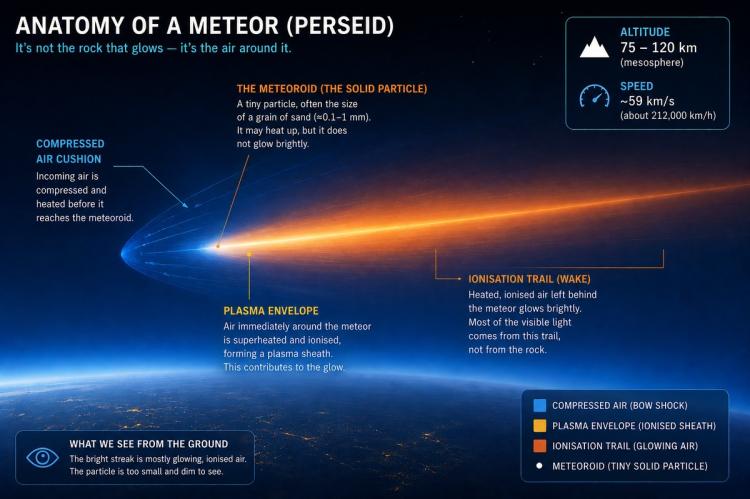
The light of a meteor is mostly glowing air, a column of ionised atmosphere left behind by a particle often no bigger than a grain of sand.
How we know — and how a shower got its name
For most of human history, shooting stars were omens: unexplained, unpredictable, and firmly in the realm of superstition. That changed with a piece of nineteenth-century detective work. After Swift-Tuttle's appearance in 1862, the Italian astronomer Giovanni Schiaparelli compared the comet's newly calculated orbit with the paths of the August meteors — and found they matched. In 1865 he showed that the Perseids were, quite literally, pieces of Swift-Tuttle. It was the first time a meteor shower had ever been traced to its parent comet, and it moved shooting stars out of folklore and into orbital mechanics. The sky's most fleeting event turned out to run on a timetable.
Modern instruments have added a stranger layer of evidence. A meteor's plasma trail doesn't vanish with the flash — the ionised air it leaves behind can linger for many minutes, invisible to the eye but real enough that radio signals bounce off it. Engineers have used this for a communication technique called meteor burst communications, deliberately skipping radio transmissions off the trails of meteors. We don't just see shooting stars; we can use their ghosts as mirrors.
One more thing the science explains: the name. The Perseids appear to stream outward from the constellation Perseus — hence Perseids — but the constellation has nothing to do with them. The debris hits Earth in parallel tracks, and parallel lines viewed from within appear to converge at a distant point, exactly as motorway lanes seem to meet at the horizon. Perseus is simply the horizon point of the Perseid lane. The meteors can flash anywhere in the sky; trace their paths backwards and they all point to the same spot.
How to watch
The best instrument for a meteor shower is the one you already own. No telescope, no binoculars — they narrow your view exactly when you want the whole sky. Find the darkest spot you reasonably can, away from streetlights. Go out after midnight, when your side of the Earth has rotated to face into the oncoming debris — the same reason a car's windscreen collects more rain than its rear window. Lie back, let your eyes adapt to the dark for twenty minutes, and be patient with the sky. Under good conditions during the mid-August peak, the Perseids can deliver up to a hundred meteors an hour. Even an ordinary night, away from city glow, will give you a handful.
And there's no urgency. The debris trail is millions of kilometres long and has been accumulating for centuries; Earth will cross it again next August, and the one after that, and long after Swift-Tuttle itself returns in 2126 to freshen the lane. Few spectacles in nature are this reliable. The sky has pre-booked the show for centuries.