A yellow leaf is showing you something that was there all summer. A red leaf is showing you something brand new, made by a tree that's about to throw the leaf away. Here's why it bothers.
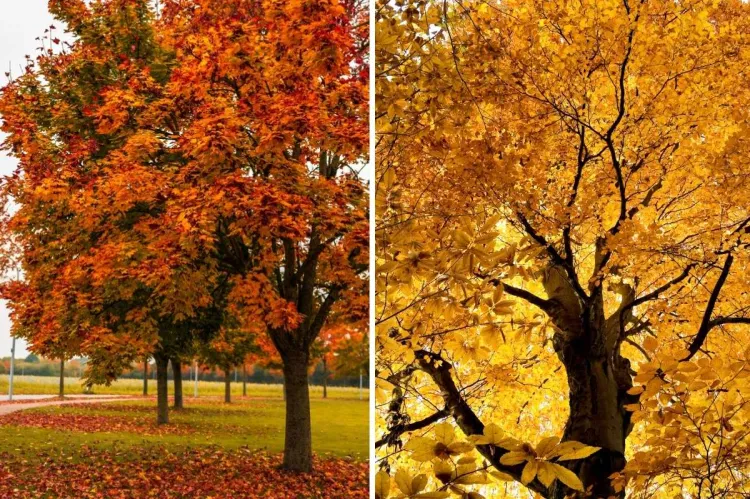
Drive through Vermont in mid-October and the hills look like they're on fire. Maples blaze scarlet, sumac goes crimson, and whole valleys turn the colour of embers. Now walk through an English beech wood the same week. It's beautiful too, but in a different key: gold, amber, bronze, and noticeably fewer reds.
You might wonder why. It's the same season, at roughly similar latitudes, with the same basic kinds of trees. The answer starts with something rather unromantic. In October, a tree is busy trying not to waste anything.
A tree's autumn clear-out
Think of a leaf as a solar panel. All summer it soaks up sunlight and turns it into food for the tree. But broad, thin leaves can't survive a freezing winter, so trees like maples, oaks and birches drop them and grow new ones in spring.
Before letting go, though, the tree salvages what it can. The most valuable thing in a leaf is nitrogen, the same nutrient gardeners buy in bags of fertiliser. Trees spend much of the summer gathering it from the soil, and they can't afford to lose it. Much of a leaf's nitrogen is locked up in chlorophyll, the green pigment that captures sunlight, and in the machinery that works alongside it.
So in autumn the tree takes that machinery apart and pulls the nitrogen back into its twigs and trunk, ready for next year. It's a bit like moving out of a rented flat: before you hand back the keys, you pack up anything worth keeping. Everything you see in October follows from that clear-out.
Yellow is a reveal, red is a new coat of paint
Here's the key idea. Yellow and red leaves look like two versions of the same thing, but they happen in completely different ways.
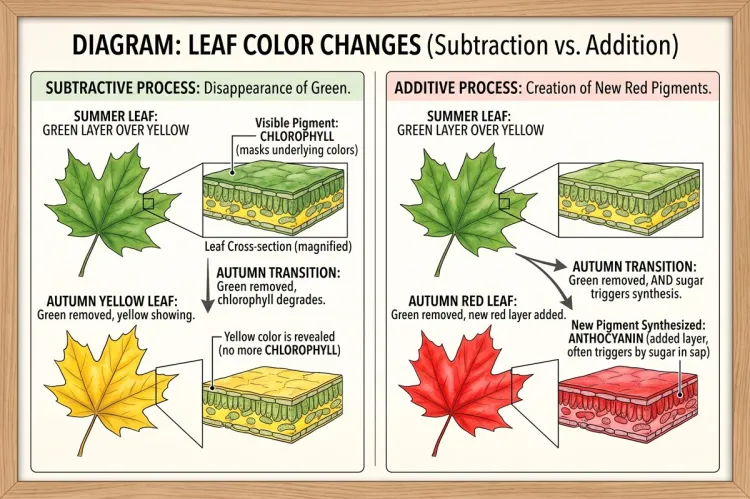
The yellows and oranges were there all along. Leaves contain yellow and orange pigments all summer, helping out with light-gathering in the background. You just can't see them, because chlorophyll is such an overwhelming green. When the tree breaks the chlorophyll down, the yellow is uncovered. It's like stripping wallpaper and finding the old paint underneath. A golden birch in October isn't making anything new. It's simply showing what was hidden.
Red is different. The red comes from pigments called anthocyanins, the same family of pigments that colours red cabbage, cherries and blueberries. They aren't sitting in the summer leaf waiting to be revealed. The tree makes them from scratch in autumn, using energy and sugar, inside a leaf it's about to drop.
Yellow is what's left behind. Red is something new.
| Yellow and orange leaves | Red leaves | |
| Where the colour comes from | Pigments present all summer, hidden by green | Anthocyanins, made fresh in autumn |
| What the tree does | Removes chlorophyll and lets the yellow show | Removes chlorophyll and spends energy building a new pigment |
| Typical examples | Birch, beech, ginkgo, many poplars | Red and sugar maple, sumac, sweetgum |
Why would a tree paint a leaf it's throwing away?
Nature is usually stingy. Spending energy on something you're about to discard looks wasteful, so scientists assume the red must be doing a job. There are two main ideas about what that job is.
The first is sunscreen. Taking a leaf's light-catching machinery apart is risky, because the sun doesn't stop shining while you do it. Light that the leaf can no longer use safely can create damaging molecules, a bit like sunburn. A red layer filters some of that light. On this view, anthocyanin protects the leaf just long enough for the tree to finish recovering its nitrogen.
There's good evidence for this. In experiments comparing normal plants with mutants that couldn't make red pigment, the red-leaved plants recovered more nitrogen before their leaves fell. Studies on red-osier dogwood found that red leaves coped better with bright light than leaves on the same bush that hadn't turned red.
The second idea is stranger. The biologist W. D. Hamilton suggested that autumn colour is a warning to insects. Aphids pick trees in autumn to lay their eggs on. A tree that can afford a costly red display may be advertising that it's strong and well defended, so egg-layers would do better to look elsewhere. It's the same logic as a peacock's tail: a display is believable because it's expensive to produce.
Neither idea has won outright. The sunscreen explanation has more experimental support, while the insect idea is harder to test. Scientists aren't completely sure yet, and several researchers suspect the red does more than one job at once.
So is America really redder?
Most visitors think so, and several studies agree, but this is where it gets interesting. Counting red-leaved species across whole continents is harder than it sounds.
Botanists Susanne Renner and Constantin Zohner compared hundreds of tree and shrub species and found that red autumn leaves are far more common in eastern North America and East Asia than in Europe. In their largest count, covering more than 1,500 species, about 27% of the North American species turned red, compared with 25% in Asia and just 9% in Europe.
Not everyone accepts those numbers. Another team, including autumn-colour researcher Marco Archetti, pointed out that many of the American and Asian species studied were grown in European botanic gardens. Gardens favour showy ornamental trees, which could tilt the count towards red. When that team counted wild native species instead, the gap shrank to a difference that could be down to chance. So the honest summary is this: the best current evidence suggests eastern North America has more red-leaved species, but how big the difference is remains under debate.
A quick word on species and scenery. Even a modest difference in species can look dramatic on a hillside. A few very common red-turning trees, like red and sugar maples, cover huge areas of eastern North America. What you see from the car window depends on which trees are most abundant, not just how many kinds there are.
Two explanations for the difference
The older explanation blames the Ice Age. As glaciers spread south, trees had to retreat ahead of them. In North America, mountain ranges like the Appalachians run north to south, so forests could shift south and return later. In Europe, the Alps and the Pyrenees run east to west, with the Mediterranean behind them. Many species were trapped and died out. On this account, Europe lost much of its red-leaved variety and never got it back.
The newer explanation, from Renner and Zohner, looks at today's climate instead. In autumn, European forests receive almost a third less sunlight than forests at the same latitude in eastern North America. North America also has more sudden cold snaps in autumn, and its native trees tend to have shorter growing seasons. Bright light plus sudden cold is exactly the situation where a leaf being dismantled most needs sunscreen.
Then comes the detail that ties everything back to nitrogen. In a later study, Renner and Zohner looked at trees that partner with soil bacteria to pull nitrogen straight from the air, like alders and black locust. These trees have plenty of nitrogen. Not one of them turned red in autumn. Among the trees without that partnership, 42% did.
That's a striking pattern. It suggests the red is worth making only when the nitrogen is worth protecting. A tree that's rich in nitrogen can afford to lose some. A tree that's short of it puts up the sunscreen.
The light helps, too
One last ingredient isn't in the leaves at all. In autumn the sun sits lower in the sky, so its light travels through more of the atmosphere before reaching you. Along the way, the air scatters away more blue light, the same effect that makes sunsets orange. What reaches the ground is warmer in colour, and it shines on trees from a low angle for much of the day.
That's why the same tree can look so much richer in October than in July. In summer, the warm golden-hour light lasts a few minutes at each end of the day. In autumn, much of the afternoon has that glow.
Why it matters
Next time you walk past a tree in autumn, you can read it. A golden tree is emptying its leaves and letting the hidden yellow show. A red tree is doing something more effortful: spending energy to protect its leaves while it rescues their nitrogen, and perhaps warning insects off at the same time.
It's easy to see autumn as a season of decline. But the colour isn't the tree dying. It's the tree saving what it can for spring. That it happens to look spectacular is a happy accident, and that's what makes it one of the loveliest bits of everyday science there is.
In short
Leaves turn yellow when the tree removes its green chlorophyll and uncovers pigments that were there all along. They turn red when the tree makes a new pigment, probably as sunscreen while it recovers nitrogen. Eastern North America seems to have more red-leaved trees, likely because of its brighter autumn sunshine and sharper cold snaps, though scientists still debate how big the gap really is.
References
- Archetti, M., & Brown, S. P. (2004). The coevolution theory of autumn colours. Proceedings of the Royal Society B, 271, 1219–1223.
- Feild, T. S., Lee, D. W., & Holbrook, N. M. (2001). Why leaves turn red in autumn: the role of anthocyanins in senescing leaves of red-osier dogwood. Plant Physiology, 127, 566–574.
- Hamilton, W. D., & Brown, S. P. (2001). Autumn tree colours as a handicap signal. Proceedings of the Royal Society B, 268, 1489–1493.
- Hoch, W. A., Singsaas, E. L., & McCown, B. H. (2003). Resorption protection: anthocyanins facilitate nutrient recovery in autumn by shielding leaves from potentially damaging light levels. Plant Physiology, 133, 1296–1305.
- Lev-Yadun, S., & Holopainen, J. K. (2009). Why red-dominated autumn leaves in America and yellow-dominated autumn leaves in Northern Europe? New Phytologist, 183, 506–512.
- Peña-Novas, I., & Archetti, M. (2020). Biogeography and evidence for adaptive explanations of autumn colors. New Phytologist, 228, 809–813.
- Renner, S. S., & Zohner, C. M. (2019). The occurrence of red and yellow autumn leaves explained by regional differences in insolation and temperature. New Phytologist, 224, 1464–1471.
- Renner, S. S., & Zohner, C. M. (2020). Further analysis of 1532 deciduous woody species from North America, Europe, and Asia supports continental-scale differences in red autumn colouration. New Phytologist, 228, 814–815.
- Renner, S. S., & Zohner, C. M. (2022). Trees growing in Eastern North America experience higher autumn solar irradiation than their European relatives, but is nitrogen limitation another factor explaining anthocyanin-red autumn leaves? Journal of Evolutionary Biology, 35, 183–188.
Changed