Piazza Navona
Rome is an outdoor city. There are churches, museums, theatres and restaurants in abundance, but the city shines best from one of its piazzas, and Navona is the piazza most people picture first.
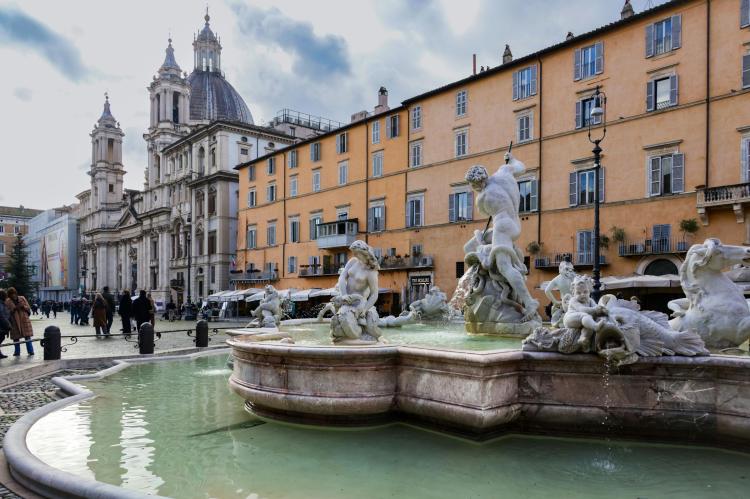
The long oval shape is not a design decision. Piazza Navona sits on the Stadium of Domitian, built in the AD 80s for athletic contests on the Greek model rather than for chariot racing, and it preserves the running track almost exactly. The stadium held some 30,000 spectators and was the only masonry stadium ever built in Rome.
The name comes from agone, meaning contest, which passed through in agone to navone and finally Navona. Part of the stadium can be seen about five metres below street level, open to visitors since 2014.
At the centre stands the Fontana dei Quattro Fiumi, the Fountain of the Four Rivers, made by Bernini between 1648 and 1651. Four river gods — the Nile, the Ganges, the Danube and the Río de la Plata — represent the four continents then known, and each was carved by a sculptor from his workshop: Giacomo Antonio Fancelli, Claude Poussin, Antonio Raggi and Francesco Baratta.
Around the central rock Bernini arranged a lion, a sea creature, a palm tree and a scatter of smaller inventions, all rising to an obelisk. That obelisk is Roman rather than Egyptian, cut under Domitian in the Egyptian manner and brought here from the Circus of Maxentius on the Via Appia.
Paying for it required new taxes on bread and other staples, and the anonymous verses pinned to Rome's talking statues at the time made the papacy's feelings on the matter widely known. The controversy has long since become part of the story, and the fountain is now simply somewhere to sit with a coffee and watch the square go by.
The church behind it, Sant'Agnese in Agone, is Borromini's, and the two men's rivalry has attached a persistent legend to the fountain: that the Río de la Plata raises a hand to shield itself from the façade. The dates rule it out. The fountain was finished before Borromini took the church on.
At the southern end, the Fountain of the Moor began as a plain basin by Giacomo della Porta in 1575. Bernini added the central figure in 1653 — a Moor standing in a shell, wrestling a dolphin rather than riding one.
The Fountain of Neptune closes the northern end. Della Porta designed its basin in 1574, in white marble and stone from Pietrasanta in Tuscany, and for three hundred years it stood bare, known locally as the Fontana dei Calderari after the coppersmiths' workshops nearby. Its sculptures — Neptune fighting an octopus by Antonio della Bitta, with nereids, sea horses and putti by Gregorio Zappalà — were added only between 1873 and 1878, to balance the other two.
Between the fountains there are stalls, cafés and portrait artists working at easels, and the square stays busy well into the night. For two centuries the piazza was deliberately flooded on August weekends by blocking the fountain outlets, a spectacle that ran until 1866. In December it fills instead with the Christmas market, which stays up until Epiphany.
Tre Scalini, on the western side, is known for its chocolate tartufo. The Antico Caffè della Pace, in a small ivy-covered square just north-west of the piazza, has been open since 1891 — not Rome's oldest café, whatever the guidebooks say, but among its more atmospheric.
The Pantheon is five minutes' walk east, past Piazza Sant'Eustachio and the coffee bar that has made the square's name.