Domus Aurea, The Golden House of Rome
One of Rome's more recent attractions is also one of its most ancient. What remains of Nero's Golden House lies beneath the Oppian Hill, and can be seen on guided tours of an excavation that is still under way.
Nero began building the Golden House in AD 64, in the months after the fire that damaged or destroyed ten of the city's fourteen districts. The story that he fiddled while it burned is an old one and an unlikely one: the fiddle would not exist for centuries, and Tacitus places him out of the city at Antium.
Whatever the truth of it, the fire cleared the ground he wanted. The work was still unfinished when he died in 68.
Estimates of the size of the complex vary between roughly 50 and 80 hectares, somewhere between 125 and 200 acres. It took in a man-made lake, vineyards, woodland and the house itself.
Calling it a house is misleading. Around 300 rooms have been recorded, yet no kitchens, latrines or obvious sleeping quarters have come to light — which has led some archaeologists to read it as a palace built for receptions and display rather than for daily living.
The vestibule held a bronze statue of Nero some 30 to 35 metres high, said to be the largest cast in the ancient world. Hadrian had it moved in AD 128 to make room for the Temple of Venus and Roma, a job that reportedly took twenty-four elephants. Its pedestal survives between the temple and the Colosseum: brick-faced concrete, once clad in marble.
The gold foil, ivory and jewels that gave the palace its name did not last. They were stripped within a few years of Nero's death, his memory condemned, and the rooms packed with rubble to serve as foundations for the Baths of Trajan.
That burial is the reason so much survives. When Renaissance artists were lowered on ropes through holes in the Esquiline hillside, around 1480, they found painted vaults that had been sealed away for fourteen centuries.
They took the rooms for caves and called the decoration grottesche, which is where the word grotesque comes from. Raphael drew on it directly, and Michelangelo, Ghirlandaio and Pinturicchio came to look. Names scratched into the plaster record their visits, joined by later ones reportedly including Casanova and the Marquis de Sade.
In 1506 the Laocoön group was unearthed in a vineyard nearby and identified at once from Pliny's description of it. Julius II bought it within weeks, and it has been in the Vatican Museums ever since.
The frescoes themselves are credited to Fabullus, a painter Pliny admired, working in the manner familiar from the wall paintings of Pompeii, some 240 kilometres to the south.
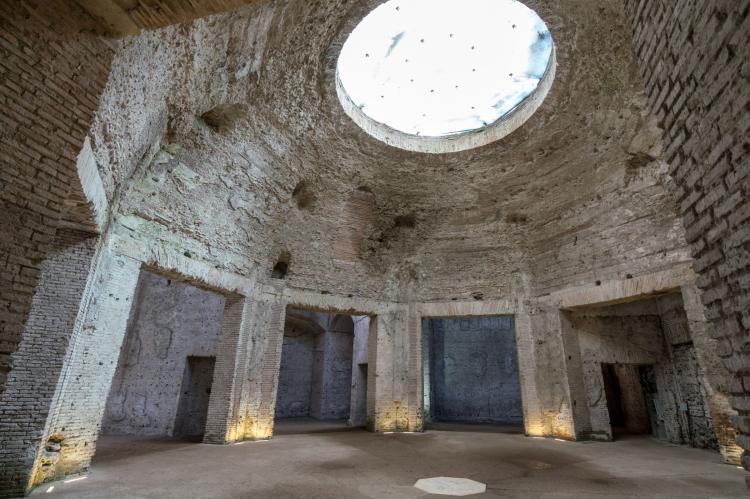
The finest surviving space is the octagonal room, an original structure rather than a reconstruction. Its domed ceiling opens to a wide oculus, and the engineering behind it points forward to the Pantheon. Some scholars identify it with the revolving dining room described by Suetonius.
Above ground, the roof of the complex lies beneath the Parco del Colle Oppio, where the garden has been replanted with light soils and shallow-rooted species to keep water from seeping into the rooms below.
Visits are by guided tour only, and booking well ahead is essential, since slots are limited and sell out quickly. Hard hats are provided, tours run to about seventy-five or ninety minutes, and VR headsets restore the gilding, marble and colour that the bare brick no longer shows. A programme of thematic tours runs on the third Thursday of most months.
Underground the temperature sits at around 10°C the year round, which is welcome in a Roman summer. A jacket is worth taking whatever the season above.
Excavation continues. The Domus Aurea remains the largest active archaeological site in Rome.