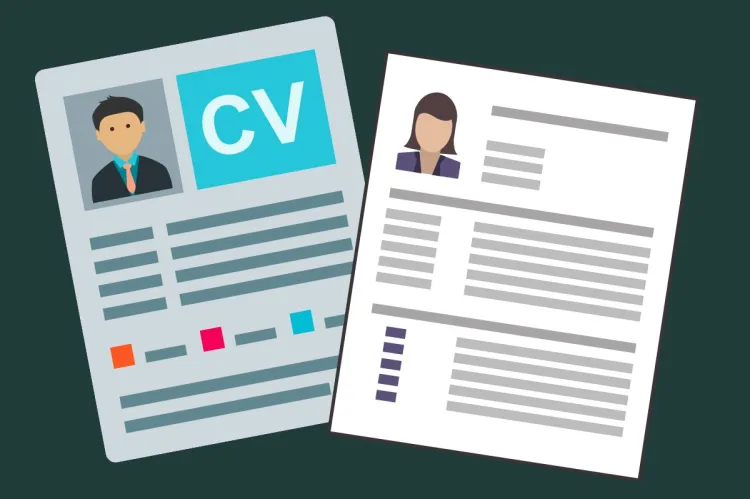
A curriculum vitae, or CV, is a short account of a person's work history, skills and qualifications, sent to an employer with a job application. Its purpose is to win an interview. Recruiters commonly give a CV less than a minute at first reading, so that clarity and relevance count for more than completeness.
Length and layout
- Two sides of A4 at most; one side is enough for a school leaver or recent graduate. Academic and medical CVs are longer by convention.
- A plain, common typeface at 10 to 12 points, with clear headings and consistent spacing.
- Bullet points in place of long paragraphs.
- No tables, text boxes, columns or graphics where the application goes through recruitment software, which may misread them.
- Saved as a PDF, unless the employer asks for another format, with a file name that includes the applicant's name.
What goes in
- Name and contact details: telephone number, a sensible email address, and town or city. A link to a professional networking profile or portfolio may be added.
- Personal statement: three or four lines saying who the applicant is, what they offer and what they are looking for, written for the particular job.
- Employment history, most recent first: job title, employer, dates, and a few bullet points for each role.
- Education and qualifications, most recent first. Recent graduates put this section before employment.
- Skills: languages, software, driving licence, professional memberships.
- Interests, only where they add something: voluntary work, sport at a serious level, anything relevant to the post.
What is left out
In the United Kingdom a CV does not carry a photograph, date of birth, age, marital status, nationality, religion or National Insurance number. Employers may not take most of these into account, and many prefer not to see them. A full home address is unnecessary. The words "curriculum vitae" as a heading, and the line "references available on request", waste space. Referees' details are supplied when asked for.
Writing about experience
- Achievements, not duties: what was done and what resulted, with figures where they exist. "Reduced customer complaints by a fifth in a year" says more than "responsible for customer service".
- Active verbs: managed, designed, trained, negotiated, delivered.
- The employer's own words: the terms used in the job advertisement for skills and qualifications are echoed where they truthfully apply, since both software and human readers look for them.
- More space for recent and relevant roles; jobs of more than ten or fifteen years ago are given a line each.
- Plain language, without clichés such as "team player" or "hard-working" unless backed by an example.
Tailoring
One CV sent unchanged to every employer is the commonest mistake. For each application the personal statement is rewritten, the order of bullet points is changed to put the most relevant first, and the skills section is matched to the advertisement. A master version holding everything is kept, from which each tailored version is cut.
Gaps and changes
- Gaps of more than a few months are accounted for briefly and honestly: caring for children or a relative, illness, travel, study, redundancy.
- Years alone, without months, are acceptable for dates long past.
- A person changing career may use a skills-based CV, which groups experience under headings such as management, communication or technical skills, with a short employment history beneath.
- Voluntary work, part-time jobs and responsibilities outside work count as experience, especially for those with little paid employment.
School leavers and graduates
With little work history, the emphasis falls on education, projects, placements, part-time and holiday jobs, voluntary work, positions of responsibility and achievements in sport, music or clubs. Each is described in terms of the skills it shows: reliability, dealing with the public, handling money, working to deadlines.
Honesty
Everything on a CV must be true. Employers check qualifications, dates and references, and a false statement is grounds for dismissal even years later, and in serious cases is a criminal offence. Presenting real experience in its best light is legitimate; inventing it is not.
Checking
- Spelling and grammar are checked by eye as well as by software, and by a second person.
- Dates run in order, without unexplained overlaps.
- Tense is consistent: present for a current job, past for earlier ones.
- The CV is printed once, to see how it looks on paper.
- It is updated every time a job, qualification or achievement is added, not only when looking for work.
Help
Free advice on CVs is given by the national careers services of England, Scotland, Wales and Northern Ireland, by Jobcentre Plus, and by university and college careers offices. Templates in word-processing software are a reasonable starting point, provided that the design is kept plain.
The letter that accompanies a CV is covered under covering letters and job applications, and the next stage under job interviews.