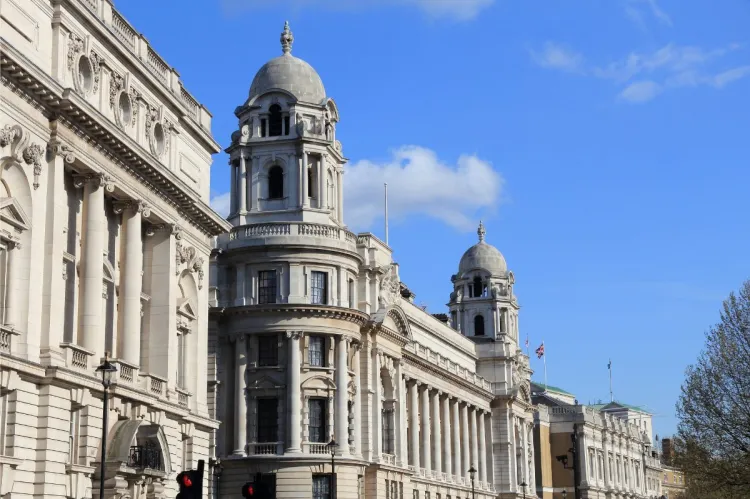
Whitehall is a street of about six hundred metres, and a word for the whole of British central government. The two meanings have one cause. The Palace of Whitehall stood here, was the sovereign's principal residence for most of two centuries, and burned down in 1698, leaving the ground to the offices of state that filled it. One building of the palace survives whole. Others survive in fragments, and one of them was moved sideways in 1949 inside a concrete box.
Where the street runs
Whitehall runs roughly north to south. Trafalgar Square is at its northern end, and the carriageway runs south for about 0.4 miles, some 640 metres, as far as the Cenotaph, beyond which the same roadway continues under the name Parliament Street to Parliament Square.
Older accounts place the Houses of Parliament at one end of Whitehall. They are not on it. They stand on the east side of Parliament Square, and the road reaching north from that square is Parliament Street first and Whitehall only after the Cenotaph. No authority fixes the changeover at a precise junction, and street numbering straddles both names, so the sensible description is that Whitehall becomes Parliament Street around the Cenotaph.
The other thing to know about the name is that it is the standard term for British central government and the civil service — the counterpart of Westminster for Parliament. That is the main reason the street matters, and it follows directly from what used to stand here.
The palace that was here
The Palace of Whitehall was the sovereign's principal residence from 1530 to 1698. At its height it had more than 1,500 rooms across about 23 acres, and was for a time the largest palace in Europe, until Versailles overtook it. Older accounts say it housed royalty and its ministers for centuries, which overstates a span of under two: William and Mary already preferred Kensington, and St James's became the principal residence from 1702.
There had been a fire on 10 April 1691. The destroying one came on 4 January 1698, when a servant hung wet linen round a charcoal brazier. It burned for some fifteen hours and was re-fanned by the wind the following day. Christopher Wren saved the Banqueting House by blocking its south windows, and about twenty buildings were pulled down to make a firebreak. John Evelyn's diary records the result in six words: Whitehall burnt! nothing but walls and ruins left.
The Banqueting House
Inigo Jones began it in 1619 and completed it in 1622. It is Grade I listed and is conventionally the first major classical building in London. The right word for it is Palladian, after Andrea Palladio, rather than the loose "Italian Renaissance" of older accounts.
Charles I was executed on 30 January 1649 on a scaffold erected against the building, passing out to it through an opening at the upper level.
The main thing inside is the one older accounts leave out altogether. Charles I commissioned a ceiling from Rubens in 1629; it was painted in the artist's Antwerp studio and the three principal canvases were installed in 1636 — The Union of the Crowns, The Apotheosis of James I and The Peaceful Reign of James I. Rubens was paid three thousand pounds and a gold chain. It is described as the largest surviving Rubens still in the place it was made for anywhere in Europe.
The building closed for conservation in May 2024 and reopened through 2026, with a limited reopening in November 2025, preview days through the spring and a full reopening that August. The work put a passenger lift in the north annexe, giving step-free access to the Main Hall for the first time; replaced the heating with air-source heat pumps reconnected to the Whitehall district heating system, for control of temperature and humidity; laid a new English oak floor, with archaeologists examining what lay beneath the floorboards for the first time since 1964; and stabilised plaster and conserved wall paintings in the Wolsey room. Opening is limited and should be checked with Historic Royal Palaces before travelling rather than assumed.
One claim in older accounts should go: there is no offer of lunchtime baroque concerts with dining. What the building has advertised is separately ticketed evening concerts, which come and go.
Its later life is worth a line. After the 1698 fire it served as a Chapel Royal; Queen Victoria gave it to the Royal United Services Institution in 1893, and it held a services museum until 1962. Jones's low ground floor is a warren of cellars under the double-height hall, and the undercroft is included in admission when the building is open.
What else survives of the palace
Older accounts call the Banqueting House the only surviving part of the palace. It is the only original integral building still standing, which is not the same thing.
- The Tudor wine cellar, a brick-vaulted undercroft that began as part of Cardinal Wolsey's York Place and was absorbed into the palace by Henry VIII. It is conventionally called Henry VIII's, but Wolsey's is the accurate provenance.
- Queen Mary's Steps on Horse Guards Avenue, Grade I listed — reconstructed remains of a Tudor palace wall together with Wren's river terrace and steps of 1691 to 1693.
- A tower and part of Henry VIII's tennis courts, built into the fabric of the Old Treasury and Cabinet Office buildings.
The cellar needs a correction that matters. It is not where it was built and not on view. In 1949, because its position clashed with the new government building going up, it was encased in concrete, steel and brick, moved 43 feet 6 inches onto a steel frame, lowered on screwjacks and moved a further 33 feet 10 inches into its final position in the basement of the Ministry of Defence Main Building. It is covered by that building's Grade I listing, which names the sixteenth-century undercroft explicitly. No public access route is published, so it should be understood as beneath the Ministry of Defence and not normally accessible.
Horse Guards
The building is William Kent's, put up in the 1750s on the site of the old tiltyard, with a central carriage arch and two pedestrian arches leading through to Horse Guards Parade.
The regiment on duty is the Household Cavalry Mounted Regiment, drawn from the two regiments of the Household Cavalry — the Life Guards, in red tunics with white plumes, and the Blues and Royals, in blue tunics with red plumes.
Two mounted sentries stand at the Whitehall entrance, but only between ten in the morning and four in the afternoon, changed hourly, so an early or late visitor will not find them. Changing of the King's Life Guard is at eleven on Monday, Wednesday and Friday; on Tuesday and Thursday there is a patrol in the late morning instead; at weekends the duty officer inspects at eleven and the guard stays in place. A dismounted inspection, long known as the four o'clock parade, takes place daily. The schedule is operational and alters, so it is worth checking rather than relying on the older formula of eleven every day.
The Household Cavalry Museum is in the Horse Guards building itself, entered from Horse Guards Parade. Visitors watch troopers working in the stables through a glass partition, and an audio tour is included. Short-notice closures for ceremonial duties are frequent.
The parade ground is a place in its own right — the setting for Beating Retreat and for the King's Birthday Parade, the ceremony older accounts spell "Trooping the Color". It is Trooping the Colour, it marks the King's official birthday rather than the Queen's, and it is held on a Saturday in June, preceded by two formal reviews. The date moves each year and the regiment trooping its Colour rotates among the Foot Guards, so neither is worth printing.
The Cenotaph
Sir Edwin Lutyens designed it, and the date needs care. The structure unveiled on 18 July 1919 for the Victory Parade was a temporary one of wood and plaster, dismantled that January. The permanent Portland stone Cenotaph was begun in May 1920 and unveiled by George V on 11 November 1920. It is Grade I listed and in the care of English Heritage.
Older accounts describe it as commemorating the fallen of the First World War. That was its origin, not its present meaning: George VI rededicated it on 10 November 1946, with the dates of the Second World War added to the inscription, and it now commemorates the British and Commonwealth dead of both world wars and of later conflicts. The inscription reads The Glorious Dead. It is the United Kingdom's official national war memorial.
The November ceremony older accounts mention in passing is the National Service of Remembrance, on Remembrance Sunday, the Sunday nearest 11 November. Whitehall closes to traffic, there is a two-minute silence at eleven, wreaths are laid first by the monarch and then by the Prime Minister or their representatives, and serving personnel and veterans' associations march past.
The monument in the middle of the road
A short way north of the Cenotaph, standing in the carriageway itself, is the Monument to the Women of the Second World War. It is John W. Mills's, hollow bronze, 6.7 metres tall, and was unveiled by Queen Elizabeth II on 9 July 2005. Its form resembles a coat rack hung with seventeen sets of uniforms and working clothes, answering Churchill's call for the women to come forward. Most of the cost came from the National Heritage Memorial Fund, with over three hundred thousand pounds raised publicly. Any account that mentions the Cenotaph should mention this too.
Other memorials along or just off the street include the Gurkha Memorial on Horse Guards Avenue, the Earl Haig Memorial, and statues of Montgomery, Slim and Alanbrooke outside the Ministry of Defence. The Royal Tank Regiment Memorial — Vivien Mallock's, after a 1953 maquette by George Henry Paulin, unveiled on 13 June 2000 and showing a five-man Comet tank crew at one and a half times life size — stands at Whitehall Court, overlooking Whitehall Place rather than on Whitehall proper.
Downing Street
Older accounts leave it out, which is odd in a street described as the heart of government. It is a cul-de-sac off the west side, towards the southern end just above Parliament Street. Number 10 is the Prime Minister's official residence and office and is Grade I listed; number 11 is the Chancellor's; number 12 houses the press and whips' offices.
The gates are usually dated to 1989, and that is approximately right — Westminster City Council granted permission on 4 October 1989 and they went up over the Christmas period, after an ill-fitting first delivery. But public access had been closing for decades before that: barriers between 1920 and 1922 against campaigners for an Irish state, a vehicle barrier in 1973, and low railings across the entrance in 1982 following attacks, after which pedestrians could no longer walk up to the door. The gates consolidated the restrictions rather than beginning them.
The buildings along the street
Departmental occupancy changes every few years and is the fastest-dating information on a street like this, so the buildings are the durable way to describe it.
- Horse Guards — William Kent, 1750s.
- Ministry of Defence Main Building — E. Vincent Harris, who won the competition in 1915 and was re-selected in 1933; built 1938 to 1959, the north end ready in 1951. Grade I listed, the listing covering the Tudor undercroft in its basement. Charles Wheeler's figures Earth and Water flank the Horse Guards Avenue portico.
- Dover House — James Paine, with Henry Holland's refurbishment of 1788; Grade I; the Scotland Office.
- Gwydyr House — 1772; Grade II*; the Wales Office; on the east side, opposite Dover House.
- Government Offices Great George Street — HM Treasury, with the Churchill War Rooms beneath it.
- Admiralty House — Grade I; Cabinet Office meeting rooms, with ministerial residences above.
One change since older accounts were written deserves stating plainly. The Old War Office is no longer in government use. It was sold and converted into a hotel and residences, which opened on 29 September 2023. Admiralty Arch, at the Trafalgar Square end, was similarly sold on a long lease in 2012 for conversion to a hotel.
The Churchill War Rooms
Three corrections. The site is now called the Churchill War Rooms — it was the Cabinet War Rooms, became the Churchill Museum and Cabinet War Rooms on the 2005 redevelopment, and the name was shortened in May 2010. It is run by Imperial War Museums, which took over its administration in 1982 and had responsibility formally transferred in 1989. And it is not a recent addition: the bunker became operational on 27 August 1939, the war rooms opened to the public on 4 April 1984, and the Churchill Museum opened in February 2005 — more than two decades ago.
The entrance is at Clive Steps, King Charles Street, beneath the Government Offices Great George Street, so it is off Whitehall rather than on it. Pre-booking is advised.
Trafalgar Square, at the north end
The square is at the northern end of Whitehall rather than part of it, has its own registered entry and is managed by the Greater London Authority.
Nelson's Column needs two corrections. Its height is 169 feet 3 inches, 51.6 metres, established by a survey in 2006 and measured from the bottom of the pedestal to the top of Nelson's hat. The long-quoted figure of about 185 feet is wrong, and the 174 feet of older accounts matches neither. A bare number invites exactly that error, so the basis of the measurement is worth stating.
The second correction is the attribution. The column is William Railton's, built from 1840 to 1843. The statue is Edward Hodges Baily's, 17 feet tall and carved in a now-rare Craigleith-type sandstone. The bas-relief panels are by J. E. Carew, J. Ternouth, M. L. Watson and W. F. Woodington. Sir Edwin Landseer designed only the lions, and not alone: Baron Carlo Marochetti cast them between 1858 and 1867, and they were added in 1867, a quarter of a century after the column. Older accounts attach Landseer to the monument as a whole, which is misleading.
At Charing Cross, at the head of the street, stands the equestrian statue of Charles I by Hubert Le Sueur, probably cast in 1633 and on the site of the Eleanor cross since 1675. It faces down Whitehall towards the Banqueting House, where he was executed, which makes it the best single device for holding the two ends of the street together. Official road distances to London are measured from this point.
The gardens, which are not called Whitehall Gardens
Older accounts recommend strolling in the beautiful Whitehall Gardens. There is no public park of that name. Whitehall Gardens was a terrace of houses, demolished from 1938 to make way for the Ministry of Defence Main Building.
The gardens that exist are Victoria Embankment Gardens, now in the care of the City of Westminster, and the southernmost section, between Horse Guards Avenue and the ministry, is labelled Whitehall Gardens on some maps. They are also not on Whitehall: the way in is down Horse Guards Avenue or Richmond Terrace.
The statue of General Gordon is there, and its history is the opposite of what is usually assumed. Hamo Thornycroft made it, and it was unveiled on 16 October 1888 in Trafalgar Square, between the two fountains, on an eighteen-foot pedestal. It was removed in 1943 to the grounds of Mentmore Towers and reinstated in 1953 on a lower plinth on the Victoria Embankment, about half a mile to the south-east. Churchill had argued in the Commons in 1948 for its return to Trafalgar Square, and it did not go back.
Also in that southern stretch are statues of General Sir James Outram and Air Marshal Lord Trenchard, the Chindit Memorial, which also commemorates Orde Wingate, and the Korean War Memorial, unveiled in December 2014. The RAF Memorial of 1923 stands at Whitehall Steps on the Embankment.
Southwards to Parliament
Two things older accounts get wrong about the far end.
The first is tours of Parliament. Paid guided tours run on Saturdays throughout the year and from Monday to Saturday during recess — not for two months in the summer, which has not been true for many years. There is also a free tour for UK residents, booked through a Member of Parliament or a member of the House of Lords, and ticketed tours of the Elizabeth Tower and of Speaker's House. The tower climb has an age limit and more than three hundred steps, and whether overseas visitors can book it directly is not clearly stated by Parliament, so it is worth asking rather than assuming.
The second is the galleries. Watching a debate needs no prior arrangement and costs nothing, for overseas visitors as much as for residents: on most sitting days it is a matter of queueing at the Cromwell Green entrance. Tickets are needed only for Prime Minister's Questions, and can be requested in advance for Ministerial Question Time.
Finally, the names. Big Ben is the bell — strictly the Great Bell of the Great Clock of Westminster. The tower is the Elizabeth Tower, renamed in 2012 for the Diamond Jubilee. The chimes were silenced on 21 August 2017 for conservation; the scaffolding came off in December 2021, the gantry in April 2022, and the bell returned to regular service on 13 November 2022. The tower stands at the far end of Parliament Street rather than on Whitehall, visible in the view south.
Changed