On the afternoon of 22 May 1960, the ground in southern Chile began to shake. It didn't stop for ten minutes. The earthquake near the city of Valdivia — the most powerful ever recorded by instruments, at magnitude 9.5 — left two million people homeless, triggered a tsunami that reached Hawaii fifteen hours later and Japan twenty-two hours after that, and caused the entire planet to vibrate at its own natural frequencies, the way a wine glass hums when you run a wet finger around the rim. Seismographs detected those oscillations for days. The Earth had been struck like a bell, and it was still ringing.
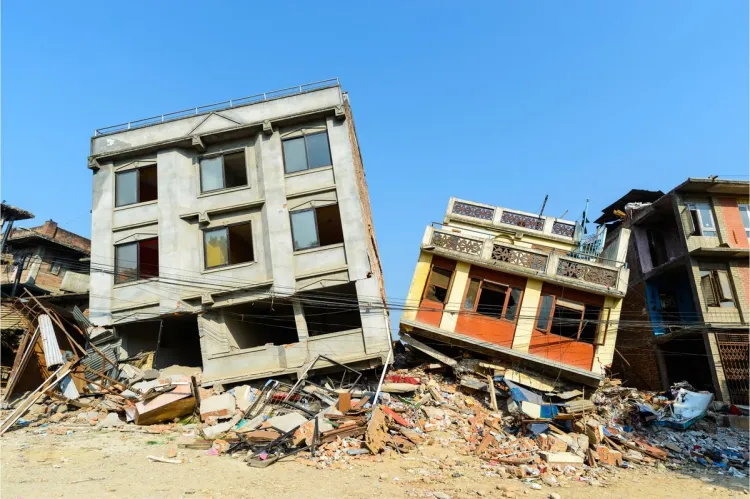
That event is the largest, but it isn't the deadliest. That distinction belongs to an earthquake in the Shaanxi province of China in January 1556, which killed an estimated 830,000 people — most of them asleep in cave dwellings carved into cliffs of compressed silt that collapsed around them. The 2004 earthquake off the coast of Sumatra generated a tsunami that killed people across fourteen countries. The 1976 earthquake beneath the industrial city of Tangshan, China, struck at 3:42 in the morning when its million residents were asleep, and levelled the city in seconds.
The physics behind all of them is the same. And it starts with a surprising idea: in an earthquake, the ground doesn't break. It rings.
The ground isn't breaking — it's ringing
When people imagine an earthquake, they often picture the ground tearing open — a chasm splitting the surface, the earth swallowing what stands above it. That image persists in mythology and disaster films, and it occasionally appears as a surface effect in extreme shallow events. But it isn't the earthquake itself.
Below the surface, tectonic plates — vast slabs of the Earth's outer layer, thousands of kilometres across and tens of kilometres thick — are in constant slow motion, compressing, grinding, and sliding past each other. At a fault, two sides of rock are pressed together and held in place by friction while the plates continue pushing. The stress accumulates over years, over decades, sometimes over centuries. Rock is extraordinarily strong, but not infinitely so. When the accumulated strain finally exceeds what the fault can hold, the rock slips — sometimes just centimetres, sometimes several metres — and that slip happens in seconds.
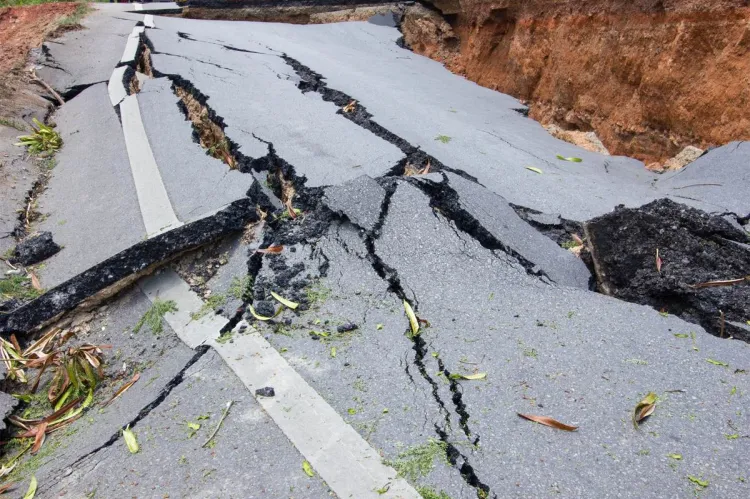
The released energy doesn't stay at the rupture point. It radiates outward in all directions through the surrounding rock. Think of striking a bell: the hammer hits the metal — that's the fault slipping — and energy radiates through the structure as vibration. The bell doesn't shatter; it rings. An earthquake is the Earth ringing. Not the ground opening up, not the rock dissolving — a pulse of energy moving through stone at enormous speed, the only way rock knows how to carry it. The 1960 Chile earthquake was simply large enough that the bell, in this case, was the entire planet.
Three waves, three sensations
The ripples from a pebble dropped in a pond all travel at the same speed and look the same. Seismic waves don't. A fault rupture generates several distinct wave types, each moving at a different speed and producing a completely different sensation at the surface. This is why the same earthquake can feel like violent jolting in one city and like a slow, rolling swell in another two hundred miles away.
| P-wave (primary) | S-wave (secondary) | Surface wave | |
|---|---|---|---|
| Speed | 5–8 km per second | 3–5 km per second | 1–3 km per second |
| Ground motion | Compression and expansion in the direction of travel | Side-to-side, perpendicular to direction of travel | Rolling motion along the ground surface |
| Travels through | Solids, liquids, and gases | Solids only — blocked by liquid | Ground surface only |
| What it feels like | A sudden sharp jolt; sometimes heard as a deep boom before it's felt | Violent side-to-side shaking; the wave most responsible for structural collapse | Slow, rhythmic swaying; felt far from the epicentre, sometimes for minutes |
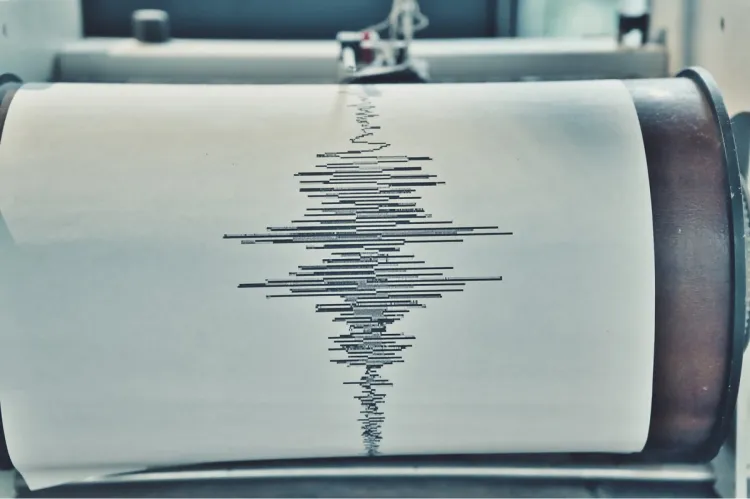
P-waves — primary waves — arrive first. They compress and expand the rock in the direction they're moving, like a piston. Close to an epicentre, they feel like a sudden punch. Some people report hearing an earthquake before they feel it: a low, resonant boom, like a heavy door slamming somewhere underground. That's the P-wave, vibrating at frequencies that cross into the audible range.
S-waves follow close behind and do most of the catastrophic damage. They move the ground sideways — perpendicular to their direction of travel — producing the violent lateral shaking that brings down walls and collapses floors. S-waves can only travel through solid material and are blocked entirely by liquid. This turns out to be one of the most important facts in the history of geology: seismographs on the far side of the planet from an earthquake receive P-waves but no S-waves. The S-waves vanish somewhere in between. That absence was the evidence that the Earth has a liquid outer core — a discovery made not by drilling or sampling, but by listening to waves that never arrived.
Surface waves are slowest of all, travelling along the ground rather than through it. Near the epicentre they're barely noticed, already overtaken by the violence of S-waves. But hundreds of miles away, they're the dominant sensation: a long, rolling undulation that can last for minutes, like standing on the deck of a ship in a slow sea.
Depth — the hidden variable
Two earthquakes at the same magnitude can cause entirely different amounts of damage depending on one factor that rarely gets the attention it deserves: how far below the surface the rupture occurred.
Think of it geometrically. A shallow earthquake at 10 kilometres depth concentrates its energy in a narrow cone — enormous intensity delivered to a small area directly above. An intermediate earthquake at 100 kilometres has to propagate through much more rock before its waves reach the surface. By then they've spread out considerably, like a flashlight beam widening as it moves away from the torch. The shaking is distributed across a vast area, but less devastating at any given point within it.
The 1976 Tangshan earthquake in China illustrates the shallow end with brutal clarity. The city of one million people sat almost directly above a fault rupture at around 15 kilometres depth. The magnitude was 7.5. In the few seconds before dawn, 85 percent of the city's buildings collapsed. The official death toll was 242,000; independent estimates have placed it considerably higher.
The depth of an earthquake also determines its tsunami risk. Shallow earthquakes beneath the ocean floor can violently displace enormous volumes of water, generating waves that cross entire ocean basins — as the 2004 Indian Ocean and 1960 Chile earthquakes demonstrated. Earthquakes at intermediate or deep levels tend to produce far less ocean-floor displacement, and rarely generate significant tsunamis for the same reason they produce more distributed surface shaking: the energy has further to travel and more material to absorb it on the way.
Where earthquakes happen — and why
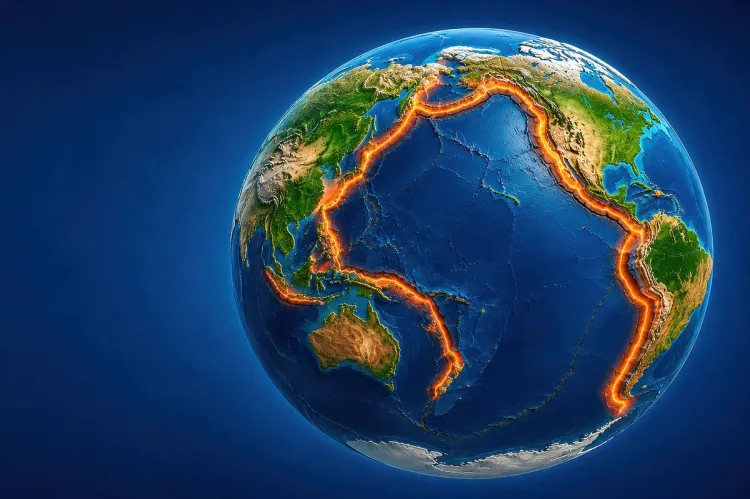
Earthquakes are not randomly distributed across the planet. Mapped across history, they cluster in unmistakable patterns: long arcs and lines that trace the boundaries where tectonic plates meet. The most prominent of these is the Ring of Fire — a band of seismic and volcanic activity that encircles the Pacific Ocean, from the southern tip of South America up through Central America, along the western coasts of North America, across Alaska and the Aleutian Islands, down through Japan, the Philippines, Indonesia, and around to New Zealand. About 90 percent of the world's earthquakes occur within this zone.
The reason is subduction: at these boundaries, oceanic plates are diving beneath continental ones, forced down into the mantle by the relentless motion of the plates above. As the descending slab sinks deeper, it's subjected to increasing temperature and pressure. It flexes. It releases water locked in its minerals. And it ruptures — sometimes at shallow depth, sometimes far into the mantle — generating the seismic activity that makes the Ring of Fire the most geologically restless region on Earth.
Some locations are more complex still. Colombia, for instance, sits at a corner where three major plates converge simultaneously, producing a tangle of overlapping fault systems that generates around 2,500 detectable earthquakes every month. Japan, Chile, and Indonesia face similar concentrations of tectonic stress at their respective positions along the Ring. Not all of these regions are equally dangerous — depth, soil type, population density, and construction quality all determine what a given earthquake actually does to the people above it — but the underlying machinery is the same everywhere along the boundary.
What the number actually means
When you read that an earthquake measured 7.5 or 8.0, it's worth knowing what the number is actually saying — because the scale behaves in a way that isn't obvious.
The scale used today is the moment magnitude scale, which replaced the older Richter scale for most professional purposes in the 1970s. Both are logarithmic, meaning each whole-number step doesn't add one more unit of energy — it multiplies it. Each step up the scale represents roughly 32 times more energy released. A magnitude 7.0 earthquake releases about 32 times more energy than a 6.0. Compared with a magnitude 5.0 — enough to rattle crockery and crack plaster — a 7.0 releases around 1,000 times more energy. The 1960 Chile earthquake at 9.5 released energy on a scale that defies easy comparison: roughly 1,000 times more than a 7.5, and a truly staggering multiple of anything that feels like a minor tremor.
News coverage tends to present these numbers as points on a familiar-looking scale, where 7.5 is "stronger" than 6.5 the way 75 is larger than 65. That framing obscures what the logarithm is doing. The difference between a 6.5 and a 7.5 isn't an increment. It's a factor of 32 in energy — which is the difference between cracked plaster and levelled buildings. The numbers look calm. The physics behind them is anything but.
What the science is for
We can't prevent fault slip. The tectonic machinery operates on timescales and under pressures entirely beyond human intervention. But understanding the wave sequence creates something practical: a warning window.
P-waves travel faster than S-waves and surface waves. In the seconds between a P-wave arriving at a seismograph and the more destructive waves following, an early warning system can stop trains automatically, open fire station doors, alert hospitals to step back from operating tables, and send elevators to the nearest floor. The window is sometimes less than ten seconds. But ten seconds is enough, and the same physics that creates the hazard also creates the opportunity. Japan, Mexico, and a growing number of countries have invested heavily in these systems. The wave sequence is identical everywhere; the investment is not.
Knowledge of soil type also matters more than most people realise. Seismic waves amplify dramatically when they pass from solid bedrock into loose, water-saturated sediment — the kind of ground that underlies many coastal cities and river deltas. Some of the most catastrophic urban earthquake damage in history has happened not because an earthquake was close, but because the ground beneath a particular neighbourhood acted as a resonance chamber, amplifying waves that would have been survivable in a different location. Understanding this shapes building codes, zoning decisions, and emergency planning in ways that save lives without anyone noticing.
Every earthquake in history, from the one that set the whole Earth ringing in 1960 to the smallest tremor that only a seismograph can detect, is the same thing: rock that could no longer hold, releasing stored energy in waves that travel outward through the planet until they dissipate. The scale varies enormously. The mechanism doesn't.
The ground isn't fragile. It's carrying energy from one place to another, in waves, exactly as it has for billions of years. We just happen to be standing on it.
Changed