Villa Borghese
Rome rewards walking, and then it exhausts anyone who does it. Villa Borghese is where the city goes to sit down, eighty hectares of gardens above the Piazza del Popolo, with one of the finest small museums in the world at the centre of them.
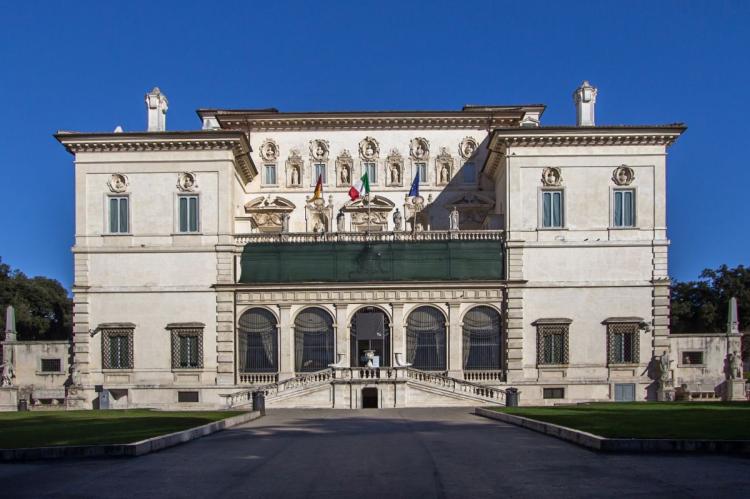
The land was vineyard until Scipione Borghese, cardinal-nephew of Paul V and the most voracious art collector of his generation, began buying it up in 1605. The villa at its heart went up between 1613 and 1616 to designs by Flaminio Ponzio, completed after his death by Giovanni Vasanzio, and it was built for a specific purpose: to hold the sculpture and paintings Scipione had acquired, by patronage, purchase and occasionally by confiscation.
The formal geometry came first, but it did not last. Between 1775 and 1793 Marcantonio IV Borghese had the grounds remade in the English landscape manner then fashionable across Europe — winding paths, irregular plantings and contrived views, the opposite of the clipped parterres of Versailles.
That remodelling produced the lake, and on its island the small Ionic temple of Aesculapius, the god of medicine, built in the 1780s. Rowing boats can still be hired there, which is the best way to look at it.
Scipione's own enthusiasms left other traces. The uccelliera housed peacocks, ostriches and other exotic birds, and a walled enclosure kept deer for the family to look at. Both survive in some form among the gardens' follies and pavilions.
The park did not pass to Rome as a gift. The Italian state bought the estate and its collection in 1901 and transferred the grounds to the city two years later, since when they have been public.
One curiosity repays knowing about. The four tritons and four carved masks now in the gardens are the originals from the Fountain of the Moor in Piazza Navona, moved here in 1874 and replaced in the square by copies from the hand of Luigi Amici. The Moor himself stayed put.
The Piazza di Siena is a grass oval laid out in 1792 and named for the family's Sienese origins — a hippodrome rather than an amphitheatre. Each May it hosts one of the oldest international showjumping competitions in the sport, and at other times it serves for concerts. Elsewhere in the park stands a decorative arch known as the Arco di Settimio Severo, an eighteenth-century garden folly rather than any relation of the Roman arch in the Forum.
Along the eastern edge, in the Valle Giulia, several pavilions built for the international exposition of 1911 now house foreign academies and cultural institutes, the British School at Rome among them.
The Galleria Borghese is the reason most people come. Bernini is here at his most astonishing — Apollo and Daphne caught at the instant of transformation, the David mid-throw, and Pluto's fingers pressing into Proserpina's marble thigh. Canova's reclining Paolina Borghese occupies a room of its own. The paintings include six by Caravaggio, more than anywhere else, along with Raphael's Deposition and Titian's Sacred and Profane Love.
Visiting it takes planning. Booking is compulsory, there are no tickets at the door, admission runs in strict two-hour slots with numbers capped, and the gallery closes on Mondays. Peak-season slots go quickly, so this is one to arrange before leaving home.
At the northern edge, the Villa Giulia holds the Museo Nazionale Etrusco. The villa was built as a summer retreat for Julius III in the early 1550s — Julius the Third, not the Second, who had been dead for nearly forty years by then. Its collection of Etruscan material from the hills north of Rome includes the Sarcophagus of the Spouses, a sixth-century BC terracotta couple reclining together that is among the most affecting objects anywhere in Italy.
Beyond that there is the Bioparco zoo, the Casa del Cinema, an open-air Shakespearean theatre, a curious eighteenth-century water clock, and, on the Pincio terrace at the western end, the finest free view in Rome — over the Piazza del Popolo and across the rooftops to St Peter's, best at sunset.
Metro line A serves both ends, at Spagna and Flaminio. The main entrances are on the Pincio above the Piazza del Popolo and at the Porta Pinciana, at the top of Via Veneto.