Vatican Museums
Listing the galleries would fill an article. Naming the artists would fill several. What follows is a route through the collection rather than an inventory of it, and a warning about how much walking is involved.
It began with one statue. In January 1506 the Laocoön group was dug out of a vineyard on the Esquiline, and Julius II bought it within weeks and set it in the Cortile delle Statue, now the Octagonal Court. It is still there. Everything else — some fifty galleries, seven kilometres of route, around twenty thousand works on display out of a holding several times that size — accumulated around it.
The classical sculpture remains the core. In the Pio-Clementino wing the Laocoön shares space with the Apollo Belvedere and the Belvedere Torso, the fragment Michelangelo admired so much that he refused an invitation to restore it.
Two nineteenth-century foundations sit close together and are easily confused. The Gregorian Etruscan Museum, from 1837, holds material excavated in southern Etruria — bronzes, painted vases and the contents of tombs. The Gregorian Egyptian Museum, from 1839, is what its name says: Egyptian antiquities, including mummies, funerary steles and sculpture, alongside Roman works in the Egyptian manner brought from Hadrian's Villa at Tivoli.
The Gregorian Museum of Profane Art is where the Roman mosaics and sarcophagi are. Its name carries no suggestion of impropriety; profane here simply means secular rather than sacred. Founded in 1844 in the Lateran Palace, the collection moved to its present building in 1970.
The Gallery of Tapestries hangs weavings produced in Brussels in the sixteenth century by the workshop of Pieter van Aelst, worked from designs by Raphael's pupils and threaded with gold and silver. They were arranged in this gallery in 1838. The trick worth watching for is the perspective: as visitors walk past the Resurrection, Christ's eyes and feet appear to follow them.
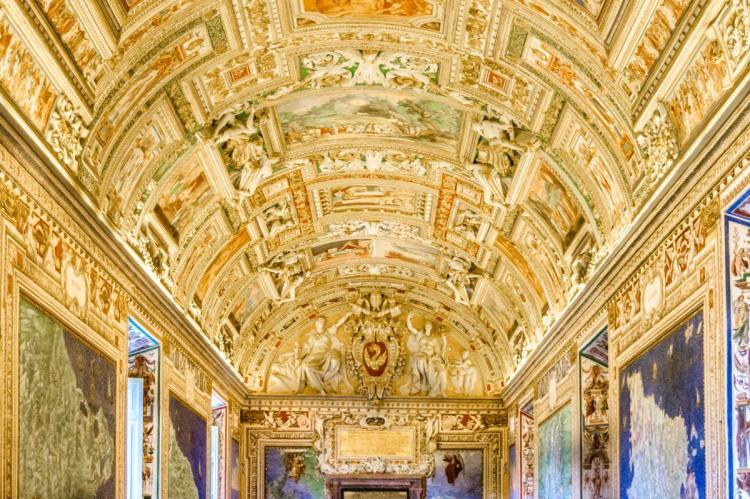
Then comes the Gallery of Maps, and it is not a gallery of the world. Its forty frescoed panels chart Italy and the territories of the Church as they stood under Gregory XIII, painted between 1580 and 1585 to a scheme by the Dominican mathematician Ignazio Danti. The Apennines divide the corridor: Tyrrhenian regions along one wall, Adriatic along the other, so that walking the 120 metres amounts to travelling the length of the peninsula. Avignon and Malta appear because the papacy held them, not because anyone thought them Italian. Most visitors never look up, which is a pity — the vaulted ceiling above is as fine as anything on the walls.
The Raphael Rooms occupy an apartment built for Nicholas V in the mid-fifteenth century. Julius II found Raphael working elsewhere in the palace and handed him the whole suite in 1508, at twenty-five. He was still at it when he died in 1520, and his workshop finished the last room. The School of Athens is here, in the Stanza della Segnatura, and it is worth arriving with enough attention left to give it.
The Pinacoteca, opened in 1932 in a purpose-built gallery by Luca Beltrami, holds the paintings: Giotto's Stefaneschi Triptych, work by Fra Angelico and Perugino, Leonardo's unfinished St Jerome, Caravaggio's Deposition, and Raphael's Transfiguration, the last thing he painted.
Smaller pleasures are scattered along the way. The Carriage Pavilion, opened in 1973 beneath the Square Garden, keeps the coaches and early motorcars of the popes. In the Pinecone Courtyard stands a colossal Roman bronze pine cone that once stood near the Pantheon. And the double-helix ramp near the exit, designed by Giuseppe Momo in 1932 after Bramante's original, lets people descend and ascend without meeting.
The route ends, as it is designed to, at the Sistine Chapel — Michelangelo's ceiling of roughly five hundred square metres, painted between 1508 and 1512, and the Last Judgment on the altar wall, begun nearly a quarter-century later and finished in 1541. Goethe thought that nobody who had not stood in that room could grasp what one person is capable of. The same could fairly be said of a dozen other rooms along the way.
A booked, timed ticket is close to essential; the early slots sell out weeks ahead, and the alternative is a queue measured in hours. Entry is free on the last Sunday of each month, though the crowds that day are the worst of the month and the hours are shortened. The dress code — shoulders and knees covered — is enforced at security. Photography without flash is fine in the museums and forbidden in the Sistine Chapel. The Vatican Gardens need a separate guided booking, and some Friday evenings between spring and autumn open the galleries late, which is the calmest way to see them. Hours and prices change, so the official site is worth a look before setting out.