Types of glues for crafts
In shops, there really ought to be a proper guide to the glues we use for arts and crafts, because the truth is gloriously simple: different materials need different adhesives. One tube does not rule them all, however much we'd like it to.
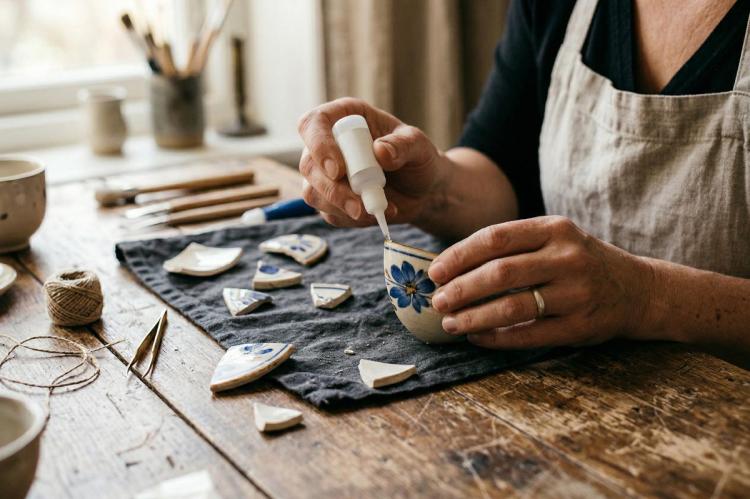
Last week I very nearly rang for help because I had stuck my thumb and forefinger together while trying to mend a favourite mug. A brilliant plan, obviously. (It was not.) Sitting on the kitchen floor, contemplating my newly immobilised hand, I realised something rather important. We spend hours choosing the perfect colours, the most expensive brushes and the loveliest textures for our projects, and then we grab the first crusty tube of glue we find at the back of the drawer.
The history of adhesives is, ironically, the history of us trying to keep things together. Our distant ancestors had no craft shops, but they discovered that birch bark, heated over a fire, yielded a sticky tar strong enough to fix stone to wood. There's something rather wonderful in the thought that civilisation itself was built on the simple wish to make two separate things become one. Today, mercifully, we don't need to boil tree bark. We have entire aisles devoted to modern adhesives, stacked with formulas that look like pure chemistry and behave like magic.
That aisle, mind you, can trigger a small existential crisis. There are white liquids, solid sticks, clear gels and guns that look like power tools. Which one do you actually need? Choosing well doesn't only rescue your projects (and your skin); it's part of that quietly satisfying business of getting better at something. Trying, getting it wrong, and finding the right tool for the job is, deep down, a fair metaphor for most of life. So if you're ready to stop ruining your makes with the wrong adhesive, come with me on this sticky little tour, from the classics of childhood to the innovations that feel beamed in from the future.
PVA glue: the versatile classic for almost everything
Polyvinyl acetate, better known as PVA or simply "white glue", is the undisputed king of the craft drawer. We all remember that smell from primary school. It's a thick white liquid that magically dries clear, and you shouldn't let its humble appearance fool you. PVA bonds by soaking into the pores of materials such as paper, card and non-washable fabric, then gripping mechanically as it sets.
What makes PVA genuinely indispensable is its versatility. It doesn't only join things; it's the star of one of the best craft tricks going. If you've ever wanted to make papier-mâché, seal a porous surface like plaster, or prime bare wood for painting, PVA is your friend.
The secret is dilution. Mix one part PVA with two parts water (or roughly half and half, depending on the consistency you're after) and you've made a lovely homemade sealer. Brush it over your project, let it dry to a clear protective film, and you've saved yourself a few quid on varnish. Do bear in mind it isn't waterproof, so don't use this trick on the plant pot you intend to leave out in the rain. (I learned this the hard way when a beautiful decoupage project quietly disintegrated on my balcony.)
Wood glue versus PVA: knowing when to level up
There comes a moment in every creative person's life when they decide to build something that has to bear weight. Perhaps a small shelf, a chunky picture frame, or an elaborate dolls' house. This is the point at which your faithful white school glue looks at you with great sympathy and says, "This is as far as I go."
Time to talk about wood glue. Although many wood glues are technically PVA-based too, they're formulated specifically (often as aliphatic resin) to form a far stronger bond, working in near-perfect harmony with the cellular structure of timber. Apply wood glue properly, clamp or weight the joint while it cures, and the bond can end up stronger than the wood itself. It's slightly mad to think the glue holds up better than the tree's own fibres.
"People assume a stronger glue is always the answer, but the real skill is matching the adhesive to the load," says Marian Ellis, a furniture restorer who runs weekend workshops in Bristol. "For anything that takes weight or tension, reach for a proper wood adhesive and clamp it. For lolly sticks and light décor, ordinary white PVA is plenty." So that's the rule of thumb: if the joint will carry strain, pressure or weight, invest in a decent bottle of wood glue (it's often slightly yellow, the better to blend with natural timber tones). For light decorative work, plain white PVA still does the job beautifully.
Modern fabric adhesives: art you can actually wear
My relationship with sewing is, to put it kindly, complicated. I love the idea of customising my clothes, adding patches to a denim jacket or fixing a fallen hem, but threading a needle tests every last scrap of my patience. Happily, fabric adhesives have come on in leaps and bounds.
Gone are the days when glue left fabric as stiff as cardboard. Alongside trusty old Copydex, we now have clever formulas such as Aleene's Fabric Fusion and Tear Mender that soak into the weave and create a flexible bond that moves with you. Most impressive of all, they survive a cycle in the washing machine.
If you love wearable art, these glues open up a whole world: rhinestones, lace, patches and ribbon, all without a single stitch. Just remember to apply thin coats. Too much product can bleed through the cloth and leave visible marks, ruining the very vintage waistcoat you were trying to rescue.
The great glue gun debate
Few things make you feel quite as capable as wielding a glue gun. It's the ultimate tool for the impatient, because the melted adhesive sets in seconds. There is, however, a long-running argument in the crafting community: high temperature or low temperature?
High-temp guns melt the sticks into a near-molten liquid that forms remarkably strong bonds on wood, thick plastics and metal. The catch is the very real risk of a nasty burn. (My thumb still remembers the Christmas wreath incident of 2021.) Low-temp guns are far gentler and ideal for delicate materials that would otherwise melt, such as polystyrene, tulle or artificial flowers.
The real revolution, though, is the arrival of cordless glue guns. Brands like Ryobi and Dremel have freed crafters from the tyranny of the short cable. A light, battery-powered, ergonomic tool means you can stick things together in the middle of the living room, out in the garden, or wherever inspiration finds you, without sending mugs of tea flying off the table.
Special glues for paper: the end of wrinkles
If you've ever tried scrapbooking, or attempted to line a pretty box with wrapping paper, you'll know the particular horror of wrinkles. You spread the glue, smooth the paper down, and within minutes a mountainous landscape of horrible bubbles appears. This happens because the paper drinks the water from the glue and its fibres swell.
For delicate work, glue sticks are excellent because they carry very little water. But if you prefer a liquid for precision, you'll want a specialised formula. Modern precision craft glues are designed to dry quickly and resist warping, and many come with very fine metal tips that let you lay down microscopically thin threads of adhesive. It's a level of surgical precision that lifts your invitations and journals to a properly professional standard.
Beyond the basics: UV resin and absolute precision
Now we reach my favourite part: the science-fiction corner. In the last few years, crafting has borrowed technology once reserved for dentists and the car industry. I'm talking about UV-curing adhesives, such as Bondic and the UV resins used in jewellery making.
Imagine a liquid glue you can shape, shift and adjust for as long as you like. It doesn't dry in the air. It doesn't bond instantly to your fingers. But the moment you shine the little UV torch on it, bam, it solidifies in about three seconds. It's genuinely revolutionary for mending jewellery, building small-scale models or filling gaps, because you have complete control over the curing time.
And for those days when you just want to enjoy yourself the way you did as a child, we mustn't forget glitter glue. These clear gels, loaded with sparkle, work both for sticking light pieces and for drawing raised, shimmering lines across a card. A small dose of joy in a tube.
Small sticky changes to unlock your potential
Mind: "We could just use that ancient roll of sticky tape to fix this antique vase." Also mind: "You know perfectly well that ends in disaster."
Learning to pick the right adhesive might seem like a tiny detail, but it's precisely in these small adjustments that real growth tends to hide. Every time you decide to look something up, choose the proper tool, and do the job with a bit of intention, you're training your patience and your eye for detail. You're deciding that your projects, and your time, are worth the care.
Whether you reach for a UV resin to rescue the earrings you adore, or mix PVA with water for your next papier-mâché adventure, remember that creativity is a journey rather than a destination. So go forward with confidence, get your hands a little messy, and enjoy every part of the process. (And please, if you're using superglue, keep those fingers well apart.)
This article is for general guidance only. Always read the manufacturer's instructions, work in a ventilated space, and keep glue guns and instant adhesives away from children. For valuable antiques or structural repairs, it's worth consulting a professional restorer.