Formally the Papal Basilica of St Peter in the Vatican, and to Romans simply San Pietro, it is the largest church in the world and one of the few great sights in Rome that still costs nothing to enter. A single visit can fill a day.
The basilica stands on a Roman cemetery that spread across the Vatican hill beside the circus begun by Caligula and finished by Nero. Excavations carried out beneath the church between 1940 and 1949 uncovered that necropolis, and within it a modest second-century shrine built over a first-century grave — the monument the priest Gaius referred to around AD 200. Whether the bones recovered there are Peter's remains disputed, but the tradition is old and the site has been venerated since at least the second century.
Constantine ordered a basilica raised over the spot in the fourth century. That building stood for roughly twelve hundred years before it was pulled down.
Julius II began the replacement in 1506 to designs by Bramante. Paying for it took decades, and part of the money came from the sale of indulgences — a campaign that reached Germany under Leo X and provoked Luther's protest in 1517. The project passed through architects as well as popes: Raphael, Antonio da Sangallo the Younger, Michelangelo, then Carlo Maderno, who lengthened the nave and built the façade between 1607 and 1615. Urban VIII consecrated the finished church on 18 November 1626, four hundred years ago this year.
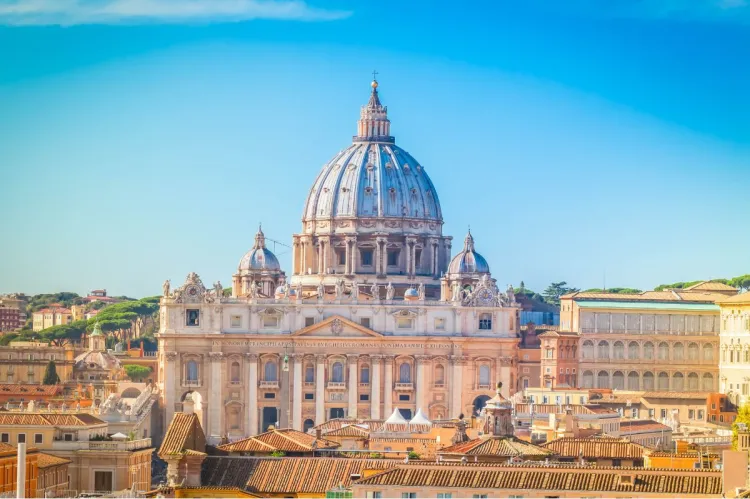
From the floor to the top of the cross is 136 metres, some 448 feet. The dome that carries it is built as two shells, one inside the other, the method Brunelleschi had used in Florence. Michelangelo took charge of the works in 1546 and died in 1564 with the drum barely finished. Giacomo della Porta completed it with Domenico Fontana in 1590, raising the profile into a steeper curve than Michelangelo had drawn. Its echoes carry as far as the Capitol in Washington.
By the 1740s the dome was badly cracked, some fissures wide enough to step through. Benedict XIV asked three mathematicians — Le Seur, Jacquier and Boscovich — for an analysis, and their report was the first to treat the problem numerically rather than by a builder's judgement. It caused an outcry among Rome's architects, who then largely did what it recommended. Five iron rings were fitted around the dome in 1743 and 1744 under Giovanni Poleni and Luigi Vanvitelli, with a sixth added later, joining three that della Porta had already built into the masonry. Some are visible from the spiral stair that climbs between the two shells.
The building covers nearly six acres and has held crowds of sixty thousand. Maderno's façade runs almost 115 metres wide and 48 metres high, with thirteen colossal statues along its balustrade — Christ, John the Baptist and eleven of the apostles.
Inside, most of what draws the eye is Baroque rather than Renaissance. Bernini's bronze baldachin rises over the papal altar, cast between 1623 and 1634, and his Cathedra Petri fills the apse beyond it. Nearby, a bronze St Peter sits with one foot worn smooth by centuries of hands.
Michelangelo's Pietà stands in the first chapel of the right-hand aisle, close to the entrance rather than beneath the dome. He carved it in his early twenties, and it is the only work he ever signed. It has been behind glass since May 1972, when a man attacked it with a hammer; the restoration took months and the damage is now hard to find.
Around a hundred tombs lie in the basilica and the grottoes below, including more than ninety popes. Among the handful of women is Christina of Sweden, who gave up her throne in 1654 and converted to Catholicism the following year.
The square outside is Bernini's, laid out between 1656 and 1667: two curved colonnades of nearly three hundred columns, arranged so that from either of the two marked focal stones the four ranks line up as one. The obelisk at the centre is Egyptian and uninscribed, which is why its date is uncertain. Caligula shipped it to Rome in AD 37 for his circus, and it stood there until 1586, when Domenico Fontana moved it three hundred metres to its present position using nine hundred men, seventy-five horses and a forest of ropes and winches.
Two fountains flank it, similar but not identical: Maderno's to the north, from 1613, and Bernini's to the south, finished in the 1670s. On the façade, two clocks added by Giuseppe Valadier in the 1780s frame a set of bells, the oldest of which was cast in 1288.
Entry to the basilica and the grottoes is free. What costs is time — the security queue in the square can run to an hour or more between April and October, which is what the paid "skip the line" tickets are really selling. Arriving before eight avoids most of it. The dress code is enforced at the checkpoint rather than at the door, and covers shoulders and knees for everyone.
Climbing the dome costs a few euros: 551 steps all the way, or a lift to the roof terrace and 320 steps from there. The basilica closes to sightseers on Wednesday mornings during the papal audience. The Scavi tour of the necropolis below the grottoes must be booked separately, well in advance, through the Excavations Office.
Changed