The Spanish Steps
Some will say they are only stairs. But the Scalinata di Spagna is one of the few staircases anywhere that people travel a long way to look at, and the tangle of nationalities behind it is half the pleasure.
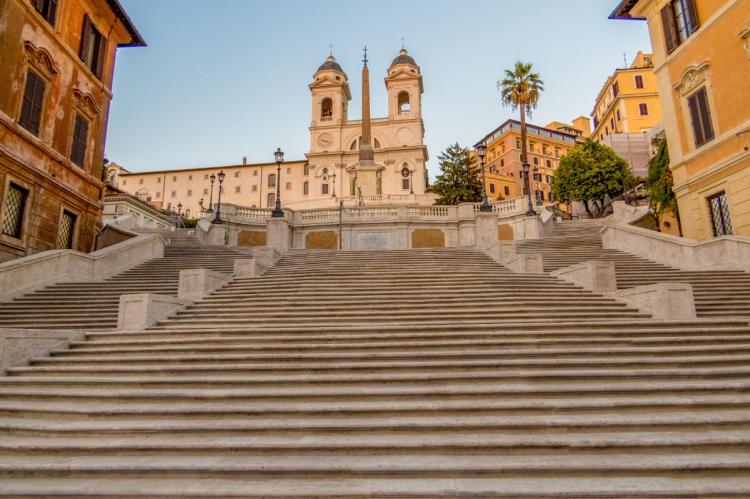
Almost nothing about the name is straightforward. The money came from a French diplomat, Étienne Gueffier, who left a legacy to connect the French church at the top of the hill with the square below. The design came from an Italian, Francesco de Sanctis, who won the commission after decades of argument. And the Spanish element is the square itself, named for the Spanish embassy to the Holy See, which still occupies the Palazzo di Spagna and is among the oldest continuously operating embassies in the world.
Building ran from 1723 to 1725. There are 135 steps by the usual count, though published figures range up to 138 depending on how the landings are counted. They are travertine, pale rather than dark, and the plan is a piece of theatre in itself: flights that split, curve outwards and rejoin at broad terraces, so that the climb keeps changing shape and the view back keeps opening up.
April is the month to see them, when the city sets out azaleas from the municipal nurseries along the terraces and the whole staircase turns pink and white.
One thing has changed for good. Sitting on the steps has been prohibited since 2019, along with eating and drinking, and the rule is enforced in earnest by officials with whistles. The fine starts at €250 and rises to €400 if the stone is stained or damaged. The ban followed a €1.5 million restoration in 2016, paid for by Bulgari, and it applies to residents and visitors alike.
At the foot sits the Fontana della Barcaccia, a marble boat half sunk in its basin, commissioned by Urban VIII in 1627 and finished two years later. It is generally credited to Pietro Bernini, perhaps with help from his son Gian Lorenzo, then in his twenties. The sinking-boat design was a practical answer to a technical problem: the Acqua Vergine reaches this part of the city with too little pressure for a tall jet, so the water seeps out through the vessel instead. The Barberini bees and suns carved on it belong to the pope who paid. The water is drinkable, and taking some is one of the few things still permitted here.
On the right at the bottom is the house where John Keats died of tuberculosis in February 1821, aged twenty-five, now the Keats-Shelley Memorial House and a small museum of English Romanticism in Rome. Directly opposite, Babington's has been serving tea since 1893, opened by two Englishwomen at a time when tea was sold in Italian pharmacies.
At the top stands Trinità dei Monti, founded in 1502 under Louis XII of France and consecrated in 1585 — some eighty years, rather than the two centuries sometimes claimed. It remains a French church. The interior keeps late Gothic bones; the façade, with its twin bell towers, is late-sixteenth-century work rather than neoclassical. The obelisk in front is Roman rather than Egyptian, a second-century copy made for the Gardens of Sallust with imitation hieroglyphs, and moved here in 1789.
Below and around, the shopping is as expensive as anywhere in Italy. Via dei Condotti runs west from the foot of the steps in a straight line of luxury frontages, and Via Veneto curves away to the north-east, ten minutes on foot — the street Fellini made famous in La Dolce Vita, and the reason the word paparazzo entered the language. It trades on that memory now more than it lives it, but the cafés and the architecture still repay the walk.
Metro line A stops at Spagna, which comes out at the foot of the steps. The Trevi Fountain is about eight minutes away, the Pantheon around fifteen. The square attracts persistent rose sellers and bracelet vendors, and the crowds attract pickpockets, which is worth bearing in mind while looking upward.