The Sistine Chapel
The chapel takes its name from Sixtus IV, who had it built in the 1470s. Its fame it owes to his nephew, Julius II, who in 1508 handed the ceiling to a reluctant sculptor named Michelangelo.
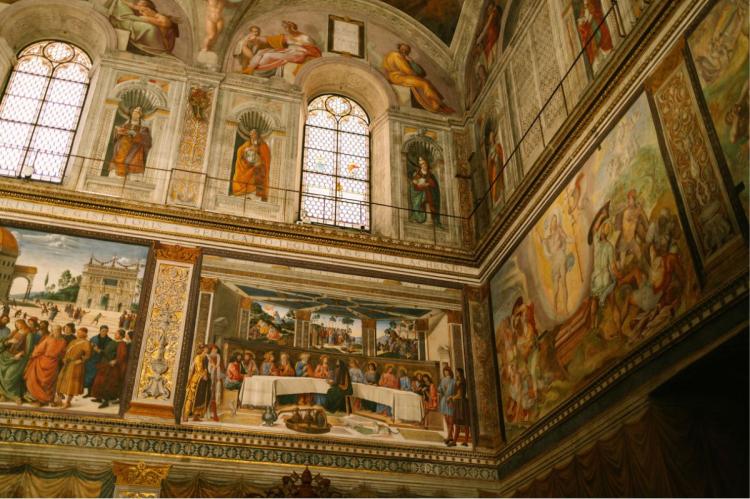
The chapel sits inside the Vatican Museums rather than near them, at the end of the visitor route — a distinction worth knowing, since the only way in is through the museums and their ticket.
It is not large: 40.9 metres by 13.4, and 20.7 metres high. The proportions are said to follow those given in the Book of Kings for the Temple of Solomon. Nor is it only a gallery. This is the room in which cardinals elect popes, sealed off from the world, and the stove whose chimney carries the smoke stands inside it. The most recent conclave met here in May 2025 and chose Robert Prevost, who took the name Leo XIV, on the fourth ballot. The chapel closes to visitors while that is going on.
The walls came first. Between 1481 and 1482 Sixtus IV assembled most of the best painters in Italy — Perugino, Botticelli, Ghirlandaio, Cosimo Rosselli, Signorelli and Pinturicchio among them — to fresco parallel cycles from the lives of Moses and Christ along the two long walls. Perugino's Delivery of the Keys is the finest thing in the series and the clearest statement of papal authority in the room. Botticelli contributed three, including the Trials of Moses and the Punishment of Korah.
Above them, the vault carried nothing but a blue sky scattered with gold stars, painted by Piermatteo d'Amelia. Julius II wanted something more. Michelangelo, who thought of himself as a sculptor and had never completed a fresco cycle, took the commission with visible reluctance and worked at it for four years, from 1508 to 1512.
What he produced covers about 500 square metres and holds more than three hundred figures. Nine scenes from Genesis run down the centre, from the separation of light to the drunkenness of Noah, with the Creation of Adam at the heart of them. Around and below sit seven prophets and five sibyls, the ancestors of Christ in the shadowed spandrels, and twenty nude youths — the ignudi — whose purpose no one has satisfactorily explained. It was unveiled on 1 November 1512.
He did not paint it lying on his back. That story is persistent and wrong: he worked standing on a scaffold of his own design, head tilted back, and left a sardonic sonnet about what the posture did to his neck, his spine and his eyes.
The technical problems were real enough without the myth. The first plaster grew mould in the Roman damp, and the fix was not a new invention but a revised mix — more pozzolana, less water — suggested by Giuliano da Sangallo. Goethe, seeing the finished room, thought no one who had not stood in it could grasp what a single person is capable of.
More than twenty years later Michelangelo came back. The Last Judgment, commissioned by Clement VII and seen through under Paul III, was painted between 1536 and 1541 and covers the whole altar wall. Among the crowd, St Bartholomew holds his own flayed skin, and it is the face on the skin — not the saint's — that is Michelangelo's self-portrait.
The nudity drew fire immediately. The papal master of ceremonies, Biagio da Cesena, called it fit for a bathhouse, and found himself painted into the lower corner as Minos with the ears of an ass. Michelangelo outlived the argument but not its outcome: after the Council of Trent, in 1564, Daniele da Volterra was set to painting draperies over the offending figures, a job that earned him the nickname Il Braghettone, the breeches-maker.
A restoration campaign ran from 1980, finishing the ceiling in 1989 and the Last Judgment in 1994, with the fifteenth-century wall frescoes completed by 1999. It lifted centuries of soot and glue and revealed colours far sharper than anyone expected — brilliantly, most critics said, though a minority argued the cleaning had taken Michelangelo's final dry-brush touches with it.
Entry is on the Vatican Museums ticket, timed and worth booking well ahead. Photography is not allowed inside the chapel, silence is requested and periodically enforced, and the dress code covering shoulders and knees applies here as at St Peter's.