Swimming in the Seine
There are three sites, all within Paris, all free, lifeguarded and without booking:
- Bras Marie, in the centre, in the arm of the river beside the Île Saint-Louis at the foot of the Pont Louis-Philippe. Open through the day.
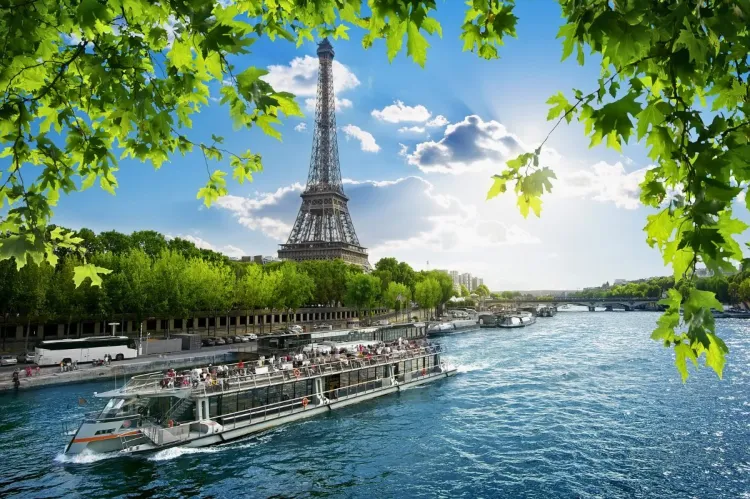
- Bras de Grenelle, in the fifteenth, facing the Île aux Cygnes and within sight of the Eiffel Tower. Shorter hours, and Sundays run in separate sessions.
- Quai de Bercy, in the twelfth, by the Simone-de-Beauvoir footbridge opposite the national library. The largest of the three, and open latest — well into the evening.
The things to know before planning around it:
- It is a summer arrangement only — early July to the end of August. For the rest of the year there is nothing to see but the river.
- Swimming ability is checked, and under-fourteens must be with an adult. Capacity is limited and shown by the counting buoys; river traffic is suspended in the bathing arms while they are open.
- Closures happen. In the first season thirteen days were lost to water quality after rain. In 2026 the weather was dry enough that rain was not the problem, but one site shut for a week for an international open-water championship and two closed intermittently after a fuel spill that came down the Marne. The flags at each site show the day's state.
- Paris also has free supervised bathing at the Bassin de la Villette through the summer, and in the Canal Saint-Martin on Sunday afternoons, both of which are calmer than the river sites.
The banks are a park now
This happened in stages and is easy to miss if the only description to hand predates it. Sunday closures began in 1995. The left bank between the Musée d'Orsay and the Pont de l'Alma was handed to pedestrians in 2013. The right bank followed in 2016, when three and a third kilometres of the Voie Georges-Pompidou — a dual carriageway along the water — were closed to traffic, and the two halves opened as the Parc Rives de Seine in 2017.
It was not uncontested: a court annulled the right-bank decision on procedural grounds in 2018, and the city simply re-made it on different legal footing. The park stayed. What is there now is deckchairs, pétanque pitches, climbing walls, planting and a good deal of running, along the water from the Tuileries tunnel to the Pont de Sully.
Three bridges worth stopping on
Thirty-seven bridges cross the river inside Paris. These three are the ones older accounts single out, and two of them need correcting.
The Pont Neuf is, despite the name, the oldest standing bridge in Paris. Henri III laid the first stone on 31 May 1578; the Wars of Religion stopped work from 1588; it resumed in 1599 under Henri IV, opened to traffic in 1604 and was finished in 1606. Twelve arches, and the first bridge in the city built without houses on it, which is why it was immediately somewhere to stand and look. The equestrian statue is Henri IV — the original was destroyed in 1792 and the present one recast in 1818.
The Pont d'Austerlitz is the one older accounts get most wrong. There were two bridges. The first, of 1801 to 1805, did have five cast-iron arches of about thirty-two metres. An inspection in 1853 found more than two thousand fractures in them, and the bridge was demolished and rebuilt in masonry in 1854, keeping the same five spans; it was widened once, in the mid-1880s, from eighteen metres to about thirty. What stands there today is stone, not iron, and has been for well over a century.
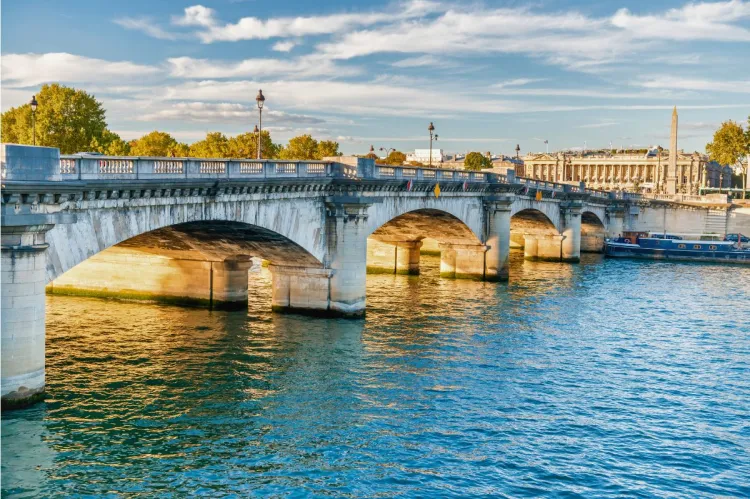
The Pont Alexandre III is the showpiece, built for the Exposition Universelle of 1900, with its foundation stone laid by Tsar Nicholas II and named for his father, who had signed the alliance with France. It runs from the Esplanade des Invalides to the Grand Palais. Older accounts mention a gilded Pegasus; there are four — one on each of the four pylons, each a gilded bronze Fame reining in a winged horse, standing for the Renown of the Arts, the Sciences, Commerce and Industry. The lamps with their cherubs and nymphs are as described, and it has been a listed monument since 1975.
Where the river comes from
Older accounts say the Seine flows from Dijon. It does not. Dijon is in a different river basin altogether, draining south to the Rhône. The Seine rises on the Plateau de Langres, in the Côte-d'Or some thirty kilometres north-west of Dijon, at a spring marked by a small grotto. It runs seven hundred and seventy-seven kilometres to the Channel, reaching the sea through the estuary between Le Havre and Honfleur. Only about thirteen of those kilometres are inside Paris.
The booksellers
The green boxes clamped to the parapets belong to the bouquinistes, of whom there are around two hundred, selling second-hand books, prints and postcards. They came close to being removed: ahead of the 2024 opening ceremony the authorities ordered some five hundred and seventy boxes dismantled on the grounds that they could hide explosives. The decision was publicly reversed in February 2024, and the stalls stayed. They are a working trade rather than a display, they keep their own hours, and in bad weather a good many simply do not open.
Boats, and the evening
The boat trip is the one piece of advice in older accounts that needs no correction. Several operators run the central reach, from small open launches to large glassed-in boats with dinner service, with commentary in English and French; departures are from quays along the middle of the river, including beside the Pont Neuf, where the Square du Vert-Galant occupies the downstream tip of the Île de la Cité and is reached by the steps from the middle of the bridge.
Dusk is the right time, and the reason is specific: the Eiffel Tower changes colour as the light goes and then begins its hourly sparkle, and the bridges are lit from below. An hour is enough.
Worth knowing, since the river invites it: the stone steps down to the water are open along much of the central reach, and standing under an arch looking up at the vault is a better five minutes than most paid attractions. The Musée d'Orsay sits on the left bank a short way downstream, in the converted station older accounts mention.
What is protected, and how much of it
The river is the reason a large part of central Paris carries World Heritage status. The inscribed property is Paris, Banks of the Seine, listed in 1991, and it is not a line on a map so much as a corridor: the river and its quays between the Pont de Sully and the Pont d'Iéna, taking in both islands and twenty-three of the city's thirty-seven bridges, together with the monuments along that reach.
So the Louvre, Notre-Dame, the two Palais, the Invalides and the Eiffel Tower are all, formally, parts of a listing about a river — which is a fair description of how the city was built.