The science behind auroras
Have you ever seen the sky suddenly grow curtains (green, rippling, alive) like Earth is quietly putting on a light show just for you?
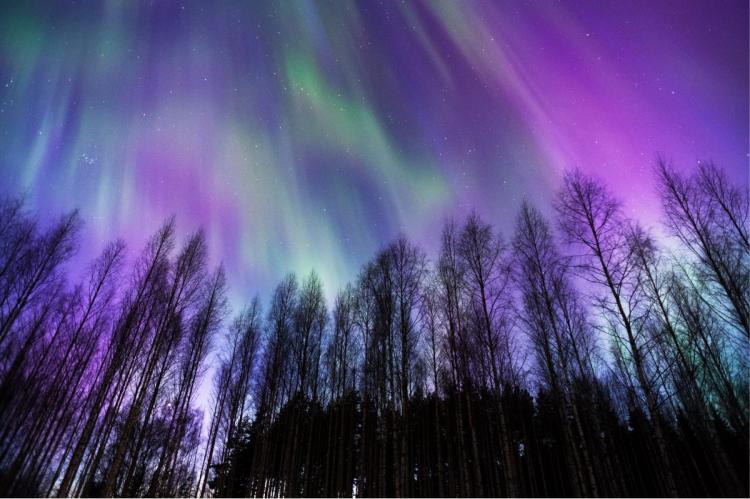
That’s an aurora. And as magical as it feels, it’s really a piece of space weather touching our air.
Zoom out: Earth lives inside the Sun’s influence
The Sun isn’t just a warm lamp in the sky. It constantly blows a thin, fast stream of particles called the solar wind (mostly electrons and protons) out into the Solar System. Think of it like an invisible breeze made of charged “grains” of matter, racing past planets.
Earth sits in that breeze.
The core idea in simple words
An aurora happens when charged particles from space get guided into Earth’s upper atmosphere and make the air glow.
“Charged” just means the particles carry electric charge, so they respond strongly to magnetic fields.
The concrete picture
Imagine Earth wrapped in a giant, invisible magnetic bubble called the magnetosphere (that’s the region where Earth’s magnetic field dominates space around us). Most of the solar wind gets deflected around this bubble, like rain flowing around an umbrella.
But the umbrella isn’t perfect.
Near the poles, Earth’s magnetic field lines bend down into the atmosphere. Those lines act like cosmic train tracks, guiding some incoming particles toward the top of the sky over the Arctic and Antarctic.
When those fast particles slam into the upper atmosphere (around 100–300 km up, sometimes higher), they collide with atoms and molecules, mostly oxygen and nitrogen. The collisions “excite” them, meaning they get bumped into a higher-energy state, like winding up a toy.
Then the atmosphere relaxes. And when it relaxes, it releases the extra energy as light.
That’s the glow you see.
Why the colors look the way they do
Different gases and different heights give different colors, like different ingredients in a recipe changing the flavor.
- Green is most common: usually oxygen emitting light around ~100–150 km up.
- Red can appear higher up: oxygen again, but in thinner air where it can “hold” its excited state longer.
- Blue/purple often comes from nitrogen, especially during more energetic storms.
Side note: It’s not that the aurora “paints” the air. The air itself is emitting light, the way a neon sign glows, except the power source is the Sun, and the wiring is Earth’s magnetic field.
How we know it’s real, not just a pretty story
We don’t just infer this from the look.
- Satellites directly measure the solar wind and detect surges that often precede strong auroras.
- Instruments measure the electric currents and magnetic disturbances in near-Earth space during auroral events.
- Spectrometers (devices that split light into its component colors) show the aurora’s light matches the known “fingerprints” of oxygen and nitrogen emissions.
In other words: we can track the particles, track the magnetic response, and read the colors like a barcode.
So what? Why it matters
Auroras are the visible tip of a much bigger interaction between the Sun and Earth. The same disturbances that make auroras brighter can also:
- disrupt radio communication,
- interfere with GPS accuracy,
- stress power grids,
- and increase radiation exposure for satellites and polar flights.
So when you watch an aurora, you’re not just seeing beauty, you’re watching a planet defend itself, and sometimes get splashed by the Sun anyway.
Quick recap
Auroras happen when the Sun’s charged particles are steered by Earth’s magnetic field into the polar upper atmosphere, where they collide with oxygen and nitrogen and make them glow. It looks like magic, but it’s really physics you can see with your own eyes: space weather turning air into light.