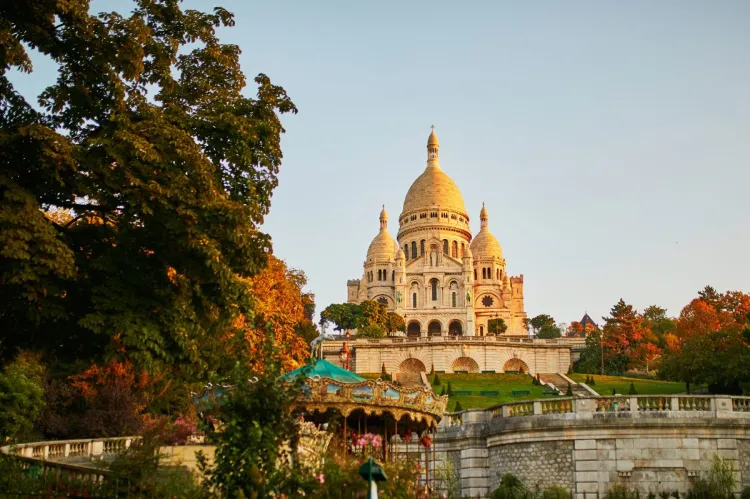
The vow, and the argument about it
Older accounts say only that the basilica owes its existence to the misfortunes of war, and mention the Franco-Prussian War. The actual origin is a specific document with a specific date.
On 8 December 1870, with France losing the war and Paris under siege, Alexandre Legentil wrote to the Bishop of Poitiers proposing what became the Vœu national — a vow to build a church in Paris consecrated to the Sacred Heart, in penance and in hope. He and his brother-in-law Hubert Rohault de Fleury pressed it; Cardinal Guibert, Archbishop of Paris, approved the vow on 18 January 1872 and chose the Montmartre site later that year; and the National Assembly declared the project to be of public utility in 1873, which is how a private religious vow came to be built with the state's blessing on the most conspicuous hill in the capital.
Then there is the Commune, which is where the argument lies. The basilica's own account points out that Legentil wrote his letter in late 1870, months before the Commune of March to May 1871, so the vow cannot have been a reaction to it. The opposing reading is not about the vow but about the site: Montmartre is where the Commune began, and putting an expiatory church on that particular hill, in 1872, was read then and has been read since as an act of expiation for it. The city's own deputy mayor for heritage said in 2022 that historians find no link between the basilica's creation and the Commune.
Both things are true at once, and that is the honest way to put it: a vow born of the defeat of 1870, placed on ground whose associations gave it a second meaning it has never shed.
Who built it, and how long it took
Paul Abadie gave it the Romano-Byzantine style and the Greek-cross plan, and after his death in 1884 it passed through five architects in turn: Honoré Daumet, Jean-Charles Laisné, Henri-Pierre-Marie Rauline — advised by Charles Garnier, of the Opéra — then Lucien Magne, who built the campanile, and Jean-Louis Hulot, who finished the work in 1924.
The sequence older accounts give is broadly right and worth filling in. The first stone was laid in 1875. There was a solemn inauguration on 5 June 1891, while the great dome was still missing. The campanile and the lantern cross were finished in April 1912. A consecration set for October 1914 was cancelled by the outbreak of war, and the building was finally consecrated on 16 October 1919 — forty-four years after the first stone. The apse mosaic was dedicated in 1923.
Why it gets whiter
This is the one thing older accounts have almost exactly right, and it is the best fact about the building. The stone is a travertine of the Château-Landon type, quarried at Souppes-sur-Loing, south-east of Paris. It is hard and fine-grained, and on contact with rainwater it releases calcite. So rain, which blackens most Paris stone, bleaches this one: the building cleans itself and has stayed startlingly white for a century in a city where nothing else does.
One note on the description rather than the fact. Older accounts call the domes "Oriental-style" and then add a gloss explaining that this does not mean Asian. The style has a name — Romano-Byzantine — and using it removes the need for the gloss.
The bell, the mosaic, and the two horsemen
- La Savoyarde is the largest bell in France and the fifth largest in Europe — about nineteen tonnes and three metres across. It was cast by the Paccard foundry at Annecy in 1891 and given by the four dioceses of Savoy, arriving in 1895, which is why a Paris basilica's great bell is named after a mountain region two hundred miles away.
- The apse mosaic — properly The Triumph of the Sacred Heart, usually called the Christ in Majesty — was designed by Luc-Olivier Merson and dedicated in 1923. It covers four hundred and seventy-five square metres in something like twenty-five thousand enamelled and gilded pieces, and is among the largest mosaics anywhere.
- The two bronze horsemen over the entrance are Joan of Arc and — not "King Louis", as older accounts have it — Saint Louis, Louis IX. Both are by Hippolyte Lefèbvre.
How high it actually is
Older accounts compress two different facts into one wrong sentence, saying the church rises a hundred and twenty-nine metres above sea level and is the second highest location after the Eiffel Tower. Untangled:
The hill, not the church, is about a hundred and thirty metres above sea level — and it is the highest natural ground in Paris. Its actual summit is inside the little Calvaire cemetery beside Saint-Pierre, which opens one day a year; the highest point the public can stand on all year round is over at Belleville, a metre or two lower.
The dome is eighty-three metres tall, which puts its top at roughly two hundred and thirteen metres above sea level. On that measure the claim survives: it is the second highest viewpoint in Paris after the Eiffel Tower, and marginally above the Tour Montparnasse. The view from it is the best in the city after the tower's, and far less queued for.
Going in, and going up
- Entry to the basilica is free. The nave, the mosaic and the chapels cost nothing, and it is a working church with services through the day.
- The dome is charged, and it is 280 steps with no lift. The stair is narrow and enclosed, and the basilica itself advises against it for anyone with mobility problems, anyone pregnant, young children, and anyone uneasy in confined spaces. There is no advance booking — tickets are sold on the spot.
- Dome hours run from the middle of the morning to the late afternoon with a break at midday, and they shift with the season and close for weather. The crypt is separately ticketed.
- Older accounts call access to the site challenging, which is fair. The approach from Anvers is up the steps or the funicular; the quieter way is to come along the hill from Abbesses or Lamarck–Caulaincourt and arrive at the basilica from the side.
Prayer without a break since 1885
The thing that most distinguishes this building is invisible and older accounts miss it entirely. Perpetual adoration of the Blessed Sacrament began here on 1 August 1885 — before the walls were finished — and has continued day and night, without interruption, ever since: through two world wars, the occupation of Paris, and every closure since. Someone is praying in the apse at four in the morning. Visitors are welcome at any hour the basilica is open, and the atmosphere in the nave makes a good deal more sense once this is known.
Saint-Pierre next door, which is not sixth-century
Older accounts call the small church beside the basilica a still-standing sixth-century building. It was built between 1133 and 1147 and consecrated in 1147 by Pope Eugene III, in the presence of Bernard of Clairvaux and Peter the Venerable of Cluny, before Louis VII and his mother. It was the church of the royal Benedictine abbey of Montmartre, founded in 1134, for more than six centuries.
That makes it one of the oldest churches in Paris, which is the claim worth making and is impressive without being inflated. The hill's Christian history does run much further back — devotion here is traced to the third century, with an oratory attributed to Saint Denis — but an oratory of about 250 is not a church of the 500s, and it is the confusion of the two that produced the error.
Listed at last
The basilica was inscribed on the supplementary list in December 2020 and then classified outright by order of 13 December 2022, after the national heritage commission voted for it unanimously. That it took until 2022 is the point.
The process was paused through 2021 at the request of the mayor of Paris, so that it would not coincide with the hundred and fiftieth anniversary of the Commune. When it resumed, left-wing politicians moved to block it, invoking the Communards' memory. The Conseil de Paris approved it in October 2022 and the order followed in December. The protection is partial: it covers the basilica with its crypt and sub-crypt, the sacristy, parts of the annexes and the Square Louise-Michel below — named, as it happens, after a Communard — while leaving out the embankment and the three great staircases.
One final thing for anyone who watched the 2024 Olympics. The road cycling went over this hill — three climbs of Montmartre in the men's race on 3 August and three laps of the same circuit in the women's the next day, with the descent running down past Saint-Pierre. The crowds on the Butte were the enduring image of those two days, and the gradient that made the racing is the same one that makes the walk up hard.