The Roman Forum
In the valley between the Capitoline and the Palatine lies the Forum Romanum, for a thousand years the place where Rome governed, traded, worshipped and argued with itself, and today one of the foremost archaeological sites in the world.
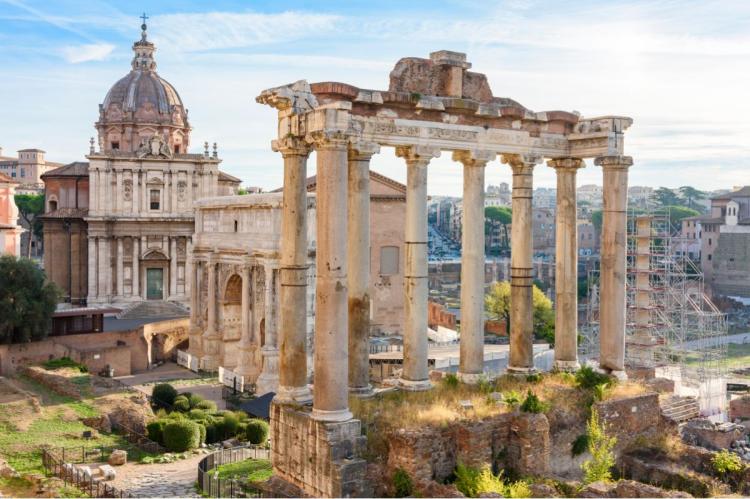
The valley began as marsh. Draining it, through the great sewer known as the Cloaca Maxima, made the ground usable around 600 BC, and by the seventh century BC a public square had taken shape there. Everything else followed from that piece of engineering.
Through the Republic the Forum was the city's centre of gravity: law courts and the Senate house, temples, the state treasury, markets, triumphal processions and public funerals all within a few hundred metres. Augustus — Julius Caesar's great-nephew and adopted heir, rather than his son — rebuilt much of it in marble in the decades either side of the turn of the millennium.
It did not stop there. The Arch of Titus went up in 81, the Temple of Vespasian later that century, the Arch of Septimius Severus in 203. The last monument raised in the square was the Column of Phocas, in 608, six hundred years after Augustus. The Forum kept accumulating for as long as Rome had emperors to commemorate.
One point of confusion is worth clearing up: the Imperial Fora next door — those of Caesar, Augustus, Nerva, Vespasian and Trajan — are a separate complex, built later and visited on a different ticket.
The Western Empire ended in 476, and the buildings were gradually put to other uses. The Senate house survives almost whole only because it became a church in 630. Others were burnt for lime or stripped for stone; the worst of it came in the 1540s, when Paul III quarried the Forum for the new St Peter's. Silt buried what was left, and by the sixteenth century the square was pasture, known to Romans as the Campo Vaccino, the cow field.
Carlo Fea began clearing debris from the Arch of Septimius Severus in 1803, which is where the modern excavation starts. Giacomo Boni brought scientific method to it from 1898, uncovering the Lapis Niger, the Regia, the Temple of Vesta and the archaic necropolis. The work has run for two centuries and has not finished.
What stands now rewards a slow walk. The Temple of Saturn keeps eight columns of its porch and once housed the state treasury. Three columns of the Temple of Castor and Pollux carry a fragment of entablature and have become the emblem of the site. The Temple of Antoninus and Faustina survives better than any of them, having been fitted out as a church, its ancient portico still embedded in the later façade.
Of the Temple of Concord, vowed in 367 BC to mark the settlement of the long quarrel between patricians and plebeians, only the podium remains. It once held a celebrated collection of Greek art. At the eastern edge, the Temple of Venus and Roma is Hadrian's own design and was the largest temple in the city, set on its platform facing the Colosseum.
Smaller things carry as much weight. The round Temple of Vesta held the fire that was never allowed to go out, tended by the priestesses whose house adjoins it. At the Temple of Caesar, built over the spot where his body was burned, visitors still leave flowers.
The Romans did not invent the arch — Etruscans and others were using it well before — but they mastered it and built the two great triumphal arches that anchor either end of the Forum. That of Titus, from 81, carries a relief of the spoils of Jerusalem, the seven-branched menorah among them. That of Septimius Severus, from 203, records campaigns in Parthia.
The Rostra takes its name from the bronze rams of warships captured at Antium in 338 BC and mounted on the speakers' platform. Mark Antony delivered the funeral oration for Caesar from it, and Cicero's head was displayed there after his murder.
The Lapis Niger is a patch of black paving covering an archaic shrine, and beneath it stands a stone bearing the oldest known Latin inscription, from the sixth century BC. Roman tradition connected the spot with Romulus.
The Via Sacra is not a shrine but a street — the Sacred Way, the road that runs the length of the Forum and along which triumphal processions climbed towards the Capitol. Walking it is the simplest way to make sense of the layout.
The Forum is entered on the combined ticket with the Colosseum and the Palatine, timed and worth booking in advance. There is very little shade, and the ground is uneven stone throughout; early morning and late afternoon are kinder in every sense.