Why close focus fails in the mid-forties, what reading glasses, bifocals, varifocals and contact lenses each do about it, and why not getting on with a correction is a normal outcome rather than a failure.
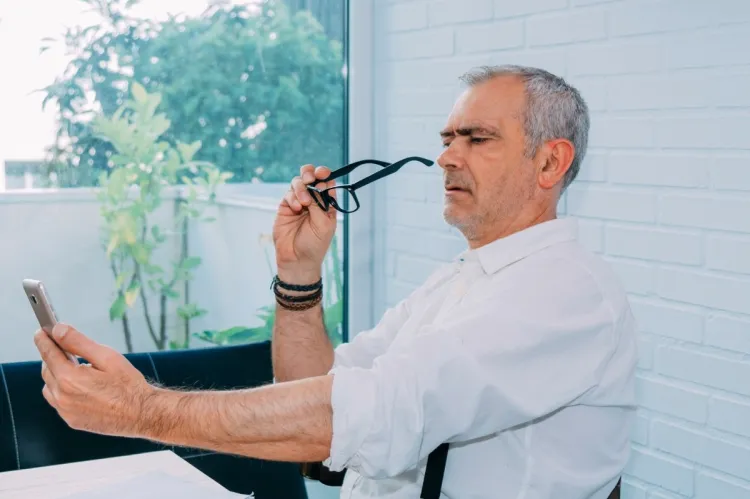
What it is
The lens inside the eye is flexible in youth. Muscles around it change its shape to bring near objects into focus — a process called accommodation — and it happens without any conscious effort at all.
That flexibility declines steadily from childhood onwards. The decline only becomes noticeable when the range left no longer reaches as far as reading distance, which for most people is somewhere in the mid-forties. Small print blurs, the arms seem to have got shorter, and a menu suddenly becomes easier to read by a window than in a dim restaurant.
This is presbyopia. The word means “old sight”, which is unhelpful, since the people discovering it are typically in their forties and not notably old.
What it is not
Several beliefs attach themselves to presbyopia, and all of them cause unnecessary worry.
It is not a disease. Nothing is damaged and nothing is deteriorating in the sense that word usually carries. It is a change in the mechanical properties of the lens, and it happens to everyone who lives long enough.
It is not caused by reading in poor light, close work or screens. Those make it more obvious, because any demanding near task does, but they do not bring it on and they do not accelerate it.
It cannot be prevented. No exercise, supplement or habit alters the course of it.
Using correction does not make it worse. The idea that reading glasses weaken the eyes is persistent and wrong. The eye continues to change on its own schedule and would have done so regardless; what changes is that the difference becomes obvious once the glasses come off.
It does progress, though. The strength of near correction required increases through the forties and fifties before levelling off, so whatever is prescribed first will need revisiting every few years.
The spectacle options
Three arrangements cover most people, and they are genuinely different rather than better and worse versions of each other.
Reading glasses correct near vision only. For someone whose distance vision needs no correction, they are often the entire answer: cheap, optically clean, and sharp through the whole lens. The nuisance is practical — they have to go on and come off, and they are left in other rooms.
Ready-made readers from a chemist work perfectly well for a good many people. Their limitation is that both lenses carry the same power and the optical centres are set at a fixed distance apart, which suits an average face and an even prescription. Anyone whose two eyes differ, or who has astigmatism, will do better with a prescription pair, and the difference is usually obvious when the two are compared side by side.
Bifocal spectacles carry a distance lens with a near segment set into the lower part, divided by a visible line. The line is unfashionable, and that is most of why they fell out of favour. Optically they are honest: each zone is a clean single-vision lens, so vision through either is as sharp as the prescription allows. What they lack is the middle distance, which is why a bifocal wearer at a computer tends to end up with their chin in the air.
Varifocals, also called progressive lenses, change power smoothly from distance at the top, through intermediate, to near at the bottom. There is no line and no jump, and they cover the full range of working distances in one lens. They are the default recommendation in most practices, and for most people they work very well.
What varifocals cost
The compromise is in the periphery, and it is worth understanding before buying rather than after.
A lens surface that changes power gradually down a narrow central channel cannot stay optically clean on either side of it. Varifocals therefore carry regions of aberration and geometric distortion to the left and right of the corridor. Looking through those areas gives blurred or swimming vision, which is why varifocal wearers learn to turn the head rather than move the eyes. Designs differ in how much distortion they carry and where they put it, and better ones push it further out, but none eliminate it. The stronger the near addition, the more there is to accommodate, so the effect tends to grow as presbyopia progresses.
Adaptation takes anywhere from a few hours to a couple of weeks. Headache and dizziness during that period are common rather than alarming, and the standard advice is to take the glasses off briefly when symptoms appear and then put them back on.
Depth perception and distance judgement can be unreliable while adapting, which is why stairs and kerbs are the classic difficulty: the near zone sits in the lower part of the lens, exactly where the feet are. This is worth knowing about beyond the adaptation period as well, because multifocal spectacles have been associated with an increased risk of falls in some groups of wearers. It is one factor among several — age, mobility and medication matter more — but it is a reasonable thing to raise with an optometrist, particularly for someone older or already unsteady. Keeping a pair of single-vision distance glasses for stairs, gardening or walking outdoors is a common and sensible answer.
Set against all that, varifocal vision is optically very good — better, on the evidence, than soft multifocal contact lenses or monovision.
The contact lens route
Contact lenses can correct presbyopia too, by methods that have no spectacle equivalent.
Multifocal lenses place distance and near powers in front of the pupil at once and leave the visual system to attend to whichever image is sharp. Monovision corrects one eye for distance and the other for near. Both work well for a good many people, and both involve trade-offs — reduced contrast and haloes in the first case, reduced depth perception in the second.
These are covered properly in a separate article on bifocal and multifocal contact lenses, along with how they are fitted and what to expect from a trial.
It is also worth saying that this is not an either/or. Glasses and contact lenses each do things the other cannot, and a great many people end up using both, decided by activity rather than by preference.
Not getting on with them is normal
This deserves saying plainly, because very little written about presbyopia says it.
A high proportion of people adapt to varifocals without much trouble, which is why they are recommended as a matter of course. But a real minority never become comfortable in them, however long they persist and however good the design. The phenomenon is well enough recognised to have a name — progressive non-tolerance — and it describes wearers for whom the peripheral distortion simply outweighs the convenience.
The same applies to multifocal contact lenses, where the evidence is less comforting still: genuine adaptation to simultaneous vision is poorly supported. Visual complaints are more noticeable in the first week and may settle somewhat, but someone who still dislikes the vision after a fair trial is unlikely to be won round by persistence.
None of this is a failure on anyone's part, and it is not a sign of being fussy or difficult. It reflects real differences in pupil size, visual demands, how much of the day is spent at which distances, and how much optical irregularity a given visual system will put up with.
The alternatives are perfectly respectable, and people who use them are not settling for less:
- separate pairs of single-vision glasses, swapped as needed
- bifocals with a visible segment, which give clean optics in both zones
- a dedicated pair set for screen distance, which solves the commonest complaint about both bifocals and varifocals
- reading glasses worn over distance contact lenses, an arrangement a great many long-term lens wearers arrive at
- a different varifocal design, since they are not all alike, or a lower near addition with readers for the smallest print
What is worth avoiding is persevering miserably with something because it is supposed to be the modern answer. Several things are worth trying, and none of them has to be the one that works.
When to get it checked
Difficulty with close work in the mid-forties is expected, and a routine sight test is the right response to it. The standard interval in the UK is every two years, and a good many people qualify for a free NHS test without realising it.
What is not presbyopia is anything sudden. Presbyopia arrives gradually over months and years, affects both eyes, and concerns near vision. A rapid change in vision, a change in one eye only, distortion of straight lines, a shadow across part of the field of view, or pain are all different matters and need looking at promptly rather than at the next routine appointment.
Needing reading glasses earlier than expected, in the thirties, is also worth mentioning at a sight test — not because it is usually sinister, but because uncorrected long-sightedness and a few general health conditions can bring near difficulty forward, and it is worth knowing which applies.
Changed