Popular tabletop games around the world, and the social rituals behind them
Something has changed about the way an evening at home is spent. Board game cafés have moved from curiosity to high-street fixture, "competitive socialising" has become an industry term, and tactile games — tiles, discs, wooden pieces, worn cards — are back on tables that had quietly been handed over to screens.
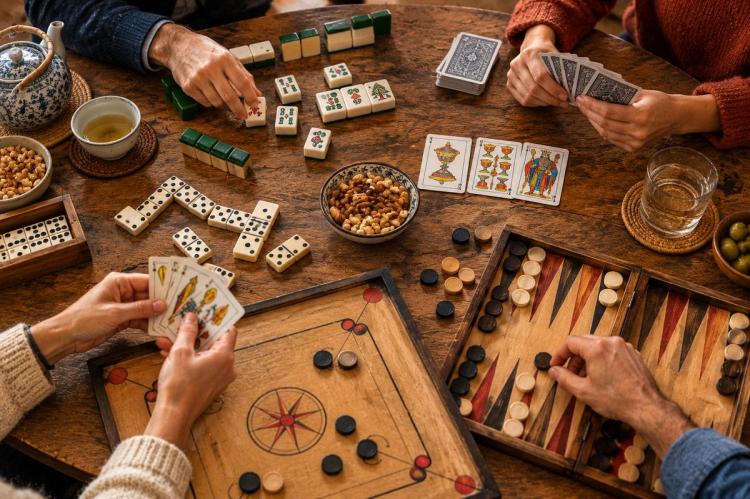
The interesting part is that the game itself is rarely the point. What a tabletop game really provides is a shape for the evening: a fixed number of seats, a turn order, and a good reason to stay in one place for two hours. Conversation happens in the gaps between turns rather than in place of the activity, which suits people who find an unstructured evening harder work than a structured one.
Almost every country has arrived at its own version of this. The games differ; the social architecture underneath them is remarkably consistent.
Why the table matters more than the game
A few features turn up again and again in the games that have lasted.
Four seats. Mahjong, dominoes in the Caribbean, most partnership card games and yut nori all seat four, usually in two pairs. Four is large enough for banter and small enough that nobody drifts out of the conversation.
Very little kit. A set of tiles, a folding board or a pack of cards travels easily and costs little to keep. Games that require a dedicated table and a large outlay rarely become everyday habits.
Turns that leave room for talk. The most sociable games involve short individual turns and long stretches of watching. That rhythm produces conversation naturally, rather than demanding it.
Repetition. The strongest tradition in each country is not a game but a standing appointment — the Wednesday club, the Friday corner, the game that only appears at Lunar New Year. Ritual removes the need to organise anything.
A teacher at the table. These games are almost never learned from a rulebook. Someone who already knows how to play sits in, calls the disputes and explains the scoring. That transmission from player to player is what keeps regional variants alive.
United Kingdom: pub games and the café revival
The British tabletop tradition grew up in public rather than at home. Cribbage, dominoes and card schools have been fixtures of pub back rooms for generations, played by regulars in the same seats each week.
The modern version of that habit is the board game café, which arrived in Oxford in 2013 and London in 2014 and has since spread to most large towns and university cities, alongside a substantial annual games convention in Birmingham. The format solves a practical problem: it supplies the table, the shelf of games and a person who can explain the rules, which removes the two barriers that usually stop a group playing anything new.
Britain also has a longer relationship with mahjong than most people assume — an English-language rule set was published here in the 1920s and became the basis for the version played across much of the Commonwealth.
Germany: the Eurogame tradition
Germany treats board games as a mainstream household product rather than a hobbyist niche. An annual game-of-the-year award, running since the late 1970s, reliably turns its winner into a supermarket item, and the trade fair at Essen is the largest event of its kind anywhere.
The design tradition that grew from this — often called the Eurogame — is deliberately sociable. Player elimination is rare, turns are short, and scores tend to stay close until the end, so nobody spends the last half hour watching. Catan, the best-known example, was designed with exactly that in mind.
Spain: parchís, dominó and mus
Parchís is the family game — a race board descended, by a long route, from Indian pachisi, and a fixture of holidays and long afternoons with several generations round the table.
The more revealing game is mus, a partnership card game built on bluffing, in which partners are permitted to signal to each other across the table by facial gesture. Play involves an entire vocabulary of small movements, plus the constant possibility that the other pair has spotted them. It is a game that only works among people who know each other well, which is precisely why it has lasted in bars and social clubs.
Italy: scopa, briscola and tombola
Italian card games belong to the bar as much as the home. Scopa and briscola are played with regional forty-card decks whose suits and artwork change from one part of the country to another, and games are short — a round lasts minutes, so a table can form and dissolve around a coffee.
Tombola, the Neapolitan ancestor of bingo, does the opposite job. It appears at Christmas, seats an entire extended family including small children, and is designed so that skill plays no part at all.
France: belote and tarot
Belote is the everyday French card game: four players in two partnerships, bidding and taking tricks, played in homes, cafés and clubs. French tarot, played with a larger deck and generally by four or five, is the more demanding relative and has an active club and tournament scene. Both share the partnership structure that makes a game feel like a shared project rather than a fight.
Turkey and Greece: backgammon
In Turkish tea houses and Greek kafeneía, backgammon — tavla, or távli — is played fast, loudly and in public. Dice are thrown and counters moved almost in one motion, matches run to several games, and spectators are part of the event rather than an audience for it.
The Greek version is usually played as a sequence of three different games on the same board, so a match has an internal arc. In both countries the game functions as a reason to occupy a table for an hour or two, which is largely the point.
China: mahjong
Mahjong is the archetype of the sociable tile game: four players, a wall of tiles, and a shuffling sound at the start of each hand that is half the experience. Hands are quick, the table talks constantly, and the game is closely tied to family gatherings and festivals, particularly Lunar New Year.
Regional variants are numerous — Hong Kong style is the most widely played worldwide — and the differences between them are usually settled at the table before play begins rather than looked up.
Japan: riichi mahjong, go and shogi
Japan's mahjong variant, riichi, went in the opposite direction from most: it was formalised into a tightly structured game with elaborate scoring and a signature declaration that commits a player to their hand. That structure makes it unusually good to watch, and it has built a large following through streams and online play, which then spills back into real-world clubs.
Go and shogi are the two-player counterweight — quiet, deeply studied, with a strong club and teaching culture. Hanafuda, the small floral card deck, remains the family game of the new year.
Korea: yut nori and baduk
Yut nori appears at Seollal, the lunar new year, and is the most inclusive game on this list. Two teams throw four wooden sticks instead of dice, move markers round a board, and knock each other back to the start. Children and grandparents play on equal terms, and the noise level is a feature.
Alongside it sits baduk, the Korean form of go, which has a professional scene and a serious teaching tradition — the same country holding both extremes of the tabletop spectrum.
India and Nepal: carrom and bagh-chal
Carrom is played on a square wooden board with pocketed corners, flicking small discs with a striker. It is a genuine skill game, recognised in India as a sport with federations and national championships, and simultaneously the game on the verandah at every family gathering. Boards are exported worldwide, and clubs exist across the UK.
Pachisi, the cross-and-circle race game, is the ancestor of Ludo and of half the family board games in Europe. In Nepal, bagh-chal — tigers against goats, with unequal sides and unequal aims — packs an asymmetric strategy game into a board that can be scratched into a step.
Cuba and the Dominican Republic: dominoes
Caribbean dominoes is the loudest entry here and probably the most social. Cuban play typically uses a double-nine set and pairs partners opposite each other; games form on street corners, in parks and outside shops, tiles are put down hard, and music runs underneath.
What is striking about the tradition is who plays. A domino table at the end of the working week mixes trades, ages and incomes with very little ceremony — the game supplies a common language that ordinary social life does not.
Canada: crokinole
Crokinole is a nineteenth-century Canadian invention: a round board on which players flick wooden discs towards a central hole, with the complication that each shot must strike the opponent's last disc. It came out of a farmhouse tradition where more elaborate games were frowned upon, and it has survived because a round takes minutes, spectators can follow it instantly, and skill is visible without being explained.
It has recently found a second home in board game cafés, where it is one of the few games that draws a crowd of onlookers.
United States: American mahjong and the party game
American mahjong evolved into something distinct from every other variant: tiles sit on racks, jokers act as wildcards, and the valid hands are set out on a card issued annually, so the game changes shape every year. It was sustained for decades by women's clubs, and it is at the centre of the current revival — one that has been as much about the objects as the play, with modern sets treated as furnishings and the game itself becoming a recognisable dinner party theme.
The other American contribution is the party and social deduction game — hidden roles, bluffing, large groups — designed for rooms rather than tables, and for gatherings where not everyone wants to concentrate.
What travels well to a table at home
The tradition that adapts most easily is the one with the fewest moving parts. A few things that the successful versions have in common:
- One game per evening rather than a stack of options. Learning two sets of rules in a night rarely works.
- Four seats, or two tables of four. Six people round one board tends to produce two conversations and one bored player.
- Someone at the table who already knows how to play, and the authority to settle disputes.
- Agreement on the variant before the first hand — the difference between Hong Kong, riichi and American mahjong is not a detail.
- Food that survives the presence of tiles: small plates kept off the playing surface, and nothing that needs cutting.
- A finish time. A standing monthly game that ends when agreed is easier to keep going than an open-ended one.
The rest is repetition. Almost every tradition described here comes down to the same group returning to the same table, which is a low bar for something that has kept people company for a century or more.