The Pantheon in Rome, Work of Genius
Few ancient buildings have come through the centuries as well as the Pantheon. Nothing of comparable age, size and span survives intact anywhere, and that is no accident but the result of exceptional engineering.
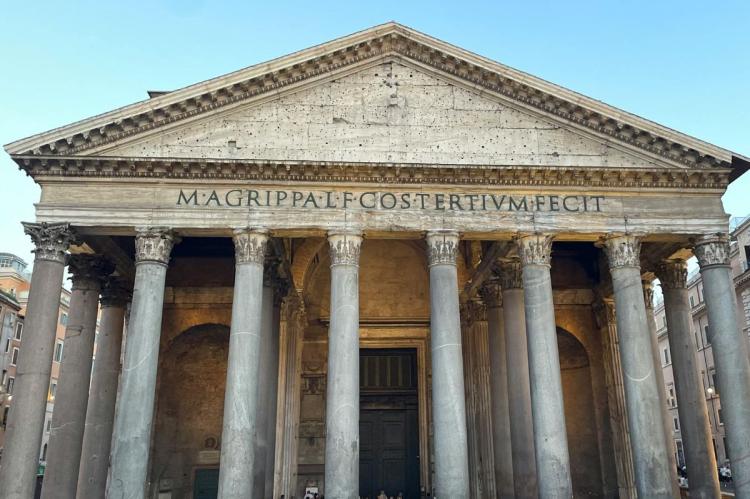
The inscription across the portico credits Marcus Agrippa, who built the first Pantheon on the site in 27 BC. That building burned, and so did its replacement. What stands today is Hadrian's, dated by the stamps on its bricks to somewhere between 115 and 127. Hadrian kept Agrippa's name on the front, which has confused visitors ever since. No ancient source records who designed it.
The plan is simple: a rectangular portico attached by a short block to a circular hall. Sixteen Corinthian columns carry the portico, eight across the front and two rows of four behind, each a single shaft of Egyptian granite some 11.8 metres — about 39 feet — high and weighing around sixty tonnes. They were quarried in Egypt, shipped across the Mediterranean to Ostia and hauled up the Tiber to the site.
Within that plain outline sits the invention. The rotunda is 43.3 metres across and exactly 43.3 metres from floor to oculus, so a perfect sphere would fit inside it. The dome above is still the largest unreinforced concrete dome anyone has built, and it was the largest dome of any kind in the world until Brunelleschi finished Florence cathedral in 1436.
It holds up through a series of decisions, each sensible on its own and remarkable in combination. The concrete changes as it rises: heavy travertine and basalt in the aggregate at the base, tufa and broken brick in the middle, and volcanic pumice near the crown — stone light enough to float. That grading alone takes roughly a third off the weight. The shell tapers too, from about 6.4 metres thick at the base to 1.2 metres at the top.
The coffers do the same work again. There are 140 of them, five rings of twenty-eight, each a recess that removes concrete from where it is not needed while drawing the eye upward. Below, the drum hides relieving arches that channel the dome's outward thrust into eight massive piers, and the stepped rings visible on the outside act like hoops around a barrel.
Then there is the oculus. The opening at the apex is about 8.8 metres across and does three things at once: it removes weight from the point where weight matters most, it forms a compression ring that spreads stress evenly around its circumference — the reason a bicycle wheel is so hard to crush — and it lights the whole interior. Rain comes in as well. The floor is very slightly domed and pierced with drainage holes, so the water runs away.
None of this required modern tools, but it did require machinery. Roman builders had treadwheel cranes, block and tackle, and a timber centring vast enough to shape the dome while the concrete cured. Nearly two thousand years later the structure stands without ever having needed major reinforcement, on ground that is far from ideal — a point worth weighing against the decades of work spent stabilising the tower at Pisa.
The Parthenon in Athens is often set against it, but the comparison is unfair. That building stood largely intact for more than two thousand years and was wrecked in a single afternoon in 1687, when a Venetian shell found the gunpowder the Ottoman garrison had stored inside it.
The Pantheon's own survival owes something to a change of use. Boniface IV consecrated it as a church in 609, dedicated to St Mary and the Martyrs, and it has been in use ever since — one of the few Roman buildings never abandoned.
That did not save its metalwork. Constans II stripped the gilded bronze tiles from the roof in 663, and in 1626 Urban VIII had the bronze beams of the portico melted down for cannon and for Bernini's baldachin in St Peter's, prompting the Roman remark that what the barbarians had not done, the Barberini did. Bernini's twin bell towers, mocked as the ass's ears, came down in 1883.
Inside are tombs as well as altars. Raphael is buried here, at his own request, along with the first two kings of a united Italy, Vittorio Emanuele II and Umberto I. It remains a working church, with Mass celebrated regularly. On 21 April, Rome's traditional birthday, the noon sunbeam from the oculus falls across the doorway; at Pentecost, rose petals are dropped through it onto the congregation.
The building has been copied more than most — the Reading Room of the British Museum, and Jefferson's Rotunda at the University of Virginia among the better attempts. Entry to the original, free for centuries, has required a ticket since 2023: €7 since 1 July 2026, with under-18s, residents of Rome and the first Sunday of each month admitted free.