Before opening the tin
The surfaces are assumed to be clean, filled and sanded, as described under preparing walls and woodwork for painting. Paint is stirred thoroughly, since pigment settles. The room should be ventilated, and neither cold nor very hot: most tins give a minimum temperature for application, commonly about 10 degrees Celsius.
Cutting in
A roller cannot reach into corners or up to an edge. The margins of each surface — along the ceiling line, round door frames, sockets and skirting boards — are painted first with a brush in a band a few centimetres wide. This is called cutting in. It is done one wall at a time, immediately before that wall is rolled, so that the brushed band is still wet when the roller meets it.
Ceilings
The ceiling comes first. A roller on an extension pole allows the work to be done from the floor, which is safer than a stepladder and gives a better view of what has been covered. The usual method is to start at the window wall and work away from the light in overlapping strips about a metre wide, without stopping in the middle of the ceiling. Eye protection keeps spatter out of the eyes.
Walls
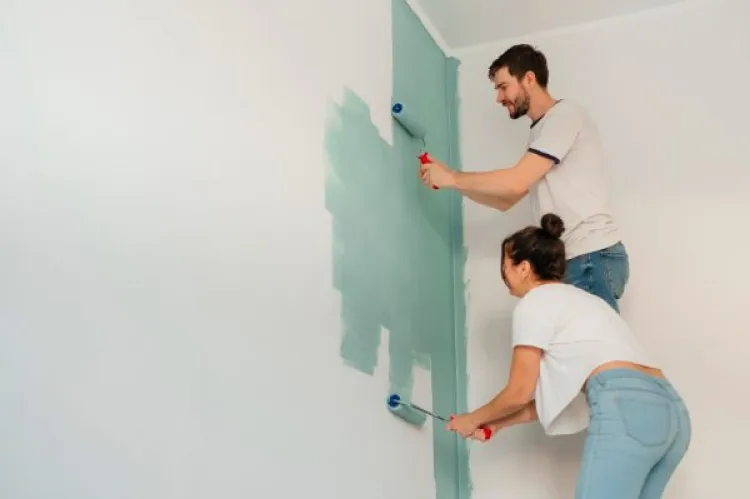
Paint is loaded onto the roller from the ribbed part of the tray so that the sleeve is evenly coated but not dripping. It is applied in a zigzag over an area of about a square metre, spread out with crossing strokes, and finished with light strokes in one direction. The next area overlaps the wet edge of the last.
Stopping halfway across a wall leaves a visible join; a break is taken at a corner. Two coats are normal, and the second is not applied until the first has dried for the time stated on the tin — a few hours for emulsion.
Woodwork
Woodwork is painted last. The paint is brushed out along the grain and then laid off: drawn over once more, lightly, with the tips of the bristles, to smooth out brush marks.
- Panelled doors are painted in a fixed order: the panels and their mouldings first, then the horizontal rails, then the vertical stiles, and finally the edges. Flush doors are painted in sections from the top.
- Windows are painted early in the day, so that they can be closed by night. The paint is carried a millimetre or two onto the glass to seal the joint with the putty.
- Skirting boards come last, with a piece of card or a wide filling knife held against the floor.
- Radiators are painted cold, and left to dry before the heating is turned on.
Between coats
A brush or roller in use need not be washed between coats. Wrapped tightly in cling film or a plastic bag, it stays usable overnight.
Drying and hardening
Paint that is dry to the touch has not finished hardening. Water-based finishes on woodwork in particular take some weeks to reach full strength, and in that time shelves and windowsills are better left clear and doors not forced shut against fresh paint.
Clearing up
- Masking tape is removed while the final coat is still slightly soft.
- Excess paint is scraped from brushes and rollers back into the tin, and wiped onto newspaper, before washing.
- Water-based paint is washed out with water and a little detergent.
- Solvent-based paint is cleaned out with white spirit or a brush cleaner. Used white spirit is not poured down a drain: left to stand in a sealed jar, the paint settles and the clear liquid can be poured off and used again.
- The lid is hammered down firmly on any paint kept for touching up, and the tin labelled with the room and the date and kept somewhere free of frost.
What to do with paint that will not be used again is set out under lead paint, asbestos and paint disposal.