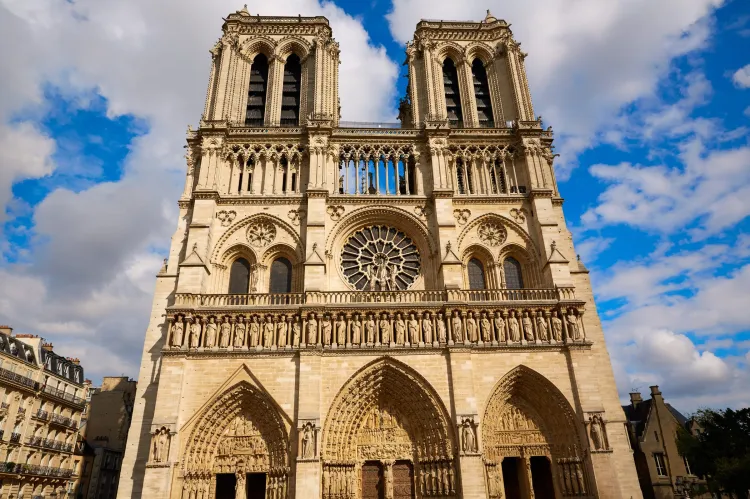
Getting in
- Entry to the cathedral is free and always has been. A slot can be reserved at no charge through the cathedral's own site or its visitor app, released seventy-two hours ahead. Reservation was compulsory in the first weeks after the reopening and is not compulsory now; those without one join the queue outside, which generally moves in a quarter of an hour even on a busy day.
- The nearest station is Cité, on line 4, which is on the island itself, or Saint-Michel–Notre-Dame on the suburban lines a few steps away. Older accounts offer Châtelet–Les Halles, which is a major interchange on the other bank and a good deal further than it sounds.
- The treasury is charged, and tickets for it are sold only on the spot.
- Hours are long — early morning to evening, later on Thursdays — but they have been adjusted more than once since the reopening and are worth checking on the day.
- It is busier than it was before the fire. Around eleven million people came in the first year, roughly a third more than in the years before 2019. Early morning is the only reliably quiet part of the day.
The towers, and a climb that has changed completely
The towers reopened on 20 September 2025, during the European Heritage Days, and they are run not by the cathedral but by the Centre des monuments nationaux. That matters practically: booking online is compulsory and there are no tickets on the door.
The visit takes about fifty minutes and runs to 424 steps. Older accounts give 387, which was the old south-tower stairway before the fire. More importantly, the route is now a one-way circuit: up through the south tower, past an introductory room and two of the original chimeras that survived the fire, past a room given over to the sound of the bells, out onto a terrace at sixty-nine metres with the rebuilt spire in full view, then past the great bells, across the cour des citernes looking onto the new roof frame, and down the north tower.
So the warning in older accounts — that there is no guard rail and that people climbing and descending have to pass each other on the stairs, with those coming down clinging to the wall — no longer describes anything. What is still true is that the passages are narrow, about forty-five centimetres in places, and low; there is no lift, no water and no lavatory on the route; and it is unsuitable for anyone with reduced mobility, a heart condition or a fear of heights, and for children under six.
The spire itself cannot be climbed, but it is seen at close range from the south terrace, with orientation tables.
Admission to the towers is charged, with free entry for under-eighteens and for eighteen- to twenty-five-year-olds resident in the European Union, and on the first Sunday of the month from November to March. That last point has shifted for British visitors since 2021: the under-twenty-six exemption is tied to EU residence, so it no longer applies to them.
What was lost, and what was decided
The fire of 15 April 2019 destroyed the roof and brought down the spire. One thing worth knowing before looking at the rebuilt one: the spire that fell was not medieval. It was designed by Eugène Viollet-le-Duc and raised in 1859, replacing a medieval spire taken down in the eighteenth century.
Its replacement was genuinely in doubt. An international competition was announced within two days of the fire, and the entries included spires of steel and glass. The competition was abandoned in July 2020, when the decision was taken to rebuild Viollet-le-Duc's design exactly, on the recommendation of the national heritage commission. The new gilded cockerel went up on 16 December 2023, and the finished spire was revealed on 13 February 2024 when the scaffolding came down.
Inside, almost everything a visitor stands among is new. The altar, tabernacle, cathedra, ambo and baptistery are by Guillaume Bardet, all in dark bronze, chosen in 2023; the fifteen hundred oak chairs are by Ionna Vautrin; the reliquary for the Crown of Thorns is by Sylvain Dubuisson; and the vestments worn at the reopening were designed by Jean-Charles de Castelbajac.
The bells, and the organ
The great bell older accounts invoke through Quasimodo is real and is named Emmanuel. It was cast in 1686 under Louis XIV, weighs about thirteen tonnes, hangs in the south tower, and is the oldest bell in the building. It is not alone: a second bourdon, Marie, of about six tonnes, was cast in the Netherlands in 2012, and eight bells were cast in Normandy and hung in the north tower in 2013 for the cathedral's eight hundred and fiftieth anniversary. The eight were returned to the belfry in September 2024, and all of them rang together again on 8 November 2024, a month before the doors opened.
The organ's survival is the part of the story least often told. It did not burn. What happened was worse in a quieter way: the collapsing lead roof filled its pipes and the spaces between its keys with dust that was harmless to the mechanism and poisonous to people. More than thirty craftsmen took the instrument apart, cleaned and decontaminated every component and rebuilt it. Retuning alone took about six months, with one team working by day and another by night because the building was too noisy otherwise. It has about eight thousand pipes, and it was blessed and played at the reopening ceremony — the first time anyone had heard it since the fire.
The twenty-eight kings
Older accounts describe the twenty-eight figures across the west front as religious figures from throughout history. They are the kings of Judah, the royal ancestors of Christ, and the gallery is named after them.
Their history is the better story. On 23 October 1793 revolutionaries pulled them down and mutilated them, having taken them for kings of France. The statues now in place are Viollet-le-Duc's replacements. And in 1977, during excavation in the basement of a bank in the ninth arrondissement, twenty-one of the twenty-eight original heads were found — bought in 1796 and buried in the building's foundations. They are now on show at the Musée de Cluny. Seven are still missing.
The nineteenth-century rebuilding, and one thing that never happened
The cathedral came close to demolition. It had decayed badly, and Victor Hugo's novel of 1831 was written partly to argue for it — a campaign that worked. The restoration that followed ran from 1844 to 1864, which is twenty years rather than the twenty-three older accounts give, and it was carried out by Jean-Baptiste-Antoine Lassus and Eugène Viollet-le-Duc, who won the commission jointly. Lassus died in 1857 and Viollet-le-Duc finished alone. Neither is named in older accounts, which is a strange omission given that one of them designed the spire that burned.
Older accounts also invite the visitor to picture, inside the cathedral, the killing of a medieval bishop. No such thing happened here. Three archbishops of Paris were killed, and all three in the nineteenth century and elsewhere: one at the barricades in 1848, one stabbed in another church in 1857, and one shot by the Commune in a prison in 1871. The image almost certainly comes from Hugo's novel, in which the archdeacon is thrown from a tower — a plot, not a record.
Still a building site, in places
The cathedral is finished; its setting is not, and nor is one part of the interior.
- Six chapels along the south side of the nave have been scaffolded since April 2026 for the new windows described below.
- The archaeological crypt under the square has been closed since June 2026 so that its finds can be conserved, with no reopening announced. Its displays on the history of the city have moved to the Musée Carnavalet in the meantime.
- The surroundings are being rebuilt in sectors until 2030. The street along the north side was finished in the summer of 2026; the quay on the south side is closed until the middle of 2027; the main square in front will be dug up from the summer of 2027 to the end of 2028, once the cathedral's own works compounds are finally removed; and the gardens behind follow in 2029 and 2030. The approach will therefore be awkward for several more years, and worth looking up before planning photographs.
The new windows, which are not settled
This is the live argument about the building, and it is worth understanding before visiting, because the chapels concerned are boarded.
Six windows about seven metres high, on the theme of Pentecost, have been commissioned from the painter Claire Tabouret and made by the Atelier Simon-Marq in Reims, for the six chapels of the south aisle. The objection is not to her work. It is that the windows being removed — grisaille glass of 1864, made by Alfred Gérente to Viollet-le-Duc's own design — came through the fire undamaged and were then restored. The matching windows on the north side are to stay, so the two sides will no longer agree.
The national heritage commission gave a negative opinion in July 2024. Two heritage associations have gone to court, and a petition against the scheme has passed three hundred and forty thousand signatures. The archbishop approved it. In May 2026 the Paris administrative tribunal refused to suspend the permit, on the ground that the work is reversible, and the main case has still not been heard. Installation was scheduled for the autumn of 2026 with an unveiling in December. Whether the glass is in by the time anyone reads this is therefore an open question, and the honest answer is that it should be checked.
Some figures worth having straight
Older accounts say the interior seats six thousand. It holds up to nine thousand people, of whom roughly fifteen hundred are seated — so the claim is wrong in both directions at once. The nave is sixty metres long, thirteen wide and forty-three high, over an interior of about four thousand eight hundred square metres.
And the cathedral is not itself a World Heritage Site. It is one component of Paris, Banks of the Seine, inscribed in 1991, which runs along the river between the Pont de Sully and the Pont d'Iéna and takes in both islands.