What the collection actually is
Older accounts say that estimates run as high as a hundred thousand pieces but that in truth nobody could know. Both halves of that are now wrong. The museum states that it has nearly five hundred thousand works in its care, of which about thirty thousand are on display across roughly seventy thousand square metres of rooms, in nine curatorial departments.
And it can be known, because the Louvre published the catalogue. An online database of the collections opened in March 2021 with more than four hundred and eighty thousand entries, covering works on show, works on loan and works in store, together with the Musée National Eugène-Delacroix and the sculpture in the Tuileries and Carrousel gardens. Anything in the building can be looked up before arriving.
So the old observation that most of the collection is in storage at any one time is right, and understated — but the storage is not where it was. A purpose-built conservation centre at Liévin, in the Pas-de-Calais, opened in October 2019 and now holds something close to a quarter of a million works, replacing reserves that had been scattered across more than sixty places, including flood-prone basements beside the Seine. The state auditor has since reported that parts of Liévin are already full and that an extension has been started, so the reserves are now split between there and the palace rather than consolidated.
Three pictures older accounts put here that are somewhere else
This is worth stating plainly, because a visitor can spend an afternoon looking for them.
- Vermeer's The Geographer is in Frankfurt, at the Städel Museum, which bought it in 1885. The Louvre's two Vermeers are The Lacemaker and The Astronomer — and The Astronomer is the companion piece to the Frankfurt picture, which is almost certainly how the error was made in the first place.
- David's The Death of Marat is in Brussels, at the Royal Museums of Fine Arts of Belgium, which have owned it since 1893. Studio replicas hang at Reims, Dijon and Versailles. There is no version in the Louvre.
- "Ingres' The Bather" needs naming. Ingres painted bathers repeatedly and they are spread across several museums. The one here is the Valpinçon Bather of 1808, and the Louvre also has Le Bain turc.
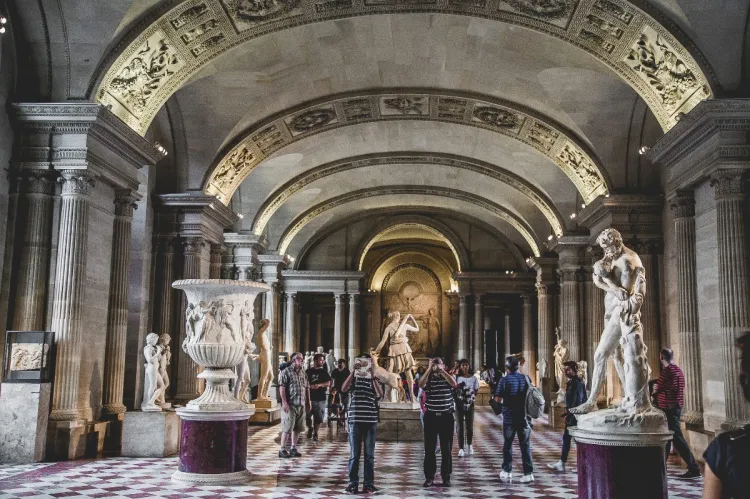
What is certainly here, with the rooms the museum's own plan gives: the Mona Lisa in the Salle des États, room 711, Denon wing; the Winged Victory of Samothrace at the head of its staircase, room 703, Denon; the Venus de Milo in room 346, Sully, on the ground floor; and Delacroix's Liberty Leading the People in room 700, Denon.
The Galerie d'Apollon, and what is no longer in it
On the morning of 19 October 2025, about half an hour after opening, thieves reached the Galerie d'Apollon from outside the building and were gone inside four minutes. They took eight pieces of the French Crown Jewels: the sapphire parure of Queens Marie-Amélie and Hortense, the emerald necklace and earrings of the Empress Marie-Louise, and three pieces belonging to the Empress Eugénie. Empress Eugénie's crown was dropped during the escape and recovered badly damaged. The Regent, Sancy and Hortensia diamonds were not taken. None of the eight pieces has been recovered.
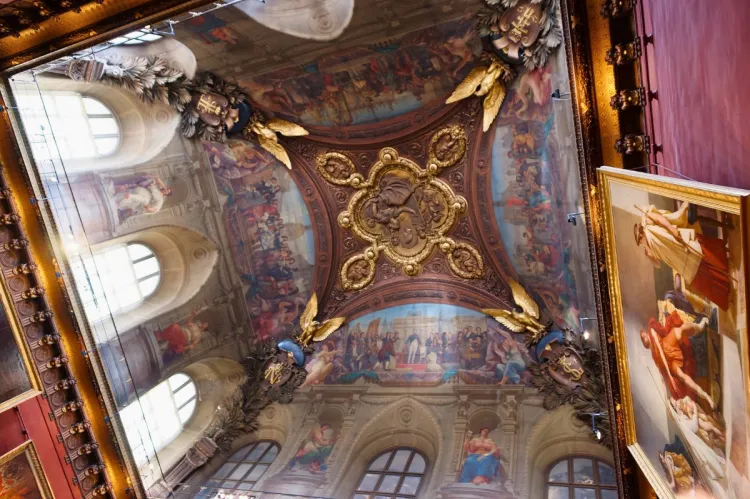
The museum shut that day and reopened on 22 October 2025. The gallery itself stayed closed for nine months and reopened on 22 July 2026 emptied of jewels: every object and every case was removed. What a visitor sees now is the room — the gilded walls, the tapestries, the sculpture, and above all the painted ceiling, with Delacroix's Apollo Slaying the Serpent Python at its centre. It is a strange and rather beautiful thing to stand in a treasury with the treasure taken out, and the ceiling is the reason to go in.
The surviving crown jewels are to be moved to a new, windowless, higher-security gallery elsewhere in the building. No opening date has been announced, and some pieces went to the Banque de France in the meantime. The subsequent reckoning was severe: only two rooms in five were covered by closed-circuit television, and the museum's president-director, Laurence des Cars, offered to resign on the day of the theft, was refused, and left when her resignation was accepted in February 2026.
The building, and the pyramid
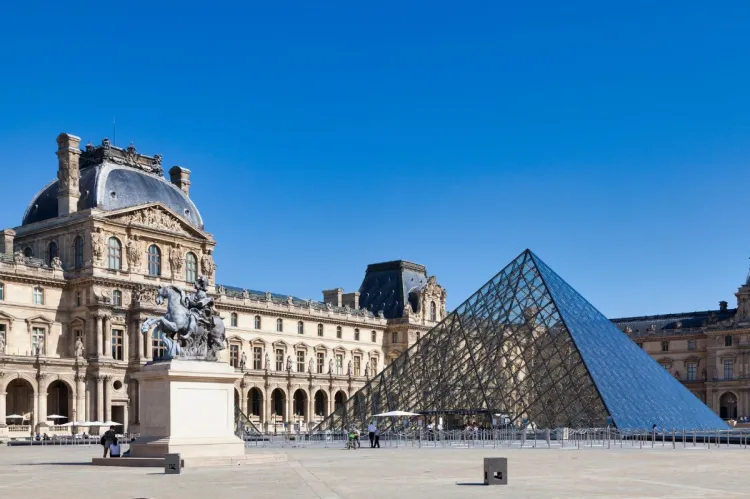
There was a fortress here from the end of the twelfth century; its base can still be walked round in the basement. The palace as it now stands was begun in 1546, and then extended by almost every regime that followed, which is why it has no single style.
It became a public museum on 10 August 1793, during the Revolution, under the name Muséum central des arts, with the first displays in the Salon Carré and the Grande Galerie.
The glass pyramid is by Ieoh Ming Pei, appointed in 1983 as part of Mitterrand's Grand Louvre scheme, and inaugurated on 29 March 1989. Twenty-one metres high on a thirty-five metre base. The museum calls it simply the Pyramid; "Crystal Pyramid" is not a name it has ever had, and it is glass rather than crystal. Whether it belongs there is a matter of taste and not of fact, and older accounts that call it grotesque are stating a preference as though it were a finding.
One building that older accounts include is not there at all. The Tuileries Palace, which closed the western end of the complex, was burned during the suppression of the Commune in May 1871 and demolished in 1883. Nothing of it stands, and its absence is what opens the long view west from the Carrousel arch. The Jardin des Tuileries beyond is a public garden outside the museum, not a wing of it — though its sculpture is curated by the Louvre. The museum's three wings are Richelieu to the north, Sully around the Cour Carrée, and Denon along the river.
The rebuild, and the crowding behind it
Around nine million people a year now enter through a pyramid designed for fewer than half that. In 2025 the consequences surfaced twice. A memorandum from the museum's director leaked, warning that parts of the building were no longer watertight and that swings in temperature were endangering the works. And on 16 June 2025 the Louvre simply did not open, when attendants, ticket staff and security refused to take their posts over crowding, understaffing and summer heat under the glass. It was not a called strike; the staff stopped.
The response, announced in January 2025, is a decade-long scheme. A new main entrance on the Perrault Colonnade, the eastern front, to take pressure off the pyramid. A dedicated space for the Mona Lisa beneath the Cour Carrée, reached separately and with its own ticket. New temporary exhibition space, and somewhere for visitors to sit. Architects were chosen in May 2026, and the work is to be finished by 2031 at the latest. The state auditor has examined the budget and said the published figure is an underestimate, and that the project began without feasibility or visitor-flow studies.
Getting in
- The station is Palais-Royal–Musée du Louvre, on lines 1 and 7, or Pyramides on line 14. Older accounts also offer Louvre–Rivoli, which is the wrong station: it is one stop east, by the colonnade, and has no entrance to the museum — anyone leaving the train there faces a long walk round. That may change eventually, since the new entrance is to be built on exactly that side, but not for years.
- There are four ways in: the Pyramid, the Carrousel, Richelieu for groups and members, and the Porte des Lions.
- A timed slot is strongly advisable, including for those entering free. The museum's own wording has moved between "recommended" and "required" more than once, and booking has been compulsory for stretches of 2026, so it is worth checking on the day rather than trusting any description of the rule. A slot is required for temporary exhibitions in the Hall Napoléon. Entry is capped at thirty thousand a day.
- Closed on Tuesdays. Free on the first Friday evening of the month except in July and August, and on 14 July unless that falls on a Tuesday — but the free evenings still need a booked slot, and they are heavily taken.
- The point that matters most to British visitors is new. Since January 2026 the Louvre has charged two different admission rates, a lower one for residents of the European Economic Area and a higher one for everyone else. Free entry for under-twenty-sixes is likewise limited to EEA residents. British visitors now fall on the more expensive side of both rules, which was not the case before 2021 and is not what older accounts describe.
- Some rooms close on weekdays by rotation while the works go on — Roman antiquities in Denon and the Islamic art rooms among them recently. The museum publishes a closure schedule, and it is worth a look before setting out for one particular thing.
A last word on strategy, since older accounts advise picking a few favourite periods and sticking to them. That is still the only sane approach, and the online catalogue has made it much easier to do in advance: three or four works located by room number, and then whatever is encountered between them.