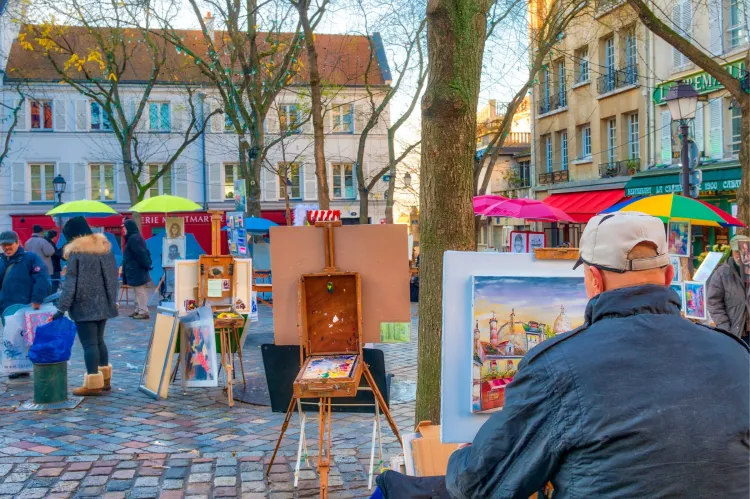
Getting up the hill
- Abbesses, on line 12, is the closest station to the Butte and the one guided visits use.
- Anvers, on line 2, is the station for Sacré-Cœur and for the funicular, whose lower station was deliberately built near it.
- Pigalle serves lines 2 and 12; Lamarck–Caulaincourt, on line 12, is the way to the quieter northern slope.
- Older accounts recommend Château-Rouge, which is on line 4 as they say but lies east of the hill and makes for a longer and duller walk. They also imply Blanche is on line 4; it is on line 2.
- Buses 30, 31, 80 and 85 serve the area, and a small electric shuttle, the Montmartrobus, works its way round the top.
- The funicular runs from early morning to a quarter to one at night, every day of the year, and takes any ordinary Métro ticket or pass — no special fare. It had a regulatory overhaul through the first half of 2026, during which it ran on one cabin, and it takes occasional single days out for maintenance.
On accessibility, the honest answer is discouraging. Only a handful of Paris Métro stations are wheelchair-accessible and they are all on line 14, so none of the stations above qualify — the lift at Abbesses serves the depth of the station, not step-free access to the street. The funicular gives level boarding, which helps, but the streets at the top are steep, cobbled and uneven, and the basilica's own visit service asks anyone with reduced mobility to contact it in advance so the route can be adapted. Anyone planning on that basis should ring ahead rather than rely on a description.
Abbesses, and a canopy that was moved here
Older accounts rightly send visitors to admire the Art Nouveau entrance at Abbesses. Two things make it better than they say.
It is by Hector Guimard — and it was not built for this station. It stood at Hôtel de Ville and was brought here in 1974. It is one of only two surviving glass-roofed Guimard entrances on the whole network; the other is at Porte Dauphine, and the one at Châtelet is a replica.
The station is also thirty-six metres down, and was for many years the deepest on the Métro — overtaken only in 2025. The spiral stairwell is painted with murals the whole way, which is worth the climb down, and there is a lift for those who would rather not.
Saint-Jean-de-Montmartre, which deserves more than its mosaics
Older accounts name this church wrongly and praise the wrong thing about it. It is Saint-Jean-de-Montmartre, on the place des Abbesses, and the mosaics around the door are the least of it.
It was built from 1894 to 1904 by Anatole de Baudot, a pupil of Viollet-le-Duc, using a reinforced-cement system patented by the engineer Paul Cottancin in 1892 — and it is generally reckoned the first religious building in France constructed of reinforced concrete. The nave is roofed with thin ribbed domes that would have been impossible in masonry. From outside it reads as brick and Art Nouveau tilework; the structure underneath is doing something no church had done before. It was classified as a historic monument in 2014.
The martyrium, and two things older accounts get wrong
On the rue Yvonne-Le-Tac is the Crypte du Martyrium de Saint-Denis — older accounts misspell the name and then make two mistakes about it.
Saint Denis is not buried there. The site marks where tradition places his beheading, not his grave. A vault found by workmen in 1611 was taken for his tomb and turned out to be a disused quarry. His burial is traditionally at Saint-Denis, north of Paris, which is why the royal basilica stands over it.
And the Jesuit connection is real but mangled. On the morning of 15 August 1534, Ignatius of Loyola — spelt thus — together with Francis Xavier, Pierre Favre and four other companions from the University of Paris, took vows of poverty and chastity here and promised a pilgrimage to Jerusalem, at a Mass said by Favre, the only priest among them. That is the origin of the Society of Jesus, formally recognised six years later. The crypt as it stands was built in the 1880s. It opens on Friday afternoons only, and is worth checking before making the walk.
The vineyard, and what becomes of the wine
Four corrections, and the last of them matters most to anyone making the trip.
- It is not the only vineyard in Paris. There are something like ten, including plantings at Belleville and Bercy.
- It is not at 12 rue Cortot. The Clos Montmartre occupies the north slope, between the rue Saint-Vincent and the rue des Saules. The rue Cortot address belongs to the museum below.
- It was created by the city in 1933, which older accounts have right — though vines are recorded on this hill as far back as the tenth century, so it is a revival rather than a foundation. There are about seventeen hundred vines over a sixth of a hectare, in some thirty varieties.
- There is nothing to drink. The vineyard is closed to the public except on special openings; the grapes are pressed in the cellars of the local town hall, and the wine is sold at auction for neighbourhood causes rather than offered for sale or tasting. Older accounts promise that the wine lover will not be disappointed, which is the claim most likely to produce a disappointed wine lover.
The Musée de Montmartre, which is what is at 12 rue Cortot
The museum occupies the Maison du Bel Air, a seventeenth-century house and one of the oldest buildings on the hill, bought in 1680 by an actor from Molière's company. Renoir lived on the site in the mid-1870s, and a long list of others worked there — Émile Bernard, Dufy, Poulbot, Reverdy among them.
The thing to see is the reconstructed studio-apartment of Suzanne Valadon, which she shared from 1912 with her son Maurice Utrillo and her husband André Utter. It was rebuilt from letters and photographs and opened in 2014, and it is the only artist's studio on the Butte that can be stood in. Older accounts credit the apartments to Renoir and Utrillo without mentioning Valadon, who was the better painter of the two who lived there and the one whose room it was.
Behind it are the Renoir Gardens, three gardens planted to an Impressionist palette, which look down over the vineyard — almost certainly how the two addresses came to be confused in the first place. A gardens-only ticket exists. Closed on Tuesdays.
Dalí, and the Renoir that broke a record
The Dalí collection older accounts call the Espace Montmartre reopened in 2018 under the name Dalí Paris, on the rue Poulbot just off the place du Tertre, after a full redesign. It was founded in 1991 by a dealer who had known Dalí, and it leans to sculpture, drawings and editions rather than the famous canvases.
On the Renoir, older accounts are nearly right and worth tightening. The painting is Bal du moulin de la Galette, of 1876, and Renoir painted it on the spot, working from a studio in a cottage on the rue Cortot — so the connection to this hill is genuine. But there are two versions. The smaller one set an auction record in 1990 and went to a Japanese buyer; the larger one has been in French public hands since the 1890s and hangs in the Musée d'Orsay. It was never the one at auction.
The windmill, and Pigalle
The Moulin Rouge's sails are the thing everyone photographs, and they are not the original ones. They collapsed overnight on 24 and 25 April 2024 — a mechanical failure, nobody hurt — taking three letters off the illuminated sign with them. The cabaret never closed. New aluminium sails were in place within months but stood still, and they began turning again in July 2025, driven by a new electric motor. So the windmill is intact, lit and moving, and is a year-old replacement.
On Pigalle, older accounts issue a warning that has not been good advice for roughly twenty years. The area began changing around 2006 and is now one of the more sought-after parts of central Paris — natural wine, bakeries, small hotels, and enough gentrification that locals complain about it. The sex shops and neon do remain along the boulevard de Clichy, and the nightlife is intact: the cabarets, the music halls, the Moulin Rouge itself. It is a district with two characters rather than a place to be avoided.
The cemetery is in the west, not the east
Older accounts place Montmartre cemetery in the eastern part of the district. It is on the avenue Rachel, off the boulevard de Clichy near the Place de Clichy — the south-western corner, down in a hollow with the rue Caulaincourt viaduct running overhead on iron columns, which is the oddest thing about it. Nearest station La Fourche.
And older accounts, having sent readers to the wrong place, then describe tombs and mausoleums without naming anybody in them. Among those buried there: Berlioz, Stendhal, Nijinsky, Dalida, Léon Foucault and Feydeau, with funerary sculpture by Rodin and Bartholdi.
Two much smaller cemeteries are actually on the hill: Saint-Vincent, on the north slope, and the Cimetière du Calvaire beside Saint-Pierre, which is the highest ground in Paris and opens one day a year.
Bistro does not come from Russian
Older accounts repeat a well-travelled story: that bistro comes from the Russian for "quickly", shouted by Cossack soldiers occupying Paris in 1814. French lexicographers do not accept it, and the dating is the reason. The word is first recorded in 1884 — and then meaning the landlord, not the place — which would require it to have entered the language seventy years earlier and gone entirely unwritten through a period when slang was being collected enthusiastically. French also already had cabaret, estaminet and taverne, so there was no gap for it to fill.
The serious candidates are all domestic: from bistouille, a northern word for rough spirits or for coffee laced with brandy; from a Poitevin word for a young servant; or from bistre, for the smoke-darkened interior. None of them is settled, and "origin uncertain" is the honest answer — which is a better fact than the Cossacks, because it is true.
One deletion while on the subject of what to find here: the erotica museum that older accounts list among the attractions closed for good in November 2016 and its collection was auctioned the following day.