He did not flee in 1848
Older accounts say that Hugo left these rooms in 1848 and fled the revolution of that year. He did leave the apartment in 1848, but he did not flee it — he was elected to the Constituent Assembly of the new Republic and stayed in Paris.
What he fled came three years later. On 2 December 1851 Louis-Napoléon seized power, and Hugo — who had turned against him and been denounced for it — left France the following day on a false passport. A few months in Brussels, then Jersey, then Guernsey, where he settled at Hauteville House and stayed until the Second Empire fell in 1870. Nineteen years, most of them within sight of the English coast, and all of it voluntary in the sense that he refused the amnesty when it was offered.
It matters for reading the rooms. Les Misérables was not written here. It was finished on Guernsey, and the apartment belongs to the earlier Hugo — the playwright and poet of the July Monarchy, before the politics and the exile.
The Chinese room, which he made himself
The most surprising thing in the house is the Chinese dining room, and older accounts undersell it by saying only that it was relocated from Guernsey.
Hugo designed and carved it himself, at Hauteville House, out of panels he assembled and engraved — an entire interior made by a novelist with no training, as a decorative scheme for the house he shared his exile with. It was installed here afterwards. It is eccentric, dark, obsessive and completely unlike anything else in the building, and it tells more about him than the manuscripts do.
Hauteville House itself still stands in St Peter Port and is open to visitors, which is unusually convenient for British readers: the two halves of Hugo's domestic life can be seen on either side of the Channel.
What is in the rooms
The apartment is arranged as a progression through his life — before exile, during it, after it — and what is on show is drawings, photographs, first editions, portraits and furniture rather than a preserved interior. It is a reconstruction, not a survival: the contents were dispersed when he was proscribed, and the rooms were put back together afterwards from what could be recovered and from descriptions. Older accounts are right that the arrangement is not exactly as he left it, and that is the reason.
Two things are worth looking for. The furniture Hugo designed — he learned to work wood for the theatre and went on doing it — and his drawings, which are the real discovery of the house. He made several thousand, mostly in ink and wash with whatever was to hand, and they are strange, dark and far better than an amateur's work has any right to be. Anyone who comes for the novels leaves talking about the drawings.
There is also a painting of his funeral procession passing beneath the Arc de Triomphe. He died in 1885; his body lay in state under the arch, and something like two million people lined the route to the Panthéon. It remains the largest funeral Paris has ever held, and the picture is the best single object for conveying what he was to France.
The square, which is the other half of the visit
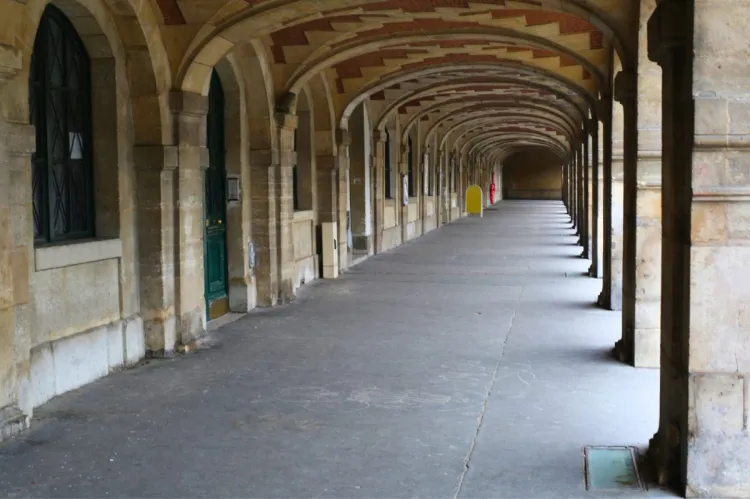
Older accounts say there are nearly forty houses on the Place des Vosges. There are thirty-six, nine to a side, built between 1605 and 1612 as the first planned square in Paris and the model for a great many that followed.
They also describe classical Greek ornamentation on the frontages, which is not what is there. The style is Louis XIII — brick and stone with steep slate roofs, arcaded at ground level and deliberately uniform, and its interest is precisely that it is not classical: it is an early experiment in making a square look like one building. Sitting under the arcades with the lime trees in the middle is the thing to do afterwards, and it is free.
Practicalities
- The permanent collection is free. Temporary exhibitions are charged.
- Closed on Mondays, open through the day otherwise.
- The garden and café added in the renovation are in the courtyard and are open to anyone.
- Métro: Chemin-Vert, Saint-Paul or Bastille, all a few minutes away.
- It is small. An hour is enough, two if the drawings take hold, and it sits well with an afternoon in the Marais around it.