Madame Tussauds is one of the very few attractions in London that is both centuries old and thoroughly of the moment. The craft behind it has barely changed since the 1790s; the faces change constantly.
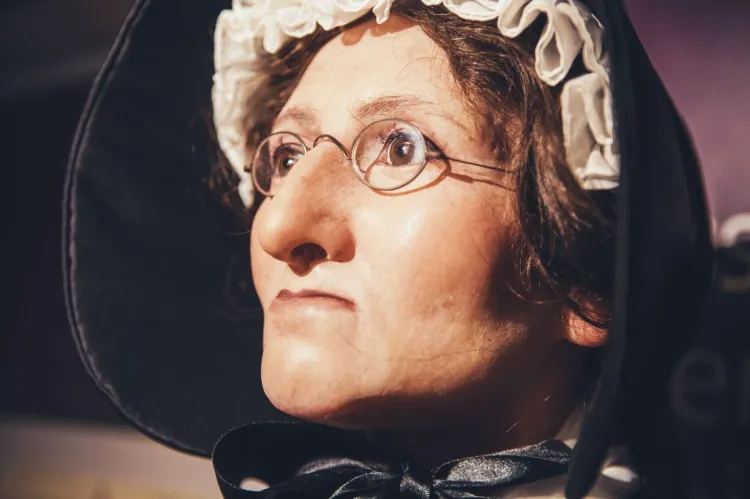
Marie Tussaud did not learn her trade at the guillotine. She was taught wax modelling as a child by Philippe Curtius, a physician turned showman in whose Paris exhibition she worked, and she was already accomplished when the Revolution came. What the Terror added was subject matter. Between 1793 and 1794 she was made to take death masks from severed heads, among them those of Louis XVI, Marie Antoinette, Robespierre and Marat.
She inherited Curtius's collection in 1794 and brought a large part of it to Britain in 1802. The Napoleonic blockade kept her from returning, so she toured the country for thirty-three years before settling the exhibition on Baker Street in 1835. It moved to the present building on Marylebone Road in 1884. That combination of exact craftsmanship and cheerful morbidity is still the character of the place, though the balance has shifted decisively towards fun.
Some of the oldest figures are still on display, alongside a section on Marie herself and on how the figures are made — a process that remains closer to eighteenth-century practice than most visitors expect. Each takes months, with hair inserted a strand at a time.
The route runs one way through eight themed zones over three floors, with more than 150 figures: film, music, sport, world leaders, the royal family, Marvel, Star Wars. Recent additions include the England captain Harry Kane and the Formula One champion Lando Norris, which gives a fair sense of how quickly the cast turns over. Visit twice a few years apart and much of it will have changed.
Two set pieces survive from the older museum. The Spirit of London puts visitors in a miniature black cab for a trip through four hundred years of the city's history, from the Great Plague and the Great Fire to the 1960s. The Chamber of Horrors deals in London's notorious crimes, Jack the Ripper among them; it closed in 2016 and reopened in October 2022, and it is recommended for older teenagers and adults rather than young children.
The Marvel Universe 4D cinema, which occupied the domed building next door, closed permanently on 15 April 2026, with no replacement announced.
What happened to the planetarium
The green dome beside the museum was the London Planetarium, opened by the Duke of Edinburgh in March 1958 on the site of a cinema destroyed in the Blitz. It seated about 330 under an 18-metre dome and ran on a Zeiss projector for its first fifty years.
It closed in 2006. Renamed the Auditorium, it showed an Aardman film about celebrities, and from 2010 the Marvel 4D film, which has now gone too. There are no longer any astronomy shows at Marylebone Road, and the building's future is undecided.
Anyone wanting a planetarium in London should head instead to the Peter Harrison Planetarium at the Royal Observatory in Greenwich, which is the only one in the city, when it opens again after renovations.
Visiting
Baker Street is the nearest Underground station, a few minutes' walk, at the edge of Regent's Park. Booking online in advance is worth doing: prices are dynamic, tickets bought on the door cost considerably more, and busy days sell out. Allow around two hours for the full route.
Queues at the entrance are usual in school holidays and through the summer, and the galleries themselves can be crowded, since the whole point is standing next to the figures rather than behind a rope. Early and late slots are quieter. The site is cashless, bags are checked on the way in, and the Spirit of London ride involves a flight of steps, so it is the one part not accessible to wheelchair users.
Changed