Limewash walls, the finish, the practicalities and the caveats
Limewash has returned as a decorating fashion, but it is a building material first. Its advantages in older British houses are structural rather than stylistic — and so are its drawbacks.
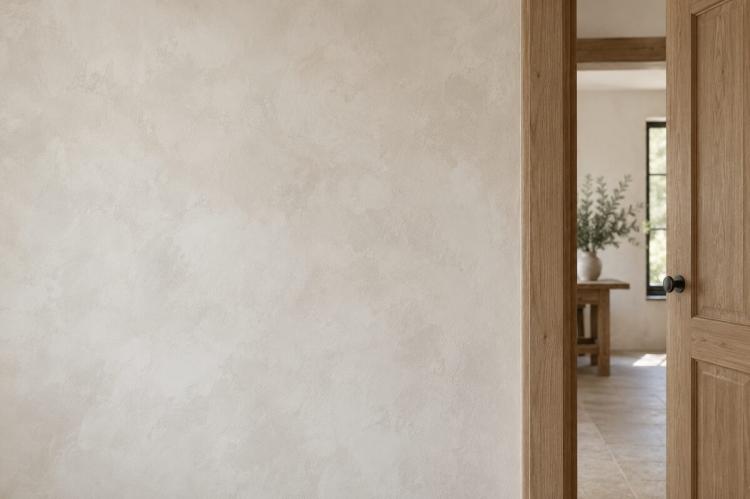
The appeal is easy to see. Where flat emulsion produces an even, inert surface, limewash produces a wall with movement — cloudy, mottled, shifting quietly as the light changes through the day. It looks aged from the moment it dries.
What most coverage of the look omits is that limewash is a traditional building material with specific behaviour, specific requirements and specific failures. In a great deal of British housing stock it is the technically correct choice. In other rooms it is a poor one, and the difference matters more than the aesthetic.
What limewash actually is
Limewash is made from slaked lime — calcium hydroxide — mixed with water and, usually, natural mineral pigments. It contains no solvents, plastics or synthetic binders.
The important distinction is how it sets. Conventional emulsion dries as a film sitting on top of the wall, sealing the surface. Limewash penetrates slightly into the substrate and then hardens by carbonation: it absorbs carbon dioxide from the air over days and weeks and gradually converts back into calcium carbonate, which is to say limestone. The wall does not have a coating on it so much as a thin mineral layer that has become part of it.
Everything else about limewash follows from that single fact — the look, the breathability, the application difficulty and the durability problem alike.
Why it looks the way it does
Because the finish is thin, translucent and applied in layers by brush, it never covers evenly. Each coat leaves subtle variation, and the layers build into a surface with visible depth. Designers call this movement. It is what distinguishes a limewashed wall from a wall painted a similar colour.
The finish is also chalky and highly matte, which means it absorbs light rather than reflecting it, and appears to change through the day as the angle of light shifts.
One practical warning is worth stating plainly: limewash photographs poorly relative to how it reads in a room. Sample images tend to flatten exactly the quality that makes it worth having. Judging it from a screen will understate it.
Where it belongs in British housing stock
This is the part that distinguishes limewash from an ordinary decorating choice, and it is largely absent from the international coverage of the trend.
A substantial proportion of British homes were built before 1919 with solid walls and no damp proof course. These buildings were not designed to keep moisture out; they were designed to let it pass through and evaporate. Lime mortar, lime plaster and lime finishes all allow water vapour to move, and the wall stays sound because it can dry.
Introducing impermeable materials into that system causes problems. Gypsum plaster sealed with vinyl emulsion traps moisture that would previously have evaporated through the wall surface. It accumulates instead, producing damp patches, salt blooming, spalling plaster and blown paint — symptoms often misdiagnosed as rising damp when the actual cause is a wall that has been prevented from breathing.
Historic England guidance holds that paint finishes on solid walls should be breathable in order to avoid trapping moisture. Limewash satisfies that requirement completely. Its high alkalinity also gives it natural resistance to mould and mildew, which is useful in the rooms where condensation collects.
None of this applies to a modern cavity-walled house, where the wall is designed to work differently and limewash is purely an aesthetic decision.
Applying it
Limewash is unforgiving in ways emulsion is not, and most poor results come from treating it like ordinary paint.
The surface must be clean, sound, free of dust and slightly damp before work begins. Very porous surfaces should be primed with limewater first, or the first coat will be absorbed unevenly. Critically, limewash will not adhere over vinyl emulsion or any sealed surface — those have to come off, which is frequently the largest part of the job.
Application is by wide, soft brush in a cross-hatched pattern, never by roller or spray unless the decorator is experienced with the material. Coats are built up thin, with each allowed to carbonate slowly. Misting between coats and keeping the room ventilated both help; drying the wall too quickly produces crazing or a powdery surface that rubs away.
Two rules cause most of the visible failures. Work should never stop mid-wall, because the join will show. And a dry area should never be touched up, because the repair will read as a patch. A wall is started and finished in one go, or it announces where the decorator paused.
Several coats are needed for even coverage, which is why limewash takes longer than an equivalent emulsion job despite the material being simple.
The limitations worth knowing before committing
Limewash rubs off. It is not scrub-resistant, it marks under contact, and it cannot be spot-repaired — a damaged area means redoing the whole wall.
That rules out a number of rooms. Hallways and staircases, where walls are brushed against constantly. Kitchens, where surfaces need wiping. Children's rooms and any space prone to scuffing. Behind furniture that moves.
Where it works well is rooms with low contact and good light: sitting rooms, bedrooms, dining rooms, studies, and the walls above dado height in spaces where the lower half is panelled or otherwise protected.
For anyone drawn to the appearance but not the fragility, modern lime paints are the sensible compromise. They give a similar mineral depth with better coverage and durability, in fewer coats, while retaining most of the breathability. Clay paints and silicate mineral paints occupy adjacent territory. On pre-1919 walls any of these is preferable to standard acrylic emulsion.
An idea of the cost
Precise figures date quickly, so the useful comparison is proportional.
Lime-based paints cost in the region of two to three times a standard emulsion per litre. Traditional limewash sits at the cheaper end of that band but requires more coats, so the material saving partly disappears in coverage.
Labour is the larger consideration in any case. The extra coats, the slow drying between them and the requirement to complete each wall in a single session all add days to a job — and on a wall previously finished in vinyl emulsion, stripping it back adds more. Materials are rarely the reason a lime job costs more than an emulsion one.
Listed buildings and conservation areas
Anyone working on a listed building should establish the position before committing. Listed status can extend to interiors, and whether internal redecoration requires consent depends on the individual listing and on what the work affects. Conservation area designation generally bears on external appearance rather than internal decoration, but the local authority conservation officer is the reliable source.
Where consent is required, determination takes weeks rather than days, which is worth building into any schedule. The relevant point is that limewash is the finish conservation guidance tends to favour, so the material itself is rarely the obstacle.
On colour
Limewash suits muted, earthy pigments — the mineral colours hold the cloudy variation better than saturated ones, which can look patchy rather than atmospheric.
The current interest is in darker shades, used to give a room depth without gloss. It is worth noting that the fashionable dark is not true black. The shades being specified are warm blacks: brown-blacks, espresso tones, charcoals with a violet or red base. They read as enveloping where a true black reads as flat, and they hold the variation that makes the finish worth using in the first place.