Four of the commonest errors about this place are the same error: treating the palace, Kensington Gardens, Hyde Park and the South Kensington frontage as one undifferentiated Kensington. West Carriage Drive, carried over the Serpentine Bridge, is the boundary. East of it is Hyde Park, with the Serpentine and the granite Diana fountain. West of it is Kensington Gardens, with the Long Water, the Round Pond, the Albert Memorial, Peter Pan and the palace at the far end. The Queen's State Apartments, meanwhile, are shut until spring 2027.
Three custodians and one boundary
Getting this right first prevents most of the mistakes that follow.
- Historic Royal Palaces, an independent charity, runs the parts of the palace open to the public and the palace's own formal gardens — the Sunken Garden, the Cradle Walk and the Orangery.
- The Royal Parks, a separate charity, runs Kensington Gardens — the Long Water, the Round Pond, the Italian Gardens, the Albert Memorial, Peter Pan, the Elfin Oak, the Diana Memorial Playground, the Broad Walk and the Flower Walks.
- The Royal Household holds the private apartments, which are not open to anyone.
The boundary is West Carriage Drive, carried over the Serpentine Bridge. Everything east of it is Hyde Park: the Serpentine, the Lido, the granite Diana fountain, and beyond them Hyde Park Corner and Wellington Arch. Everything west is Kensington Gardens, with the palace at the far end.
And the two parks do not keep the same hours, which matters to anyone planning an evening walk. Kensington Gardens opens at six in the morning and closes at dusk; Hyde Park is open from five until midnight. A visitor who reads Hyde Park's hours and walks west will find the gates shut.
Who lives there
"A working royal residence" is the Royal Household's own description and is fair. What it means has changed.
The palace holds the offices and London residences of the Prince and Princess of Wales, but their principal family home is now in Windsor: they left Apartment 1A for Adelaide Cottage in 2022 and moved again, to Forest Lodge in Windsor Great Park, in November 2025. Apartments are also held by the Duke and Duchess of Gloucester, the Duke and Duchess of Kent, and Prince and Princess Michael of Kent.
Worth noting as a matter of method: the official royal website's own page on the palace was written before the Forest Lodge move and has not caught up. Being official is not the same as being current.
The 1899 opening was a Treasury bargain
The year in older accounts is right and the story is not. Through the nineteenth century the State Apartments were neglected and used to store furniture and paintings from other palaces. In 1897 Parliament was persuaded to pay for their restoration on condition that they be opened to the public, and they opened on 24 May 1899, Queen Victoria's eightieth birthday. She consented; she did not initiate it, and the date was chosen because it was hers.
Access since then has been anything but continuous. The apartments were handed to the newly founded London Museum in 1911, closed in 1914, reopened in 1923, were bomb-damaged in the Second World War — the Queen's Apartments worst of all — and reopened in 1949 and 1950.
The building, which was not the Earl of Nottingham's in 1661
Nobody held that title in 1661, and the house is older than the date. The sequence:
- 1605 — a Jacobean mansion built in Kensington village for Sir George Coppin.
- Later in the century it passed to the Finch family and became known as Nottingham House. Heneage Finch was created first Earl of Nottingham in 1681 and died the following year.
- 1689 — bought by William III and Mary II for twenty thousand pounds, from Daniel Finch, the second Earl, who was William's Secretary of State.
So the house was named for the first Earl and sold by his son, seven years after the first Earl's death. Historic Royal Palaces' own timelines give 1686 for the purchase while its narrative gives 1689; 1689 is the consensus and fits the Glorious Revolution.
Who built what, after that:
- Christopher Wren enlarged the house for William and Mary, adding corner pavilions and reorienting the approach. A fire in 1691 destroyed part of the southern range of the Great Court and forced a remodelled approach, after which the King's Staircase was rebuilt in marble. William added the King's Gallery in 1695.
- Nicholas Hawksmoor, Wren's pupil, designed the South Front.
- 1704 and 1705 — Queen Anne's garden works and the Orangery, designed by Hawksmoor and modified by John Vanbrugh.
- 1714 to 1727 — the core of the old Jacobean house was demolished and replaced with three new state rooms: the Privy Chamber, the Cupola Room and the Withdrawing Room. William Kent won the decorating commission in 1719 by undercutting Sir James Thornhill, the official royal painter, by several hundred pounds.
The palace is Grade I listed.
The King's Staircase and the Cupola Room
Kent painted the staircase walls as a crowded recreation of George I's court, finished between 1725 and 1727, replacing plainer wooden panelling by Wren, with the figures set in a painted arcade. Several are identifiable: Yeomen of the Guard, the King's Polish page, the Keeper of the Privy Purse and his wife, and "Peter", a boy found living alone in German woods and brought to the palace. Kent put himself in it too, in a brown turban holding a palette, with his partner the actress Elizabeth Butler at his shoulder.
The Cupola Room was Kent's first major royal commission, its ceiling painting dated 1722, made for George I as one of the three new state rooms. Victoria was baptised in it in 1819, and it holds the musical clock known as the Temple of the Four Great Monarchies of the World, acquired by Princess Augusta around 1743.
What is on show, and what is shut
Start with the closure, because older accounts describe at length rooms a visitor cannot currently enter. The Queen's State Apartments are closed until spring 2027 for re-presentation, the closure having taken effect in June 2026.
What is open:
- Victoria: A Royal Childhood — the rooms where Victoria was born and raised, including a birth room recreated from the Duke of Kent's letters. It is presented as permanent and marks the bicentenary of her birth in 2019.
- The Jewel Room — gems Albert commissioned for Victoria.
- The King's State Apartments — the King's Staircase, Presence Chamber, Privy Chamber, Cupola Room, King's Drawing Room and King's Gallery. Among the things in them: Rysbrack's terracotta busts of George II and Queen Caroline of 1738 and 1739, a Grinling Gibbons limewood carving at the Presence Chamber fireplace, Kent's Privy Chamber ceiling of 1723 with Mortlake tapestries, and Vasari's Venus and Cupid.
Three corrections to what older accounts promise.
The Royal Ceremonial Dress Collection does still exist under that name — some 10,000 objects spanning 500 years — but it is a collection, not a gallery anyone can walk into. It surfaces through rotating exhibitions. Older accounts treat it as a standing display, which it is not.
The hats and handbags are a clean diagnostic of how old that copy is. It was a temporary exhibition that opened on 23 May 2003 and has been gone for more than two decades. The figure of over seventy hats cannot be verified in any contemporary report and should not be repeated.
And there is no Diana display indoors. Diana: Her Fashion Story ran from February 2017 to February 2019 and nothing Diana-specific replaced it. The permanent Diana element at the palace is the statue in the Sunken Garden.
The Queen's Apartments: late, not mid, seventeenth century
Mary II reigned from 1689 to 1694 and died of smallpox at the palace. The apartments date from the late 1600s, with the Queen's Staircase of 1690 and the Queen's Gallery of 1693, and Wren completed them under Queen Anne. The "mid-17th century" of older accounts predates the royal purchase by forty years.
The contrast those accounts draw does hold: the Queen's Staircase is deliberately plainer than the King's. Only the date fails. Two things in the rooms are worth knowing — the Queen's Closet was where Queen Anne and Sarah Churchill, Duchess of Marlborough, fell out in 1711, and the bedroom displays a bed thought to be the one in which James Edward Stuart was born in 1688.
Victoria
She was born at the palace on 24 May 1819 — a fact the standfirst of older accounts carries and their body never explains. She was baptised in the Cupola Room, first met Albert on the Stone Staircase in 1836, and in 1832 her mother the Duchess of Kent had the King's Gallery partitioned into three rooms for her. Her first Privy Council was held in the Red Saloon at eleven in the morning on 20 June 1837.
Two claims around that should go. The Red Saloon is not on the Garden Floor: an older palace guide places it at the top of a staircase, and the current visitor map states that all routes are on the upper floors. The room is also absent from that map, so it should not be described as open. And the familiar line about the bedroom where she learned of her accession cannot be established — no official source names a room for it, which is exactly the kind of detail recycled copy states with confidence.
After 1837 she chose to reign from Buckingham Palace and never stayed at Kensington again. Queen Mary was also born there, in 1867.
The Orangery, the Sunken Garden and the Diana statue
The Orangery was built in 1704 and 1705 for Queen Anne, to shelter her citrus trees from frost and to serve as a venue for court entertaining. It is now in use as a restaurant, reopened after conservation and an interior redesign around 2024.
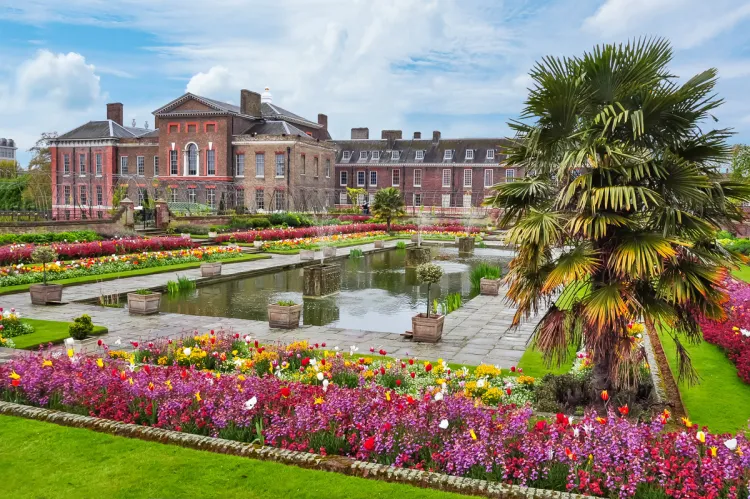
The Sunken Garden was built in 1908 on the site of former potting sheds and glasshouses, modelled on the Pond Garden at Hampton Court: terraced lawns and beds around a central pond, encircled by the Cradle Walk, a shaded arbour of red-twigged lime trained over an iron frame installed in 2008 and known locally as the Nanny Walk, after the Kensington nannies who met there. It was replanted in white and pastel in 2017 in tribute to Diana.
The statue of Diana, Princess of Wales is Ian Rank-Broadley's, in bronze. It was commissioned by Prince William and Prince Harry on the twentieth anniversary of her death in 2017, funded by public donations, and unveiled by both brothers on 1 July 2021, what would have been her sixtieth birthday. The garden was redesigned around it by Pip Morrison. The figure is surrounded by three children, said to represent the universality and the generational reach of her work. Reception was mixed.
Two further things belong in any account of the palace's later history. George II died there on 25 October 1760 and was the last reigning monarch to live there; after Queen Caroline died in 1737 large parts of the building had already fallen into disuse.
And the flowers of 1997. The tribute laid between 1 and 8 September 1997 at Kensington Palace, St James's Palace and Buckingham Palace is recorded as the largest floral tribute on record, at 10,000 to 15,000 tonnes — a figure that comes from the authorities who cleared them. The much-quoted five million bouquets is explicitly unverified and should not be repeated.
The palace's modern refurbishment had a budget of around twelve million pounds, with works running from June 2010 to June 2012 and the palace reopening on 26 March 2012. The scheme brought new public gardens linking palace to park, a new visitor entrance from the Broad Walk, a lift to all public floors, a central hub with a café, clearer routes and a permanent Victoria display. The published figure is a budget rather than a final spend.
The gardens: who actually designed them
Older accounts credit Queen Caroline with the design. She completed and separated them; the designers were three men whose names are missing from that account.
- George London and Henry Wise began the gardens in the late seventeenth century, on land taken from Hyde Park. Wise contracted around 1702 to maintain them, took over the kitchen garden and gravel pits in 1704, took 41 hectares from Hyde Park in 1705, and retired in 1728.
- Charles Bridgeman submitted estimates in 1726 and carried out works from 1727 to 1731, building a ha-ha and a new boundary wall with Hyde Park and creating the Round Pond and the Long Water. He became sole Royal Gardener in 1728 and died in 1738.
- The later Bridgeman works were begun under George I and finished after his death by George II and Queen Caroline, and it was at Caroline's request that the gardens were separated from the rest of Hyde Park in 1728.
On area, the 637 acres of older accounts is not supported by any pairing of published figures. Kensington Gardens is 107 hectares, 265 acres on the Royal Parks' own numbers, which is the managed area; the registered area is about 112 hectares, drawn differently. Combined with Hyde Park the Royal Parks' figures give about 615 acres. The combined total mostly exists to make the place sound bigger, and the gardens' own figure is the useful one. For walkers, the perimeter is about 2.7 miles without the Long Water and 3.3 with it.
The water, and what it is called
The Serpentine is in Hyde Park. The stretch in Kensington Gardens is the Long Water, and the Serpentine Bridge divides them. The bridge is the Rennies', built from 1825 to 1828 as part of the new West Carriage Drive, and it brought the two waters to the same level. The Royal Parks treats them administratively as one water body linked at the bridge, which is probably how the error got into circulation.
The formation is best given as a sequence rather than a year: Bridgeman's works ran from 1727 to 1731, forming the Long Water first and the larger Serpentine by 1731.
The underground river is long gone. The River Westbourne stopped supplying the lake in 1834, by then too polluted, after which water was pumped from the Thames for some years. Since 2011 it has been fed by three boreholes into the Upper Chalk, at the Italian Gardens and near the Lido, supplying up to 900,000 cubic metres a year. The claim in older accounts is wrong by nearly two centuries.
The circumference those accounts give cannot be sourced. The Serpentine covers about 40 acres, which is the figure to use.
What is actually in the gardens, besides the Long Water:
- The Round Pond, about 3 hectares, enlarged to its round shape between 1726 and 1728 and fed by two mushroom-shaped inlets on its western side to stop it stagnating. It is one of only a handful of ponds in the Royal Parks where the regulations allow model boats to be sailed, so that detail in older accounts holds.
- The Italian Gardens, at the north-western end of the Long Water, created in the 1860s. Prince Albert brought the idea in 1860; James Pennethorne designed them, carrying over features of Albert's Italian garden at Osborne House, and they are believed to have been a gift from Albert to Victoria. The Pump House at the north once held a steam engine, and a stoker fired it on Saturday nights so that the fountains would have pressure on Sundays. Victoria's and Albert's initials are on one wall, and the roof pillar is a disguised chimney. Restored in 2011 with a borehole-fed system, the Tazza Fountain's stone carved on site. Grade II listed.
- Queen Caroline's Temple, the Speke Monument, Physical Energy, Queen Anne's Alcove, the Broad Walk and the Flower Walks.
Peter Pan, and the Elfin Oak
Sir George Frampton made the Peter Pan, and it was erected on 30 April 1912 — erected, not cast, which is the looser wording in older accounts. Barrie commissioned it himself and had it put up without permission and without ceremony, so that children would think the fairies had placed it there overnight; he announced the gift in The Times the next day. It stands west of the Long Water, in Kensington Gardens rather than on the Serpentine, near his former home on Bayswater Road and at the spot where, in The Little White Bird, Peter lands. It is Grade II* listed. Frampton made six other full-size casts, which went to Brussels, St John's in Newfoundland, Liverpool, Perth in Western Australia, Toronto and Camden in New Jersey.
The Elfin Oak is where "almost as old" fails by nine centuries. The stump is from a 900-year-old oak brought from Richmond Park in 1928; the figures were carved by the children's illustrator Ivor Innes and the Elfin Oak was unveiled on 25 July 1930. Spike Milligan campaigned to save and restore it in the mid-1960s and again in 1996. It was listed Grade II in 1997 — a listed tree stump, which is unusual enough to be worth saying — and it stands by the entrance to the Diana Memorial Playground.
It has just been restored again. In June 2026 the Royal Parks announced conservation repairs in which 97 figurines were restored and the protective cage was altered: the mesh lining removed and the number of bars reduced, so that the carving can actually be seen.
The Victoria statue
It is by Princess Louise, Duchess of Argyll, Victoria's fourth daughter — white marble on a Portland stone base, erected in 1893 and unveiled by Queen Victoria herself on 28 June 1893, commissioned by the Kensington Golden Jubilee Memorial Executive Committee. Grade II listed.
One thing worth carrying rather than smoothing over: some contemporary press credited the work instead to Louise's tutor, Sir Joseph Edgar Boehm. Attribution disputes of that kind, around women sculptors, belong in the record. No official source states the statue's exact position, so "near the palace" is as far as it goes.
Wellington Arch is nowhere near here
Older accounts place it at the south-east corner of the gardens, leading to Green Park. It is at Hyde Park Corner, on a traffic island between Green Park and Hyde Park, not inside a park at all, and about a mile and a half east of Kensington Gardens with the whole of Hyde Park in between. It is Decimus Burton's, commissioned in 1824 and built from 1825 to 1827, moved south-east between 1883 and 1885 to make way for a new road, and cared for by English Heritage since 1999.
What is actually at the south-east corner of Kensington Gardens is the Albert Memorial. The gardens are bounded by Bayswater Road to the north, West Carriage Drive to the east, Kensington High Street and Kensington Gore to the south, and Kensington Palace Green to the west. Of the gates, Black Lion Gate on the north, off Bayswater Road, and Queen's Gate on the south are the two that can be named with confidence.
Two Diana memorials, in two different parks
The large granite structure of older accounts is the Diana, Princess of Wales Memorial Fountain, and it is in Hyde Park. It was opened by Queen Elizabeth II on 6 July 2004 and is made of 545 pieces of Cornish granite, shaped by computer-controlled machinery and fitted by hand, with three bridges crossing to the middle. It is also not a block: it is an open oval watercourse at ground level, designed to be walked on and sat beside.
What is in Kensington Gardens is the Diana, Princess of Wales Memorial Playground, near Black Lion Gate. It opened on 30 June 2000, the day before what would have been her thirty-ninth birthday, alongside the Memorial Walk. It closed for refurbishment and reopened on 5 August 2026 after a three-million-pound renewal funded by the Royal Parks charity.
The new centrepiece is officially a galleon, seventeen metres by twelve, moored on a sandy beach, and it replaces the much-loved pirate ship of the original. There is also a treehouse with three towers and a four-metre tunnel slide, a waterplay area with a crocodile sculpture, and a redesigned area for younger children.
The Diana, Princess of Wales Memorial Walk is a third thing again: about seven miles, marked by 90 ground-set plaques designed by the sculptor Alec Peever, each carrying a central rose emblem etched in aluminium. It runs through four royal parks — St James's Park, Green Park, Hyde Park and Kensington Gardens — passing three palaces and two mansions, one of them the Spencer family's former London home. It also opened on 30 June 2000.
The Albert Memorial, which older accounts leave out entirely
It is the most conspicuous object in the park and the anchor of its south-east corner.
It is Sir George Gilbert Scott's, the design formally approved in April 1863. The figure of Albert was begun by John Henry Foley, commissioned in May 1868; Foley died in August 1874 before casting was finished and Thomas Brock completed it, his first major work. Victoria opened the memorial in July 1872 and the statue was ceremonially seated in 1875. It cost a hundred and twenty thousand pounds, met by public subscription, and has been Grade I listed since 1970. It stands directly north of the Royal Albert Hall, facing south towards it.
The gilding carries a myth worth dismantling. The statue was originally gilt bronze, then covered in black paint for about eighty years. The popular explanation is that it was blackened during the First World War so as not to attract Zeppelins. English Heritage research suggests the coating predates 1914 and was more likely a response to atmospheric pollution that had destroyed the original gold leaf. It was re-gilded in a restoration completed in the late 1990s and is gold-leafed today.
The Royal Albert Hall is across a road
It is not in the gardens. It stands on Kensington Gore, separated from them by that road, with the memorial directly north of it inside the park. The relationship is the point, and older accounts miss it by putting the hall inside the gardens: the hall and the memorial are two halves of one memorial scheme, facing each other across the road.
Its full formal name is the Royal Albert Hall of Arts and Sciences; it was originally to be the Central Hall of Arts and Sciences. It was opened by Queen Victoria on 29 March 1871, with the Prince of Wales giving the welcoming speech because she was too overcome to speak. The designers were Captain Francis Fowke and Major-General Henry Scott of the Royal Engineers — not architects at all — and the dome was designed by Rowland Mason Ordish.
Three details to correct. It is an ellipse in plan, not an oval, with internal axes of 185 and 219 feet. The roof is a glass and wrought-iron dome 135 feet high. And the capacity is around 5,200 today, against an original design for 8,000, with crowds of as many as 12,000 recorded — so the figure in older accounts understates the present permitted number and misses that the historical capacity was far larger. It is Grade I listed.
The fibreglass acoustic diffusing discs below the ceiling, universally called the mushrooms, were installed in 1969 to deal with the hall's notorious echo.
The Serpentine Galleries
Serpentine South is in Kensington Gardens: a former tea pavilion of 1933 and 1934 by James Grey West, a gallery since 1970, Grade II listed.
Serpentine North is The Magazine, a gunpowder store of 1805, Grade II* listed, converted under Zaha Hadid Architects from 2010, opened in 2013 and renamed Serpentine North in 2021. It sits on the Hyde Park side of West Carriage Drive — though the galleries' own materials address both buildings loosely to Kensington Gardens, which is how that confusion spreads.
The annual Pavilion commission began in 2000 with Zaha Hadid, conceived by the then director Julia Peyton-Jones, and each pavilion is built on Serpentine South's lawn, in Kensington Gardens. By convention each is its architect's first built structure in England. Recent commissions went to Theaster Gates in 2022, Lina Ghotmeh in 2023, Minsuk Cho in 2024, Marina Tabassum in 2025 and Lanza Atelier in 2026. Each stands for one season only, so a pavilion is worth looking up by year rather than expected to be there.
What the rules actually are
Older accounts offer kite flying and rollerblading as features of the gardens. One is half right and the other is unsupported.
Rollerblading is permitted on two named routes only — the Albert Approach Road and the Broad Walk. Under the regulations, anyone over ten may use skates, blades or boards on a park road or in an area marked for the purpose, and nowhere else.
Kite flying has no designated area in Kensington Gardens and appears in no official material as something the gardens offer. It is permitted by default and can be stopped by notice, which is not the same thing at all.
The rest of the current rules are worth having, because they are structural rather than seasonal: cycling only where stated — the Broad Walk, Mount Walk, Studio Walk and Albert Approach Road — with pedestrians always having priority; no swimming in any lake or pond, the Lido in Hyde Park being the only exception; no barbecues; and dogs generally off-lead but on-lead at the edge of the Round Pond and the Long Water, around the Italian Gardens fountains and on the Flower Walks.
Getting there
"Exit at High Street Kensington" is good advice for the palace and poor advice for most of the gardens, which stretch east from it.
For the palace: Queensway on the Central line, about 730 metres and ten minutes up Bayswater Road and in through Black Lion Gate; or High Street Kensington on the Circle and District lines, a similar distance along Kensington High Street and then about five minutes more. Notting Hill Gate is a twenty-minute walk or more, Paddington about twenty. Buses 94, 148 and 274 run along Bayswater Road, and 9, 49, 52, 70 and 452 along Kensington High Street.
For the gardens: Lancaster Gate or Queensway on the Central line, or Bayswater on the Circle, with Paddington the nearest mainline station, about 500 metres north of West Carriage Drive. For the Albert Memorial and the Royal Albert Hall the practical stations are South Kensington or Knightsbridge; for Peter Pan and the Italian Gardens, Lancaster Gate or Queensway.
Weather, and the water supply
Storm closures have become routine: a wind warning in October 2026 shut the playgrounds, the allotment and both Flower Walks for a day. The longer problem is heat and drought. The Royal Parks' director of parks described 2026 as a moment of urgency, naming paths and drainage that cannot cope, trees lost to drought and high winds, and the possible loss of whole plant groups to disease, and the charity says it aims to reduce its reliance on mains water.
Which is where the boreholes of 2011 turn out to matter. The lakes in these two parks are already off the mains, drawing from the chalk beneath — a piece of Victorian-scale engineering done in the twenty-first century, and the most quietly consequential thing to have happened to the water since the Westbourne was cut off in 1834.
Changed