Speakers' Corner — not Speaker's — is the last survivor of around a hundred public speaking places active in London between 1855 and 1939, and the legally defined speaking area reaches well beyond the corner where the crowds gather. That is the strongest fact the park has, and it is only one of several that older accounts get slightly wrong: the general public were let in by Charles I rather than James I, the Marble Arch is no longer in the park at all, and the Serpentine was made by joining a chain of existing pools rather than by damming a river.
How it became a park, and when it opened
Henry VIII acquired the land in 1536 from the monks of Westminster Abbey, by a compulsory exchange for a priory in Buckinghamshire, and enclosed it as a royal hunting park in 1540. The Royal Parks describes it as added to his hunting grounds without naming the quarry, so the familiar claim about deer is supportable but better left general.
The opening to the public is where older accounts go wrong. James I, from 1603, opened it to courtiers and socialites — restricted access for the well-connected. Charles I opened it to the general public in 1637. The two are usually run together, and the second is the one that matters.
That date also supplies the claim worth making, in place of one that cannot be sustained. Hyde Park is often called the oldest park in London, and it is not: the St James's land was acquired in 1532, four years earlier, and the Royal Parks itself calls St James's the oldest of the royal parks. What is defensible — and more interesting — is that Hyde Park was the first of the royal parks to be opened to the public, with St James's following under Charles II.
It covers about 350 acres, some 140 hectares, though the registered area is given as nearer 130, so the figure is best treated as approximate.
The Serpentine, and what actually divides the parks
Queen Caroline, wife of George II, is correctly credited, and the River Westbourne is the right river. But the lake was not simply a dammed river. Henry Wise's plan of about 1706 shows a string of ten pools along the valley; these were joined to form the Long Water in 1727 and the larger Serpentine around 1731. Dates between 1726 and 1733 appear in different sources depending on what is being dated, so a flat single year is not safely citable.
The Westbourne stopped supplying it in 1834, by then too polluted, and the lake is now fed by three boreholes.
The boundary needs correcting. The lake does not divide Hyde Park from Kensington Gardens — West Carriage Drive does, formally since 1862, when it was extended south over the Serpentine Bridge. The bridge is George Rennie's, built from 1826 to 1828, and it divides the water as well as the parks: the Serpentine lies east of it, in Hyde Park; the Long Water lies west of it, in Kensington Gardens. The Serpentine runs across the south of Hyde Park.
The Marble Arch is not here
Older accounts put the Marble Arch in the north-east corner of the park. It stands on a large traffic island outside the park, at Cumberland Gate, and was isolated in three stages: the park boundary moved south in 1908 and Tyburn Way was created; gyratory traffic control in 1926 left it stranded in a roundabout; and a larger roundabout built in 1960 to 1962, with Park Lane made one-way in 1961, completed the separation. It is maintained by Westminster City Council rather than the Royal Parks.
Its own history belongs to Buckingham Palace, not to the park. John Nash designed it in 1827 as the state entrance to the palace's courtyard, Edward Blore reduced its attic stage when work restarted in 1832, and it was dismantled in 1847 when the palace's east wing needed the site. Decimus Burton initiated the move and Thomas Cubitt rebuilt it, finishing in March 1851.
Speakers' Corner
The site sits near the ground of the former Tyburn gallows, dismantled in 1783. The speaking tradition took hold after a government ban on a Reform League meeting in 1866 produced three days of rioting; a crowd of 150,000 defied a second ban in 1867 without police or troops intervening. The Parks Regulation Act 1872 then set this part of the park aside for public speaking and established the right to meet and speak through regulations governing meetings.
Two things are commonly missed. The legally defined speaking area extends well beyond the corner itself, even though the crowds gather at the corner. And anyone may speak on any subject without giving notice, so long as the police consider the speech lawful.
Suffragettes met there from 1906 to 1914, and the usual roll-call of speakers runs through Marx, Lenin, William Morris and Orwell. The single best fact about it is that it is the last survivor of roughly a hundred London speaking places active between 1855 and 1939. It remains in use, chiefly on Sunday mornings. Claims that it has declined circulate widely but rest on nothing authoritative, so they are not worth repeating.
Swimming in the Serpentine
The Lido opened in 1930, at the request of the naturist Sunlight League and delivered under the Commissioner of Works George Lansbury, whose name it carried — Lansbury's Lido. Half the cost came from a five-thousand-pound gift by Major Colin Cooper. It is a rectangular buoyed-off area on the south bank, open to the public roughly from May to September.
The club is the better story. The Serpentine Swimming Club dates from 1864, holding its first Christmas Day Race that year, and it predates the Amateur Swimming Association, founded in 1869. It should not be called Britain's oldest swimming club: the club itself makes no such claim, only the one about the association. J. M. Barrie donated the Peter Pan Cup in 1913; the Greenbury family has sponsored it since 1933; women became full members at the 1985 annual general meeting and now make up about half the active membership; and since a vote in 2005 the cup has gone to the overall winner regardless of gender. Members swim in the early morning all year round, and the club races every Saturday over imperial distances.
The lake also hosted the 2012 Olympic marathon swim and the triathlon swims, and it holds an annual open-water event each autumn.
The Diana Memorial Fountain
It is Kathryn Gustafson's, of Gustafson Porter, and was opened by Queen Elizabeth II on 6 July 2004. It is made of 545 pieces of Cornish granite, computer-cut and hand-assembled, with three bridges crossing the water to the middle, and it cost £3.6 million. It stands in the south-west of Hyde Park, south of the Serpentine.
It closed shortly after opening, following three hospitalisations from slips, and reopened that August with fencing and wardens; damage to the surrounding turf brought drainage and hard-surfacing work from December 2004.
It is worth keeping separate from the other Diana memorial, which is a different thing in a different park. The Diana, Princess of Wales Memorial Playground is in Kensington Gardens, near Black Lion Gate, and opened in 2000; it closed in 2025 for a three-million-pound refurbishment and reopened in August 2026.
Other memorials
The 7 July Memorial is by Carmody Groarke, with Arup as engineers and Colvin and Moggridge as landscape architects and Antony Gormley advising, and was unveiled on 7 July 2009, the fourth anniversary. It is made of 52 stainless steel stelae, each about 3.5 metres tall and weighing some 850 kilograms, grouped in four clusters, one for each bombing site. It stands on the east side of the park between Lover's Walk and Park Lane, near Curzon Gate.
The Holocaust Memorial Garden was constructed in 1983 — a garden of boulders among white-stemmed birches, east of The Dell, and described by the Royal Parks as Britain's first memorial to the victims of the Holocaust.
The pet cemetery, the bandstand and the riding arenas
The pet cemetery survives, in the private garden behind Victoria Lodge at the edge of the park. It was begun in the nineteenth century by the lodge gatekeeper, Mr Winbridge, holds over a thousand dogs and cats, and is cared for by the Royal Parks charity. It is not open to general access and is seen only on guided tours of the park. Burials stopped during the twentieth century; sources disagree on exactly when, giving the early 1900s or as late as 1976.
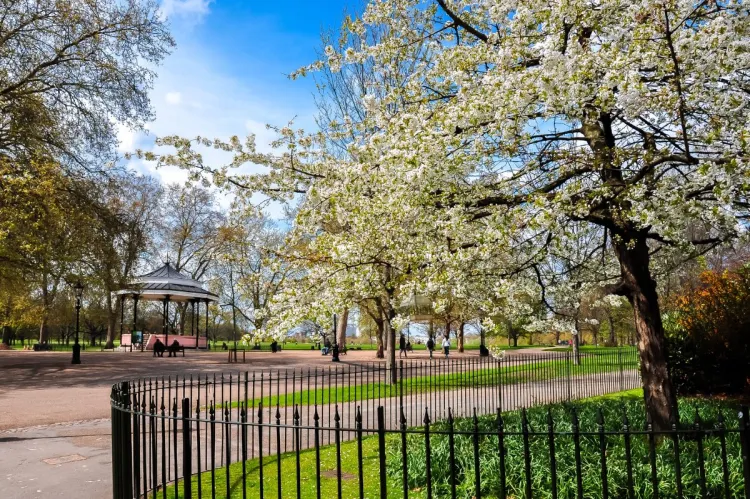
The bandstand was built in 1869, in Kensington Gardens, and moved to its present site in 1886. The three concerts a week of the 1890s are history rather than present practice, but concerts do still run: the Friends of Hyde Park and Kensington Gardens put on a free series from June to September, on Sunday afternoons, alternating between the Hyde Park and Kensington Gardens bandstands.
Older accounts contain a garbled line about something called the Magenge at the end of the Sports Field. The word is manège, a horse-riding arena. There are two in the park: one on North Carriage Drive near Clarendon Gate, and one on South Carriage Drive, at the end of the Sports Field next to the children's playground. The arena does not provide the playground — the playground merely sits beside it. There is one playground in Hyde Park, on the southern boundary, for children up to twelve.
The tennis courts and bowling green also survive, run under concession on the south side of the park: six floodlit hard courts and an artificial-grass court, a padel court, outdoor table tennis, a floodlit pitch for five-a-side or netball, grass football pitches, and a six-rink bowls green open from Easter to late September.
Concerts, and the controls on them
The park's concert history is substantial. The first rock concert was on 29 June 1968, to a crowd of fifteen thousand; the Rolling Stones played on 5 July 1969; Queen's free concert of 18 September 1976 drew between 150,000 and 200,000, the largest crowd the park has held; Live 8 was on 2 July 2005; and a radio festival has run each September since 2011.
The modern arrangement is more tightly governed, and the governing is the current story. The summer festival is promoted commercially, and Westminster City Council is the licensing authority. In June 2026 its licensing sub-committee granted the Royal Parks a new premises licence raising total capacity from about 550,000 to 630,000 across nine event days, with a ceiling just under 70,000 a day — an increase of roughly fourteen per cent. Curfews were left unchanged at half past ten on weekdays and Saturdays and ten on Sundays. It was granted over objections from residents and from the Metropolitan Police, which cited insufficient detail in the operating schedule.
Winter Wonderland in its present form dates from 2007, when the Royal Parks brought in commercial organisers after a small Christmas funfair in 2005 underperformed; it was inaugurated on 11 December 2007, expanded in 2012, and runs from mid-November to early January along Serpentine Road. It is billed as having the largest temporary outdoor ice rink in the country, along with a sixty-metre wheel, a seventy-metre star flyer and an eighty-five-metre freefall tower, and it drew fourteen million visitors in its first ten years. It was cancelled in 2020 and returned in November 2021, and its ownership changed hands in 2025. Claims about the damage it does to the ground circulate without any authoritative source behind them.
The galleries, which are next door
The Serpentine Galleries are often given as Hyde Park attractions, and the boundary runs between them. Serpentine South is in Kensington Gardens, in a Grade II listed former tea pavilion of 1933 to 1934. Serpentine North, five minutes' walk across the Serpentine Bridge, is The Magazine, a Grade II* former gunpowder store of 1805 with an extension by Zaha Hadid Architects, and it stands on the Hyde Park side of West Carriage Drive. The galleries' own materials address both buildings to Kensington Gardens, which is how that confusion spreads.
The annual pavilion commission began in 2000 with Zaha Hadid, and each pavilion is built on Serpentine South's lawn, in Kensington Gardens rather than here. The programme continues: recent commissions went to Minsuk Cho of Mass Studies in 2024, Marina Tabassum in 2025 and LANZA Atelier in 2026. Each stands only for a season, so a pavilion is worth looking up by year rather than expecting to find.
Drought and the trees
The pressure on the park is now climatic. July 2026 was officially the driest month recorded in England and Wales in 190 years, with no rain at all at the Kew Gardens station; London was formally in drought with a hosepipe ban in force, and Hyde Park was named among the most visibly scorched of the London parks. The Royal Parks' director of parks, Darren Share, called it a moment of urgency, citing consecutive heatwaves alongside the record July, in coverage of a report on climate risk to heritage parks. Drought, storms and new plant diseases together are driving significant tree loss across London's green spaces, though no figures specific to Hyde Park have been published.
One thing that has been dropped
Older accounts close with a crawl of Mayfair bars, hotel restaurants and clubs across Park Lane. Those belong to the hotels rather than to the park, and the names have changed repeatedly: of six typically named, two still trade and the rest have been renamed, rebuilt, absorbed into other ventures or closed outright, some of them more than once. Hotel dining rooms turn over faster than any guide can follow, which is the best argument for leaving them out of an account of a park.
Changed