How to play mahjong: the four main variants explained
Most people who give up on mahjong do so for the same reason. They learn the game from an app, sit down at a table where three other people learned it somewhere else, and discover within a hand that almost nothing transfers. The tiles look familiar. The scoring, the legal hands and half the etiquette do not.
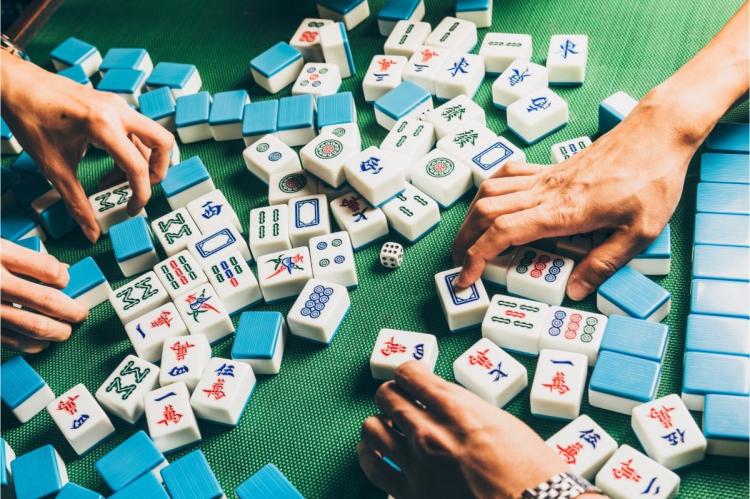
Mahjong is not one game. It is a family of games built on a shared set of tiles, and the four most widely played versions — Hong Kong, Japanese riichi, American and British — differ enough that a confident player of one can be a complete beginner at another. Knowing which is which is the single most useful thing for anyone starting out, well before any of the rules.
The common core
Every variant shares the same foundation, which is why the differences can catch people out so easily.
The tiles run to three numbered suits — circles (dots), bamboo and characters — each numbered one to nine, with four copies of every tile. To these are added honour tiles: four winds and three dragons, again four copies each. That gives 136 tiles. Most sets also include eight bonus tiles, four flowers and four seasons, taking the set to 144.
Play runs anticlockwise between four seats, each associated with a wind, with East as dealer. Tiles are shuffled and built into a wall, players take a starting hand of 13 tiles, and East takes a fourteenth and discards first. On each turn a player draws a tile and discards one. A discard can be claimed by another player to complete a set, which interrupts the turn order.
Sets are the same everywhere: a pung (three identical tiles), a kong (four), and a chow (three consecutive tiles in one suit). The classic winning hand is four sets and a pair, fourteen tiles in total.
That is where the agreement ends.
Hong Kong mahjong
The set: 144 tiles, flowers and seasons included as bonus tiles. The winning hand: four sets and a pair. The distinguishing feature: a minimum score to be allowed to win.
Hong Kong old style is the most widely played form of the game worldwide and the usual entry point into the Chinese family of variants. Hands are quick, often over in a quarter of an hour, and the mechanics are the ones most people picture when they picture mahjong.
Scoring works in faan, or doubles. Each pattern in a completed hand — a run of identical honours, a hand made entirely from one suit, a hand concealed throughout — is worth a number of faan, and the total is converted into a payment on an agreed scale. Flowers and seasons are melded as soon as they are drawn, replaced from the wall, and add small bonuses.
The rule that catches newcomers is the minimum. A completed hand that falls below the table's minimum faan cannot be declared, which means a hand of four sets and a pair thrown together from whatever arrived is often worthless. Three faan is common, but the figure is a table decision, not a fixed law, and it is the first thing to establish before play begins.
Hong Kong rules suit players who want to start quickly, and anyone likely to end up at a table with Chinese or Southeast Asian family or friends.
Japanese riichi mahjong
The set: 136 tiles. No flowers or seasons. Often red fives, which count as bonus tiles. The winning hand: four sets and a pair, plus at least one scoring pattern. The distinguishing feature: the riichi declaration, and the yaku requirement.
Riichi is the most formalised version of the game and the one with the deepest competitive scene. It went in the opposite direction from the Chinese variants — rather than loosening, it tightened.
Two rules define it. The first is the yaku requirement: a structurally complete hand is not a winning hand unless it also contains at least one recognised scoring pattern. Assembling fourteen tiles into the right shape is not enough, which forces players to aim at something specific from early in the hand.
The second is riichi itself. A player whose hand is concealed and one tile away from completion may declare riichi, depositing a thousand points on the table. The declaration announces the situation to everyone, locks the hand so that no further changes are possible, and in exchange raises the value of the eventual win considerably — including bonus tiles revealed only afterwards. It converts a private position into a public bet, which is what gives riichi its reputation as a game of nerve rather than arithmetic.
Two further mechanics matter. Dora are bonus tiles, indicated by a flipped tile in the wall, which add value but cannot satisfy the yaku requirement on their own. Furiten prevents a player from claiming a winning discard if the winning tile already sits in their own discards — a rule that turns the discard row into public information and makes defence a real part of play.
Scoring combines han (doubles) and fu (base points) and is genuinely complicated by hand, which is why online play and apps have done so much to spread the variant. A game runs as a series of hands with a running points total, and the final ranking, not a single win, decides it.
Riichi suits players who enjoy a game with depth, who are comfortable learning a vocabulary of scoring patterns, and who like the idea of watching matches as well as playing them.
American mahjong
The set: 152 tiles — the standard 144 plus eight jokers. Racks and pushers. The winning hand: whatever the card says, and nothing else. The distinguishing feature: the annual card, and the Charleston.
American mahjong separated from the rest of the family in the 1920s and 1930s and has been a different game ever since. The valid winning hands are not a matter of general principle but a published list: the National Mah Jongg League issues a card each spring, with roughly seventy hands grouped into sections, and a hand that does not appear on the current card cannot win. Every year the list changes and the strategy resets.
Play opens with the Charleston, a compulsory exchange in which each player passes three unwanted tiles to the right, three across and three to the left, with a second round optional if everyone agrees. Nothing comparable exists in the Asian variants. It lets a hand be steered towards a chosen line on the card before ordinary play begins, and it leaks a great deal of information about what everyone is collecting.
Jokers are wild, but only within groups of three or more. They cannot stand in for a single tile or a pair, cannot be passed in the Charleston, and cannot be claimed from a discard. Tiles are held on racks rather than in the hand, which is part of why the American game looks so different from across a room.
Rounds run longer than Hong Kong hands — closer to an hour — and the game is unusually welcoming to beginners, because the card removes the question of what counts as a winning hand. It is the dominant form in the United States, and the version behind most of the current coverage of mahjong as a dinner party activity.
British mahjong
The set: 144 tiles, flowers and seasons included. Some tables add jokers. The winning hand: four sets and a pair. The distinguishing feature: an elaborate scoring system, and the goulash.
The British game is the direct descendant of the version the West adopted in the 1920s, when the craze arrived from Shanghai and English-language rule books multiplied. It was later tidied up by the British Mah-Jong Association, formed in 1978, whose guide has sold in very large numbers and is still what most British clubs mean by "the rules".
The core of play is Chinese. What differs is the scoring, which is considerably more involved than the Hong Kong system: points are counted for each set, with higher values for those built from major tiles — ones, nines and honours — than from the twos to eights, with further points for concealed sets, kongs and bonus tiles, and the total then doubled for each qualifying pattern. In the Western classical tradition the British rules come from, all four players score their hands at the end of a round rather than only the winner, which changes what a losing hand is worth holding on to.
The goulash is the other local peculiarity. When a hand ends without a winner, rather than moving on, players exchange tiles and play again under altered conditions — an arrangement that arrived from the American tradition and stayed.
British rules are what most UK clubs, community groups and university society tables play, so this is the practical choice for anyone intending to join an existing group in Britain rather than start one.
At a glance
| Hong Kong | Riichi | American | British | |
|---|---|---|---|---|
| Tiles | 144 | 136 | 152 | 144 |
| Flowers and seasons | Yes, as bonuses | No | Yes, used within hands | Yes, as bonuses |
| Jokers | No | No | Eight, wild in threes or more | Optional |
| Winning hand | Four sets and a pair | Four sets and a pair, plus a yaku | Any hand on the current card | Four sets and a pair |
| Scoring | Faan (doubles) | Han and fu | Card values | Points, then doubles |
| Typical hand length | 15–20 minutes | 20–30 minutes | 45–60 minutes | 30–45 minutes |
| Mostly played | China, Hong Kong, Southeast Asia, diaspora communities | Japan, online, competitive clubs | United States | UK clubs and groups |
Which one to learn first
The honest answer is the one the nearest table plays. Mahjong needs four people, and a variant learned alone is of limited use.
Beyond that, a few rules of thumb hold. Hong Kong style is the fastest to pick up and the most portable internationally. British rules make most sense for anyone joining a UK club. American mahjong is the easiest for a group of complete beginners to start together, because the card settles what everyone is aiming at. Riichi rewards the most study and has by far the best online infrastructure for practising between games, which makes it the natural choice for anyone learning without a regular table.
What to settle before the first hand
Almost every argument at a mahjong table comes from an unstated assumption. Four things are worth agreeing aloud before tiles are shuffled:
- The variant, explicitly. "Mahjong" is not an answer.
- The minimum, where one applies — the faan threshold in Hong Kong play is the usual culprit.
- The optional rules: red fives in riichi, jokers in a British game, whether a second Charleston is being played, which year's card is in use.
- The stopping point. Most variants run as a series of rounds rather than to a target score, and a session with no agreed end tends to find one awkwardly.
One last clarification, since it accounts for a surprising share of the confusion: the tile-matching puzzle found on computers, where identical tiles are removed from a pyramid, is mahjong solitaire. It borrows the tiles and nothing else. The game described here is a four-player game of draws, discards, claims and bluffs, and the two have about as much in common as patience and poker.