How to host a mahjong night
Mahjong is an unusually good game to host around, because it does most of the organising itself. Four seats, a fixed turn order, hands that end at predictable intervals, and enough waiting between turns for a conversation to run alongside the play. An evening built on it rarely needs a plan beyond the game.
What it does need is a handful of decisions made in advance. Nearly every mahjong night that goes wrong goes wrong for logistical reasons — the wrong number of people, nobody who can settle a dispute, four players who learned four different versions — and all of those are solvable before anyone arrives.
Much of the hosting advice circulating at the moment comes from the United States and is built around matching tile sets, mats and an annual rules card. That is a real tradition, and a visiting American player will be expecting it, but it is not much help to a table in Britain or continental Europe, where the game is played differently and the practical questions are not the same.
Settle the variant before the invitations go out
This is the decision that matters most, and it is the one most often left until everyone is seated.
Hong Kong, Japanese riichi, American and British mahjong share tiles and a basic shape but are, in practice, four different games. A table that has not agreed which one it is playing tends to discover the problem somewhere around the first claimed discard.
In Britain, clubs, community groups and university societies mostly play British rules, so guests who learned at a club will assume those. Players who learned from family are most likely to know Hong Kong style. Anyone who picked the game up from an app or online almost certainly plays riichi. Guests who learned in the United States will expect jokers, racks and a current National Mah Jongg League card, none of which appear in the other three.
Naming the variant in the invitation solves it — and gives anyone who plays something else a fortnight to look at the differences rather than discovering them at the table. One variant per evening works far better than attempting to mix.
Numbers, seating and mixed abilities
Four players per table, with a fifth sitting out and rotating in if the group happens to be five. Eight is a comfortable size for two tables; anything between five and seven is the awkward range, though three-player versions of most variants exist and are perfectly playable.
Experience is worth spreading rather than segregating. A table of four beginners will spend the evening looking things up; a table with one experienced player in it will be playing properly within half an hour. Where two tables are running and only one strong player is available, the sensible arrangement is to seat them with the beginners and let the more confident table get on with it.
The table and the room
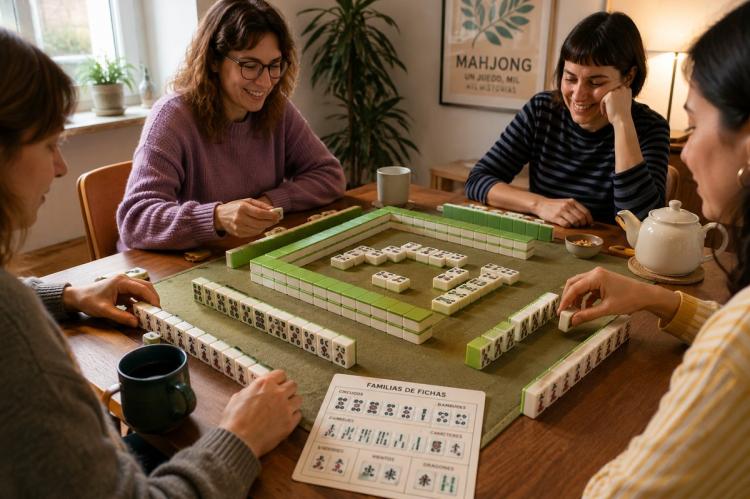
A square or round table is ideal, but any table that seats four with elbow room will do. What matters more is the surface. Bare wood or glass makes tiles skid and turns the shuffle into something genuinely loud, which is why mats and cloths are traditional — they dampen the noise, protect the table and keep tiles from sliding into each other.
Light from above rather than from behind, so that hands and tile faces are not in shadow. Drinks and plates belong on a side table or a second surface: the playing area needs to stay clear, and a glass among the discards is an accident waiting for a claimed tile.
Choosing or borrowing a set
A set that is about to be borrowed is worth checking in advance, because not all sets suit all variants. Hong Kong and British play use 144 tiles including flowers and seasons. Riichi sets contain 136, with no flowers, and often red fives. American sets add eight jokers, for 152, along with racks and pushers.
Two practical points beyond the count. Tile size varies considerably, and larger tiles with clear, high-contrast faces make a real difference to anyone playing by lamplight or with imperfect eyesight — a more important consideration than the finish. And sets marked with Arabic numerals alongside the Chinese characters are genuinely easier for beginners, though most players stop needing them within a couple of sessions.
Tiles last decades with very little attention: a wipe with a soft cloth after play to lift oils and dust, mild soapy water and a prompt dry for anything worse, no soaking, and storage somewhere cool and out of direct sunlight. Modern tiles are mostly acrylic or melamine and dislike heat far more than they dislike use.
Teaching people at the table
Mahjong is learned at the table rather than from a rulebook, and a first evening with beginners is a teaching evening whether or not it was planned as one.
A few things make that go faster. Playing the first hand with everyone's tiles face up, as a demonstration rather than a game, gets the mechanics across in about twenty minutes. Scoring can be ignored entirely at first — the aim of the first session is for everyone to recognise a complete hand and understand what can be claimed from a discard. A printed summary of the sets and the winning shape, one per player, saves a great deal of repetition.
It also helps to nominate one person as the authority for the evening, ideally the most experienced player, who settles questions and makes the calls. Rules disputes between four people of equal uncertainty consume an entire evening; the same dispute settled in ten seconds by an agreed referee costs nothing.
Timing, and knowing when to stop
Hands are short. A Hong Kong hand runs fifteen to twenty minutes, a riichi hand a little longer, an American hand closer to an hour once scoring is included. A full game in most variants means working through a set number of rounds, which can take an evening on its own.
A first session with beginners will get through far fewer hands than the same four people manage a month later, and that is normal. What keeps a group coming back is an agreed finishing time rather than an open-ended evening that dwindles. A session that stops while everyone still wants another hand is the one that becomes a standing arrangement.
Feeding a mahjong table
The constraint is the playing surface, not the menu. Anything that needs cutting, anything eaten with two hands, and anything greasy is a poor fit for a table covered in tiles that will be handled by everyone.
What works is small, dry and one-handed, served away from the board: nuts, olives, crisps, cheese and crackers, dumplings, small pastries, fruit that has already been dealt with. Tea is traditional and practical, being the one drink nobody minds refilling mid-hand. Anything more substantial is better placed between rounds — a genuine break, with people standing up, rather than a meal competing with the game.
The current fashion for elaborately themed mahjong tablescapes is enjoyable if that is the point of the evening, but it is worth being clear which is being hosted. A game night and a dinner party with tiles on the table are different events, and the second usually produces less mahjong.
Whether to play for anything
Mahjong is played for money in much of the world, and some guests will assume stakes while others will assume none. Most social tables in Britain and Europe play for nothing at all, or keep score on paper across the evening, or use matchsticks or counters that settle nothing beyond bragging rights.
Any of those is fine. What causes discomfort is leaving it unstated until someone wins, so a line in the invitation covers it.
Guests who learned in the United States
American mahjong diverged from the rest of the family in the 1920s and 1930s and is now its own game. A visiting player who learned there will be used to jokers, to tiles held on racks, to the Charleston — a compulsory exchange of tiles before play — and above all to the annual card, which lists the only hands that can win that year.
None of that applies at a British or Hong Kong table, and the card is no help there. The good news is that the reverse is straightforward: an American player can sit down to British or Hong Kong rules with the same tiles set aside from the jokers, and the underlying mechanics of drawing, discarding and claiming will feel entirely familiar. The gap is the winning conditions and the scoring, both of which can be explained in a hand or two.
Where several players hold current cards, American mahjong is best given an evening of its own rather than folded into a mixed table.
Making it a standing game
The traditions that last are the ones that repeat. A fixed night — the first Tuesday, the last Sunday of the month — removes the organising entirely, and hosting that rotates between three or four homes stops it becoming one person's burden.
A group chat for confirming four players is usually all the administration required. Where numbers fall short, most cities now have clubs and board game cafés running mahjong sessions, which also serve as a useful place for newer players to get hands in between home games.
Checklist
- The variant, named in the invitation
- Four players confirmed, or eight for two tables
- A set that matches the variant, checked in advance
- A cloth or mat, and clear light from above
- Printed summaries of the sets and winning hand for beginners
- One person nominated to settle rules questions
- Drinks and food on a separate surface
- Stakes, or the absence of them, agreed
- A finishing time