Harrods has been owned by the Qatar Investment Authority since 2010, and in 2025 it applied for consent to strip out the Egyptian escalator hall its previous owner built in 1997 — including the sixteen carvings of his own face. Older accounts still have the Fayed family as proprietors. The building itself is Grade II* listed, and the best things in it are the Doulton tile panels of 1903 in what is now the Dining Hall.
The shop before the shop
Older accounts have the business established on its present site in 1849. Harrods itself does not: its own account gives 1834 for the founding and says it moved to Knightsbridge in 1849.
Charles Henry Harrod was born in Essex in 1799 and was a draper before he was a grocer. He traded in Southwark from 1824 — a London Gazette notice of January 1826 dissolving his partnership is the earliest hard record of him — then had a grocery in Clerkenwell from 1832 and a wholesale grocery in Stepney from 1834, specialising in tea. He took a small shop in Knightsbridge in 1849 and bought it outright in 1853. It began as one room with two assistants and a messenger boy, selling medicines, perfumes, stationery and fruit and vegetables. He died in 1885.
Charles Digby Harrod took over in 1861, aged twenty, and is the one who built the business: five staff in 1867, sixteen by the early 1870s, about a hundred by 1880. He retired and sold out in 1889, when the business floated as Harrod's Stores Limited. Richard Burbidge, managing director from 1891, made it the store it now is — eighty departments and some two thousand staff by 1900.
The fire, and the story the store tells about it
The fire that destroyed the shop came in early December 1883, and the date in older accounts is right. Harrods says it completed every Christmas order that year regardless, and beat its trade targets while doing it. The claim is repeated by major museums, but every modern telling traces back to Harrods' own account and there appears to be no contemporary source for it — so it is best given as the store's own story rather than as a documented fact. A larger shop reopened in 1884 and turnover more than doubled.
The motto
The motto is Latin: Omnia Omnibus Ubique. Harrods' own 1912 catalogue renders it "all things for all people, everywhere", and that is the wording to use. The "Everything to Everybody Everywhere" of older accounts matches no published rendering of it.
The same catalogue described the shop as the supply centre for the Empire, which places the motto rather precisely. It should not be presented as a present-day slogan; the firm's current corporate line is something else entirely.
The building
The architect is C. W. Stephens, appointed in 1894, and the main building went up from 1901 to 1905, built by John Allen and Sons of Kilburn. It is Grade II* listed — the higher grade, and the listing covers the interiors, which matters later.
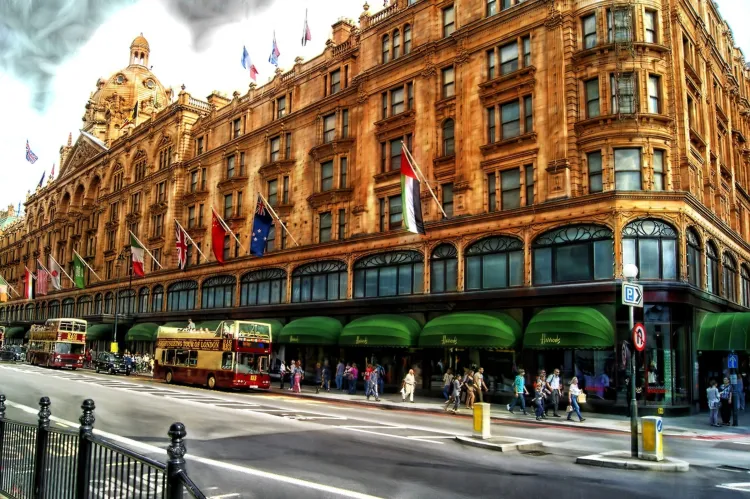
Older accounts describe terracotta tiles and Art Nouveau windows topped with a baroque dome. That is about half right. The Brompton Road front is faced in pinky-buff Doulton terracotta — facing, not tiles — and the style is properly exuberant Baroque with French Second Empire features, which describes the whole frontage rather than a dome. The Art Nouveau belongs specifically to the tracery of the first-floor windows. The Basil Street elevation, rebuilt in 1929 and 1930 by Louis D. Blanc, uses brown Doulton terracotta and Hathernware faience over a black granite ground floor, and the mansard attics are sheeted in fish-scale copper.
The rest of the fabric is datable in layers: the Hans Road range of 1910 to 1912; the Georgian Restaurant of 1911, remodelled in 1928 and 1929; the lifts and Georgian stair of 1927 and 1928; the barber's shop of 1930; the Hans Crescent elevation partly rebuilt in 1939 by John L. Harvey; the Floral Hall and Charcuterie of 1925.
Two details worth having. The basement Safe Deposit keeps its original fittings of 1897 and 2,646 deposit boxes. And the windows were smashed in the suffragette campaign of March 1912.
On size, older accounts give four and a half acres and a million square feet, and the two are different kinds of measurement run together. Harrods publishes no current floor area or department count at all. What can be said is that it occupies about five acres in Knightsbridge, on eight floors rather than the seven of older accounts — lower ground to sixth — with over three hundred departments, a figure that is approximate and moving while the store is redeveloped.
The escalator
On 16 November 1898 Harrods introduced a moving staircase, reported in the Drapers' Record that week. It was Britain's first escalator, not the world's: the first working escalator was Jesse Reno's at Coney Island in 1896.
The detail that survives checking is that attendants served brandy to shoppers unnerved by the ride at the top. The smelling-salts version of the same story rests on much thinner evidence, and the brandy is the better fact anyway.
The lights
The figure in older accounts is right: about 12,000 bulbs. Two things they cannot contain. The display began in the 1950s as a temporary Christmas decoration and simply stayed. And it was converted to LED in a scheme completed in 2024, designed by L'Observatoire International, which kept the festoon character and added a separate architectural layer of lighting to the building.
They have been switched off deliberately once, in 1997, after the deaths of Dodi Fayed and Diana, Princess of Wales.
What Harrods used to sell
The funeral service, the circulating library, the aeroplanes and the animals are all real, and all belong in the past tense — more firmly than older accounts allow.
The funeral department handled Sigmund Freud's funeral in September 1939. Older accounts say it embalmed him, and it did not: he was cremated at Golders Green, and his ashes were placed in a fourth-century-BC Greek krater from his own collection. The true version is the better fact.
The circulating library — the period term — was once claimed as the best in London. When it closed is not on record.
The pet department ran from 1917 to 2014, and sold exotic animals, among them alligators, lions and elephants, until the 1970s. Harrods announced the closure on 10 January 2014 and shut it at the end of that month, to make room for expanded womenswear. So the menagerie is not merely historical but closed, and a page that is cheerful about the present selection of animals would be wrong.
Two of those animals are worth naming. The best documented is Christian the lion, bought from Harrods in 1969 by John Rendall and Anthony Bourke; Harrods had acquired him from a zoo park at Ilfracombe in Devon. The elephant needs more care than older accounts give it: a press photograph of November 1967 records a baby Indian elephant called Gertie, supplied by Harrods and bought by the exiled King Leka of the Albanians as a gift for Governor Ronald Reagan of California, flown out from London Airport on 9 November. Other tellings have Reagan telephoning the store himself, and the company's own history dates the episode to the 1980s — so the buyer and the decade are both unsettled, and the one firm thing is the 1967 photograph.
The teddy bear is right in substance and loose in wording. In 1921 A. A. Milne bought a bear at Harrods for his son Christopher Robin's first birthday; it became Winnie-the-Pooh, and it is now in the New York Public Library with the original Eeyore, Piglet, Kanga and Tigger. Calling it "the original Winnie-the-Pooh" does two jobs at once, because the bear was not called Winnie when it was bought, and it took the name from a real bear at London Zoo.
David Prowse did work there, as a fitness consultant — though he was Darth Vader's body rather than his voice, which is worth getting right. The claim that Pierce Brosnan worked in the pharmacy cannot be sourced at all, and his documented early career leaves no room for it, so it should go.
Three other things in older accounts have no source behind them and should simply be deleted: fresh fish flown to Alfred Hitchcock; opera singers performing at the top of the Egyptian escalator; and artesian wells beneath the building, the deepest given as 489 feet. Nothing supports any of the three.
1985, and the inquiry that followed
Older accounts reduce this to the word "expansion". It is one of the better-documented episodes in modern British corporate history.
Lonrho, under Roland "Tiny" Rowland, had sought control of House of Fraser from 1977, and a Monopolies and Mergers Commission ruling blocked it in 1981. In November 1984, after the Trade Secretary ruled that Lonrho could not increase its holding, Mohamed and Ali Al Fayed bought Lonrho's stake of about thirty per cent from Rowland for some £138 million. In early 1985 they bought the remainder and took the group private, for £615 million — the figure older accounts give, and the right one.
Harrods came with House of Fraser, which had owned it since 1959. In 1994, before House of Fraser was relisted, Harrods was separated out of the group and kept in private Fayed ownership, so the two have been separate companies ever since. The 2010 sale did not involve House of Fraser at all.
Then the inquiry. Inspectors were appointed on 9 April 1987 under the Companies Act to report on the affairs of House of Fraser Holdings, with particular reference to the acquisitions of 1984 and 1985. They delivered their report on 23 July 1988; it was not published at the time, going instead to the Director of Public Prosecutions and the Serious Fraud Office. It was published on 7 March 1990, a week after both announced they would not prosecute. The inspectors found that the Fayeds had dishonestly misrepresented their origins, their wealth, their business interests and their resources. No prosecution followed and no disqualification was sought. The inquiry was into the holding company rather than into Harrods itself, which is a distinction worth preserving.
The £300 million refurbishment figure in older accounts cannot be traced to any primary record; published estimates range widely over an undefined period. What is datable is what the money bought: the Egyptian escalator hall of 1997.
2010, and who owns it now
The sale was announced on 8 May 2010, to Qatar Holding, then the investment arm of the Qatar Investment Authority, for £1.5 billion. Other figures were reported for the same transaction in dollars and euros, and the bank advising the family trust declined to confirm any of them. Mohamed Al Fayed stayed on as honorary chairman for six months.
Harrods has been owned by the Qatar Investment Authority ever since. Qatar Holding has since been absorbed into that structure, so naming it as the present owner would be wrong.
One divestment is worth a line: Harrods Bank, which had traded since 1893, was sold in 2017 and rebranded under another name.
Diana and Dodi, and what became of the memorials
A pyramid shrine was unveiled in April 1998 at the foot of the Egyptian escalator: photographs under a pyramidal case, with the wine glass from their last dinner and a ring Dodi Fayed had bought the day before the crash.
A bronze, Innocent Victims, by the sculptor William Mitchell, was unveiled in September 2005, showing the pair dancing in waves with Dodi releasing a bird.
The bronze's removal was announced in January 2018 and carried out that year. The store's managing director said returning it to Mohamed Al Fayed was appropriate now that Princes William and Harry had commissioned a memorial at Kensington Palace, and it went to Al Fayed's house in Surrey. When the pyramid shrine was taken out, and where it went, is not on the public record.
Mohamed Al Fayed, and what Harrods has said since
He died on 30 August 2023, aged ninety-four. In September 2024 the BBC published the accounts of more than twenty former Harrods employees alleging sexual assault, five of them rape, and broadcast a documentary on them. He had died before any case was tested and no charges were brought.
Harrods issued a public apology, saying that as a business it had failed the employees who were his victims, and describing the present company as a very different organisation from the one he controlled between 1985 and 2010.
It then established the Harrods Redress Scheme, funded by the company and administered through an outside firm of solicitors, with an independent survivor advocate appointed alongside it. The scheme opened on 31 March 2025 and closed to new applications on 31 March 2026, with applications made before that date still being processed. Harrods has set aside more than £60 million for it.
The Egyptian hall, which is going
The Egyptian Escalator Hall dates from 1997 and is William Mitchell's — the same sculptor as the bronze. Historic England calls it the most significant of the store's modern concept interiors: reliefs of Egyptian warriors, cast-glass lotus capitals, a frieze of warriors and chariots. The staircase beside it is of 1927 and 1928; escalators were put into the main stairwell in 1986 and the decoration embellished by Mitchell in 1995. The hall carries images of Al Fayed as a pharaoh, and an inscription from Shelley's Ozymandias.
In July 2025 Kensington and Chelsea granted consent for a remodelling of the ground and lower ground floors by Make Architects, creating a combined fine jewellery and watches department and what the architects describe as Europe's first curved escalators, with construction due to begin in 2026. In September 2025 Harrods confirmed it had applied to remove the escalator hall itself and the sixteen carvings of Al Fayed's face, saying it had heard the feedback of survivors and accelerated the work. In October 2025 the Twentieth Century Society objected, calling the hall a Mitchell masterpiece and the replacement bland, while agreeing that the likenesses should go.
Whether the hall's own listed building consent has been determined separately from the July permission could not be established, so the honest position is that applications have been made and contested rather than settled.
The Food Halls
There are four historic halls, and their interest is architectural rather than gastronomic.
- The Meat Hall of 1903 is described by Historic England as the outstanding survivor in the building from before 1914. It is lined with Art Nouveau tiling by Doulton, designed by W. J. Neatby, with wall plaques of birds and fish, hunting scenes and stylised trees; the ceiling carries gilt flying peacocks; the counter fronts are Brecchia Sanguini marble with Carrara colonettes.
- The Tea, Coffee and Chocolate Hall, also 1903 and formerly the bakery, has Doulton tiling, a floral frieze and an original plaster ceiling with Art Nouveau Rococo mouldings.
- The Floral Hall and Charcuterie of 1925 is Louis D. Blanc's, its Doulton tiles partly renewed.
The four halls were overhauled between about 2017 and 2019. The third phase turned the Meat and Fish Hall into the Harrods Dining Hall, opened in June 2019 to a design by David Collins Studio, with counters round the two long walls and a central oval wine bar. The Neatby tiling was restored, missing sections matched to the original pigments and the cartouches re-gilded. One consequence is worth knowing: natural light once came through a glass roof over the central coffer, and the womenswear floor above has closed it off, so the tiling and the gilded ceiling are now lit artificially.
The counters themselves change too fast to be worth printing. Of the five that opened in 2019 only one survives under its own name, and two that were trading in 2024 have already gone. Older accounts name a pasta concession and pass judgement on its value for money, which does not belong in a reference entry and would in any case be describing something temporary.
The dress code there no longer is
Harrods enforced a specific dress code from 1989, banning ripped jeans, backpacks, swimwear, flip-flops and bare feet, and turned people away over the years, footballers in tracksuits among them.
It no longer has one. Its own current statement is that there is no dress code for the store or any of its restaurants, and that sportswear including trainers, shorts and tracksuits is permitted throughout — while reserving the right to refuse entry to anyone not thought appropriately dressed. When the 1989 code was dropped is not on record.
What does restrict entry, and is more use to anyone planning a visit: suitcases and oversized bags are not admitted and there is no left-luggage service; no wheeled devices other than mobility aids; no helmets or balaclavas; no animals except assistance dogs; and under-eighteens must be accompanied by an adult.
Getting there
Knightsbridge station, on the Piccadilly line, is at the store's door, its main entrance on Brompton Road.
The change older accounts cannot contain is that step-free, street-to-platform access opened in April 2025, through a new entrance on Hooper's Court with three lifts — the ninety-third step-free station on the network. Passengers who do not need the lifts are asked to use the Brompton Road entrance.
One last thing that bears on a shopping trip rather than on the shop. Tax-free shopping for overseas visitors ended in Great Britain on 1 January 2021, and retailers in Knightsbridge and the West End have argued since that high-spending international visitors have moved to Paris and Milan instead. The figures in that argument come largely from interested parties, so they are worth attributing rather than repeating.
Changed