The Fountains of The Eternal City
Other cities treat a fountain as plumbing. Rome treats it as sculpture, and the reason lies in the aqueducts, which have been arriving here for two thousand years and have always been announced with a flourish.
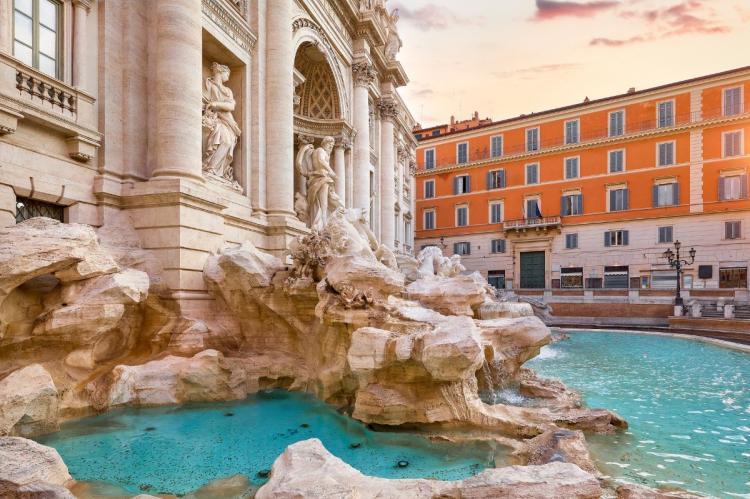
Most of Rome's great fountains are mostre: display pieces built where an aqueduct reaches the city, designed to make the arrival of water look like a triumph. That habit began under the emperors, was revived by the popes of the sixteenth century, and produced almost everything worth stopping for today.
The Trevi is the largest and the most famous. It marks the end of the Acqua Vergine, the aqueduct Agrippa completed in 19 BC and the only one of Rome's ancient water supplies still in continuous use. Its name comes from the story carved into the relief on the right: a young girl who showed thirsty soldiers where to find the spring.
Nicola Salvi won the competition for the present fountain in 1732 and worked on it until his death in 1751; Giuseppe Pannini finished it in 1762. It stands 26.3 metres high and 49.15 metres wide, built against the flank of Palazzo Poli, whose façade Salvi turned into a stage set rather than building free in the open. Bernini had drawn up a scheme for the site a century earlier under Urban VIII, and although it came to nothing, something of his thinking survives in the finished design.
The central figure is Oceanus, carved by Pietro Bracci, riding a shell chariot drawn by two sea horses — one calm, one plunging, for the moods of the sea — each led by a triton. The figures in the niches either side are not gods but allegories: Abundance pouring from an urn, and Salubrity with a snake drinking from her cup, both by Filippo della Valle. Part of the cost was met by a tax on wine, which prompted the complaint that the pope had taxed the city's wine to give it water.
Coins still go in, at something like three thousand euros a day, and the proceeds go to Caritas. The tradition is a single coin thrown over the left shoulder with the right hand; the three coins of popular belief come from the 1954 film. Since February 2026 the water's edge has been ticketed — two euros for access to the gated basin area, which is capped at four hundred people. The piazza and the view from above remain free.
Bernini's Fontana del Tritone, finished around 1643 in Piazza Barberini, is the Baroque at its most confident. Four dolphins stand on their heads, tails raised to carry an open scallop shell, and on it kneels a triton blowing a conch from which the water rises. The Barberini bees on the base mark the family that paid for it.
Near the foot of the Spanish Steps sits La Barcaccia, a half-sunken boat, built between 1627 and 1629. It is usually given to Pietro Bernini, Gian Lorenzo's father, perhaps with his son's help — not to Gian Lorenzo alone. The sinking-boat conceit solved a practical problem: the Acqua Vergine arrives at Piazza di Spagna with too little pressure for a tall jet, so the design works low and horizontal instead.
Piazza Navona holds three. Bernini's Fountain of the Four Rivers stands at the centre, made between 1648 and 1651, with river gods for the Nile, Ganges, Danube and Río de la Plata carved by his workshop. At the southern end, the Fountain of the Moor began as a plain basin by Giacomo della Porta in 1575, with four tritons; Bernini added the central figure in 1653, a Moor wrestling a dolphin rather than the Neptune he is often taken for. The Fountain of Neptune closes the northern end, at the far side of the square rather than beside the Moor. Its basin is della Porta's too, from 1574, and stood bare for three hundred years before the sculptures were added between 1873 and 1878.
In the Piazza Bocca della Verità, in front of Santa Maria in Cosmedin, the Fontana dei Tritoni is Carlo Francesco Bizzaccheri's, built in 1715 for Clement XI. Two tritons kneel on a rocky base and hold up a shell from which the water springs. The two Roman temples beside it were known for centuries as the temples of Vesta and of Male Fortune; both names are wrong, and they are now identified as the temples of Hercules Victor and Portunus.
Two others repay a detour. The Fontana delle Tartarughe in Piazza Mattei, from the 1580s, is small and perfect, its bronze turtles added later. The Acqua Paola on the Janiculum — the Fontanone — is a mostra on the grand scale, with one of the best views over the city behind it.
And there are the nasoni, some two thousand five hundred cast-iron street taps running constantly across the city. The water is the same that feeds the monuments, it is drinkable, and it is free, which in a Roman August is worth more than any of the marble.