How often eyes need testing, who is entitled to a free NHS sight test, what the examination actually involves, and the symptoms that should not wait for the next appointment.
How often, and who pays
The standard interval in the UK is every two years. An optometrist can recommend testing more often where there is clinical reason — a condition being monitored, a rapidly changing prescription, a family history — and can bring an appointment forward if something changes in the meantime.
NHS sight tests are free for a long list of people, and many who qualify never realise it:
- anyone under 16
- 16-, 17- and 18-year-olds in full-time education, including education at home
- anyone aged 60 or over
- anyone registered as partially sighted or blind
- anyone diagnosed with diabetes or glaucoma
- anyone aged 40 or over with a parent, sibling or child diagnosed with glaucoma
- anyone told by an ophthalmologist that they are at risk of glaucoma
- anyone eligible for an NHS complex lens voucher, or named on a valid HC2 certificate
- recipients of certain benefits, including Pension Credit Guarantee Credit and qualifying Universal Credit awards, and their dependants under 20
Those not covered pay, and prices vary between practices. Optical vouchers towards glasses are available to most of the same groups.
For readers in the United States
Very little of the above transfers. Routine eye examinations are generally not covered by standard health insurance, which treats vision separately; coverage usually comes from a dedicated vision plan, and Medicare does not pay for routine examinations for glasses or contact lenses at all.
The recommended intervals differ as well. The American Academy of Ophthalmology advises a baseline comprehensive evaluation at 40 for adults with no symptoms or risk factors, then every two to four years to 54, every one to three years to 64, and every one to two years after that. Children are assessed at routine health supervision visits, with visual acuity and eye alignment checked by around three and a half, and roughly every one to two years once at school.
Driving vision standards are set state by state rather than nationally.
Who does what
Four professions deal with eyes in the UK, and the differences matter when deciding where to go.
Optometrists carry out sight tests. They examine the eye, measure the prescription, detect disease and refer onwards when something needs a doctor. These are the practitioners in high street practices, registered with the General Optical Council.
Dispensing opticians fit and supply glasses, and with further qualification contact lenses. They do not test eyes. This is a point of regular confusion: “optician” in everyday speech covers both, but only an optometrist performs the examination.
Ophthalmologists are hospital doctors specialising in eyes. They diagnose and treat disease and perform surgery — cataract operations, retinal repair, glaucoma management. Reaching one normally means being referred by an optometrist or GP.
Orthoptists diagnose and manage problems with eye movement and alignment, including squint and lazy eye. Much of their work is with children.
The practical consequence is that a high street sight test is a genuine clinical examination, not a retail formality, and the person performing it is qualified to spot disease.
What actually happens
A sight test begins with questions — symptoms, general health, medication, family history of eye disease, and what the eyes are asked to do all day. The answers steer everything after.
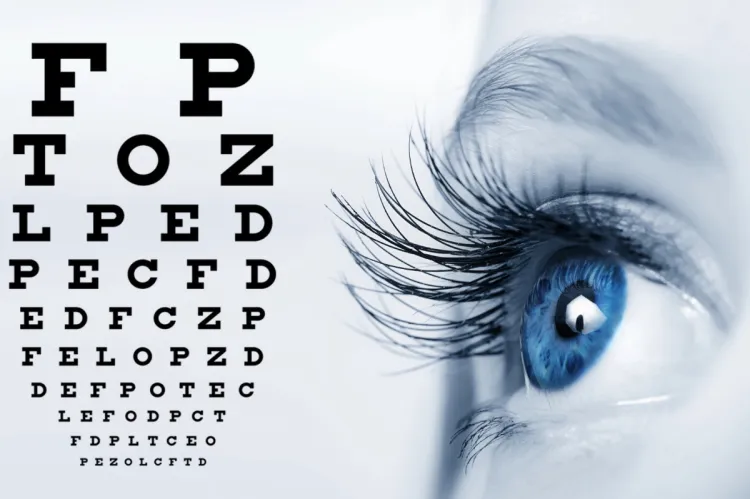
Visual acuity comes next, read from a letter chart at a set distance, each eye separately. Then refraction: the practitioner compares lenses until the sharpest combination is found, either in a trial frame or through a phoropter, the mounted bank of lenses that swings in front of the face.
Eye movement, coordination and pupil reactions follow, testing how the two eyes work as a pair and whether the nerve pathways respond normally.
A slit lamp examines the front of the eye under a narrow beam and magnification, showing the cornea, lens, iris and tear film in cross-section.
The back of the eye is then examined, either directly with an ophthalmoscope or through retinal photographs. This is the part that most often finds something unexpected, because the retina is the only place in the body where blood vessels can be seen directly. Diabetes, high blood pressure and raised cholesterol all leave signs there.
Finally, screening for glaucoma: pressure inside the eye, usually with a puff of air or a contact measurement, and a visual field test mapping the sensitivity of peripheral vision. Glaucoma causes no symptoms until a substantial amount of sight has already gone, which is precisely why it is tested for in people with no complaints at all.
The extras
Many practices now offer OCT — optical coherence tomography — usually as a paid addition. It produces a cross-sectional scan through the layers of the retina, showing structure beneath the surface that a photograph cannot.
It is genuinely useful, particularly for monitoring changes over years, and especially where glaucoma or macular degeneration is a concern. It is not a replacement for the core examination, and nobody needs it to have their eyes properly tested. For anyone with a family history or an existing diagnosis it earns its cost; for a healthy twenty-five-year-old it mostly produces a baseline.
Retinal photography is often included as standard and does much of the same work less precisely.
Children
Children are entitled to free NHS sight tests from birth, and the entitlement is worth using, because children rarely report vision problems. Having never seen anything else, they have no reason to think their sight is unusual.
In England, vision screening is offered in the reception year, at around four or five. It is a screen rather than a full examination — it catches a good deal, but not everything, and a child with a family history of eye problems or squint warrants a proper sight test regardless of the screening result.
Signs worth acting on: sitting very close to screens or books, tilting or turning the head consistently, covering one eye, rubbing eyes persistently, avoiding close work, or an eye that drifts. A squint in a baby beyond a few months old always needs checking.
Diabetic eye screening is a separate thing
This causes genuine confusion, and the confusion is risky.
Anyone aged 12 or over with diabetes is invited to NHS diabetic eye screening, a separate programme with its own appointments, usually annual. It photographs the retina specifically to look for diabetic retinopathy.
It is not a sight test and does not replace one. It will not check the prescription, examine the front of the eye, or screen for glaucoma. Equally, a routine sight test does not substitute for screening. People with diabetes need both, and being diagnosed with diabetes also brings entitlement to free NHS sight tests.
The driving standard
There is a legal minimum, and it applies continuously rather than only at the point of passing a test.
A car driver must be able to read a current-style number plate in good daylight from 20 metres, or 20.5 metres for older plates with wider characters, wearing glasses or contact lenses if they normally do. Visual acuity must be at least 6/12 on the Snellen scale with both eyes open, or in the one eye if sight is only in one. There is also a minimum width of visual field required, without significant defects in the central area.
Anyone whose sight falls below that standard, or who develops a visual field defect, must tell the DVLA — the DVA in Northern Ireland. Lorry and bus drivers are held to a stricter standard.
The number plate test can be done at the roadside by anyone, which makes it a reasonable self-check every few months. It is not a substitute for a sight test, since it says nothing about field of vision or eye health.
When not to wait
A routine interval is for routine circumstances. Several things warrant an appointment straight away rather than at the next two-year point:
- a sudden change in vision in either eye
- new floaters, a shower of spots, or flashes of light
- a shadow or curtain across any part of the field of vision
- pain in or around the eye
- double vision
- persistent redness that is not settling
- headaches that seem related to using the eyes
The first three can indicate a retinal tear or detachment, where the difference between outpatient laser and major surgery is often a matter of days. Sudden painless loss of vision in one eye is an emergency and belongs in an accident and emergency department rather than an optician’s diary.
Changed