Getting in
- Tickets are timed, and the time on the ticket is when to be underneath the tower. Lift tickets go on sale about two months ahead and stairs tickets about one; same-day sales and the ticket offices exist but cannot be relied on in summer.
- Lift and stairs are separate tickets, and there are four combinations: the lift to the top, changing at the second floor; the lift to the second floor only; the stairs to the second floor; and the stairs up with a lift to the top. The staircase above the second floor is not open to the public, so nobody climbs the whole thing.
- There are two entrances, south and east, and two security checks — one on the way into the perimeter, which takes ten to twenty minutes, and a second at the pillar.
- Everyone in the party needs identification, children included, and anyone claiming a reduced rate needs proof of it. Tickets must be shown as a PDF at full screen brightness: phone wallet apps are not accepted, which catches people out.
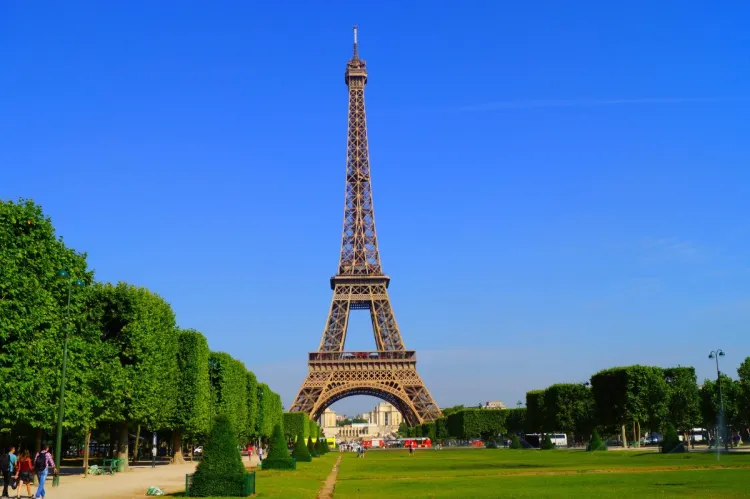
- The gardens and the esplanade underneath are free, and about ten million people a year go no further — against roughly 6.75 million who buy a ticket for the levels.
- The top and the stairs are closed to visitors with reduced mobility or on crutches.
How tall it is now
Older accounts give three hundred metres, which was right for sixty years. The tower has been raised repeatedly by the equipment bolted to its head: a television aerial took it to 312 metres in 1949, the rebuilding after a fire to about 321 in 1957, digital television to 324 in 2000, and a six-metre digital radio antenna, flown up by helicopter on 15 March 2022, to its present 330 metres.
It was the tallest structure in the world for forty-one years, until the Chrysler Building in 1930 — a long reign for something there had been organised petitions to demolish.
The numbers of the thing
- 18,038 metal parts and two and a half million rivets, only about a third of them driven on site; the rest were done in the factory at Levallois-Perret, which is why it went up so fast.
- Two years, two months and five days, from January 1887 to March 1889. Around a hundred and fifty men in the workshop and between a hundred and fifty and three hundred on site — so the figure older accounts give is roughly the site peak, not the workforce.
- Fifty-three hundred working drawings by fifty engineers and draughtsmen.
- 7,300 tonnes of iron in the frame, about 10,100 tonnes all told.
- 1,665 steps to the top and 674 to the second floor.
- The top moves up to eighteen centimetres away from the sun as the lit side expands — not away from the vertical at random, which is the detail that makes it interesting.
- In high wind it sways about nine centimetres. Older accounts give five inches, which is rather more, and in imperial units at that.
The paint, and a claim that is not true
It has been repainted twenty times in its life, at roughly seven-year intervals, by about fifty painters using some sixty tonnes of paint — not the fifty older accounts give, and a further fifteen tonnes or so weathers off between campaigns.
The twentieth campaign has been the hardest. It began in 2019, meaning to have the whole tower repainted for the 2024 Olympics; it lost months to the pandemic, and then stripping nineteen layers of old paint released lead, which suspended the work. Something like a third of the tower had been done by the spring of 2024. The remaining faces were programmed through 2025 and 2026, and a further campaign including more stripping is expected after that. The colour being applied is the yellow-brown that Gustave Eiffel himself chose in 1907, replacing the browner shade used since 1968.
And one thing in older accounts should go altogether. Visitors have never voted on the colour, and there is no computer in the tower for doing so. The tower has been a listed historic monument since 1964, so its colour is decided by the operator and the City of Paris together with the chief architect of historic monuments, on the basis of a documentary study. It is the opposite of a popular vote.
Why it is still standing
Eiffel had a twenty-year permit. The tower was due to revert to the City of Paris on 1 January 1910, and the City had every intention of taking it down.
What saved it was wireless. A Morse link was established from the tower to the Panthéon in 1898, and signals exchanged with London the following year. Captain Gustave Ferrié ran the experiments from a wooden shack at the foot of the south pillar, and by 1908 was reaching six thousand kilometres. A permanent station was built underground beside the south pillar in 1909 — months before the tower was to be demolished — and its military value won Eiffel a seventy-year extension instead.
It has been a transmitter ever since: regular broadcasting from December 1921, experimental television from 1935, a rebuilt head after a fire in January 1956, then television and FM from 1957, digital television from 2005, and digital radio from 2022. The thing that looks most like decoration is the reason the tower exists.
The cosmic-ray measurement, properly told
Older accounts say that in 1910 Wulf used the tower to make measurements that resulted in the discovery of cosmic rays. The real story needs two corrections and is much better for them.
Theodor Wulf was a German Jesuit priest and physicist. He took an electrometer of his own design to the base and then the top of the tower and compared the air's ionisation. If the radiation came from the ground, as everyone assumed, it should have halved within about eighty metres. Over three hundred metres it fell only from about six ions per cubic centimetre to three and a half — far too little — and he concluded that something was coming from above the atmosphere.
He was not believed, and the measurement did not result in the discovery. That came from Victor Hess, who took instruments up by balloon in 1911 and 1912 — decisively in April 1912, to five thousand three hundred metres — and showed radiation increasing with altitude, with Domenico Pacini's underwater measurements supplying the other half of the argument. Hess received a share of the Nobel Prize in 1936. Wulf got there first and was ignored, which is the point of telling it.
Eating up there, and Eiffel's flat
Both restaurants older accounts name are wrong, one of them twice over.
Altitude 95 has been gone for a long time. The first-floor restaurant became 58 Tour Eiffel and then, in June 2022, Madame Brasserie, under Thierry Marx. On the second floor, Le Jules Verne is still there, under Frédéric Anton — and it now holds two Michelin stars, not one. There are also buffets on the esplanade and the first two floors, a macaron bar on the second, and a champagne bar at the very top, which is the one most people do not know about until they arrive.
The other thing at the top is a reconstruction of Gustave Eiffel's own office, with wax figures of Eiffel, his daughter Claire, and Thomas Edison, who came up and signed the visitors' book in September 1889. It is viewed through the windows only and cannot be entered.
On the first floor, part of the deck is a glass floor, installed in the refurbishment of 2014. It is the single best thing on that level and is routinely walked straight past.
The lights, and who owns them
The golden floodlighting is not original. It was designed by Pierre Bideau and switched on at the end of 1985 — three hundred and thirty-six lamps, which come on automatically at dusk.
The sparkle is separate: twenty thousand bulbs, for five minutes at the top of every hour, from nightfall until the tower closes. It ran for ten minutes until 2008 and has been five since. The last one is at midnight, or at one in the morning in summer, when the golden lighting and the beacon go off and only the sparkle fires.
And a point worth knowing for anyone taking photographs for anything other than their own album. The 1985 illumination is treated as a copyrighted work in its own right, separate from the tower, which is long out of copyright. The City of Paris's own guidance is that images of the tower by day are free to use, while commercial use of the lit tower at night requires permission from the operator, because France's freedom-of-panorama exception covers non-commercial use only. No court has ruled on whether the lighting really qualifies, so the position is contested rather than settled — but it is the operator's position, and it has been asserted.
What has hung on it
Twice the tower has been used as a hoarding, and both episodes are worth a line.
From 1925 to 1934 three of its faces carried an illuminated Citroën sign, the largest advertisement in the world at the time.
And for the 2024 Olympics the rings were mounted between the first and second floors, in June, and taken down again in September 2024. The mayor said afterwards that she wanted them kept permanently, which drew objections from heritage bodies and from Gustave Eiffel's own descendants, and it emerged that displaying the symbol outside a Games period would require a change in French law. They are not on the tower now, and whether they return — and in what form — remains unresolved.