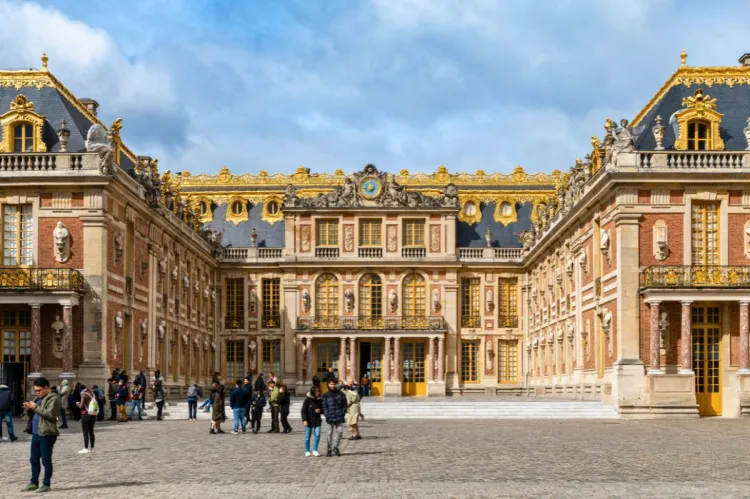
The Hall of Mirrors, and two mornings that changed Europe
The Galerie des Glaces was built between 1678 and 1684. It is seventy-three metres long and ten and a half wide, and the detail that makes it work is the symmetry: seventeen mirrored arcades holding three hundred and fifty-seven mirrors, facing seventeen windows onto the gardens, so that the room is lit twice. Older accounts give seventy windows, which is a corruption of seventeen and makes nonsense of the design.
Two further corrections to the same sentence. The pilasters are not green and not Corinthian: they are red marble, and their gilt-bronze capitals are in a French order invented for this room by Charles Le Brun at Colbert's request — a fleur-de-lis beneath a royal sun, flanked by two Gallic cockerels. It is a piece of deliberate propaganda in the architecture, and more interesting than a borrowed Greek order would have been.
What happened in it is the omission that matters most:
- 18 January 1871. Wilhelm I of Prussia was proclaimed Emperor of Germany here, Bismarck reading the proclamation, while Paris was under siege a few miles away.
- 28 June 1919. The Treaty of Versailles was signed here, in the same room, by deliberate choice — the humiliation returned.
The estate, the gardens, and the water
The estate now covers more than eight hundred hectares. Before the Revolution the park exceeded eight thousand, so what survives is a tenth of what there was — a better fact than the acreage older accounts give, which is roughly today's figure presented as the historic maximum.
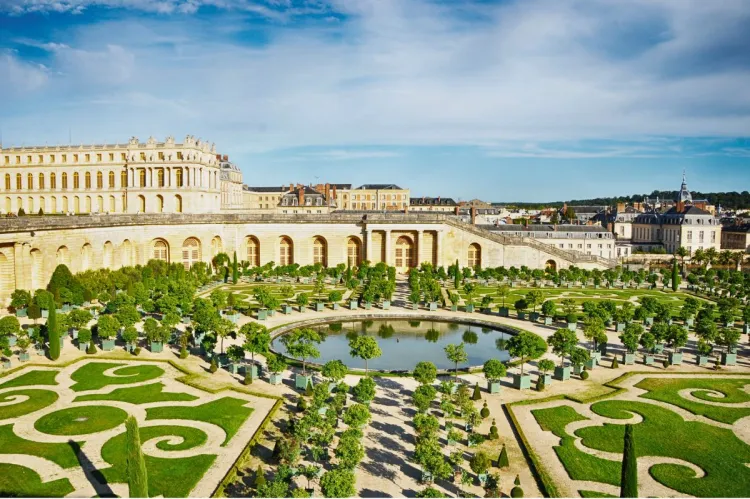
The gardens were made by André Le Nôtre, who is not named in older accounts at all. He was summoned here in the early 1660s and worked on them until his death in 1700, which is why the usual dating of the design to those four decades holds; Le Vau, Le Brun and later Hardouin-Mansart all had a hand in the wider estate.
On the water, older accounts are wrong by a factor of five. There are fifty-five basins and fountains, fed by some six hundred and twenty jets through about thirty-five kilometres of piping — not fifteen hundred fountains of which three hundred survive. The system is seventeenth-century in conception and still working, which is the remarkable part.
The Fountain of Apollo, which older accounts rightly single out, was craned out in December 2022 and restored over about eighteen months, including regilding to recover its original bronze-like finish. It has been back in action since March 2024, and it had not been touched since the early 1930s. The Dragon Fountain is now undergoing the same treatment.
The fountain shows, which are not on Sundays only
Older accounts say the gardens and fountains are a show on Sundays. The arrangement is both larger and more complicated than that, and getting it wrong is the difference between seeing the fountains play and seeing them switched off.
- The Musical Fountains — the fountains running to music — are a weekend event through the season, roughly April to early November, with additional Tuesdays in late spring.
- The Musical Gardens run Tuesday to Friday and are a different thing: the groves are opened and music plays, but the fountains do not run. This is the trap.
- The Night Fountains are summer Saturday evenings, with fireworks, and are separately and more expensively ticketed.
- The gardens are free in low season, from November to the end of March. In season, on show days they are ticketed, and the all-estate Passport includes one entry.
One current caveat: the estate has been operating under a drought alert, with the display timetable adjusted to conserve water. Anyone travelling specifically for the fountains should check what is running before setting out.
Trianon, which older accounts omit entirely
Half an hour's walk across the park, or a ride on the little train, is the part of the estate most people regret missing. The Grand Trianon, the Petit Trianon and the Queen's Hamlet — Marie-Antoinette's model village, with its dairy and its mill — form a separate domain with its own character, far less grand and far more habitable than the palace.
It is not included in a palace ticket. Either the whole-estate Passport covers it, or there is a separate Estate of Trianon ticket, which is the cheaper way in for anyone who does not want the state apartments. Trianon opens at midday and closes on Mondays, so it cannot be done first thing.
Marie-Antoinette's own private chambers in the palace, incidentally, reopened in 2023 after restoration — which makes the vague reference in older accounts to recent work on the Queen's Apartments some years out of date.
The stables, and what is actually on there
The Grande Écurie opposite the palace does hold horses again, and older accounts are right that it was closed to the public for a very long time. The rest needs updating.
The Académie équestre de Versailles was founded there by the horseman Bartabas in 2003, and it is still working. It keeps about forty horses — Lusitanos and Sorraias among them — not the twenty older accounts give. Its performance is now La Voie de l'écuyère, danced by horsewomen, on weekend afternoons and evenings through most of the year, with a break from early August to the middle of September.
Two practical corrections. The visit to the stables is now self-guided and included free after the performance, rather than the directed tour older accounts describe; a separate, paid guided tour behind the scenes is sold through the town's tourist office. And the morning training session with riders in costume is no longer in the programme — it appears on a good many third-party sites that have not been updated, and anyone travelling for it would arrive to nothing.
The Chapel and the Opera
Neither is simply walked into, and both are worth planning for.
The Royal Chapel had an exceptional open summer in 2026, which included its newly restored sacristies — rooms never previously shown. Since the autumn of 2026 the Chapel and its annexes are accessible on guided tour only, with booking compulsory.
The Royal Opera is not on the ordinary visiting route at all. The way in is to buy a seat: it runs a full season of opera, concerts and ballet, and hearing eighteenth-century music in an eighteenth-century theatre is a better experience than filing through it would be.
How many rooms, and who was allowed in
Older accounts give seven hundred rooms. The palace has something closer to two thousand three hundred, over roughly sixty-three thousand square metres — which only strengthens their point that a single visit covers a fraction of it.
On access, older accounts claim the gates were left open to suggest the palace was owned by the people of France. That is an anachronism. The real rule was a dress code. Anyone decently dressed could come in, provided a man wore a hat and carried a sword, and the gardens, the royal collections, the state apartments and the Hall of Mirrors were open daily. The private apartments could be seen only when the royal family was away, and only by those with a connection among the court staff. It was a display of royal magnificence and of the king's accessibility — close to the opposite of popular ownership, and a stranger idea than the version older accounts offer.
Getting there, and a road closure worth knowing about
- The station older accounts name has been renamed. It is Versailles Château – Rive Gauche, on the suburban line C, and it has been since 2012. About ten minutes' walk from the gates, and the closest of the three.
- From Montparnasse to Versailles Chantiers is about eighteen minutes' walk; from Saint-Lazare to Versailles Rive Droite about seventeen. The second of those runs on Transilien Line L — the château's own practical-information page names the wrong line for it, which is worth knowing if the two disagree.
- A bus, the 171, runs from the end of Métro line 9 at Pont de Sèvres in about half an hour.
- Anyone thinking of driving should not. The A13 is closed in the Paris-to-Versailles direction from November 2026 until the end of August 2027, and in both directions for part of that summer. The estate is advising public transport.
Two closing notes. The palace and park were inscribed on the World Heritage List in 1979. And the 2024 Olympic equestrian events and modern pentathlon were held here, on a temporary arena by the Grand Canal — everything was dismantled afterwards, deliberately leaving no trace, so there is nothing of the Games to look for.
Older accounts advise dressing for the heat, and that advice has aged in the right direction: the state apartments are crowded, unventilated and can be brutal in high summer. Early morning, or the low season when the gardens are free, is a materially better visit.