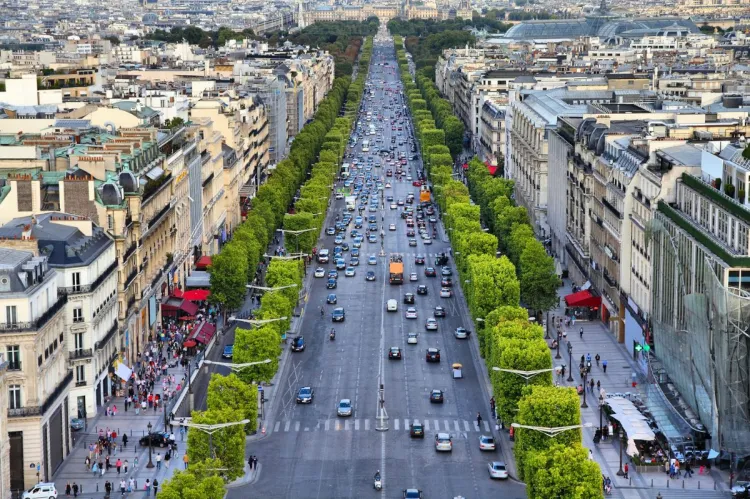
Two halves, divided at the Rond-Point
Older accounts place the commercial half at the Place Charles de Gaulle and the walking half at the Place de la Concorde. Those are the squares at either end, not the halves. The avenue changes character at the Rond-Point des Champs-Élysées, roughly midway.
Above it: shops, international flagships, cinemas, cafés, offices, and the highest retail rents in France. Below it: the Jardins des Champs-Élysées, laid out as twelve garden squares either side of the roadway and classified since 1910. In among them are the Grand Palais and the Petit Palais, three theatres, several pavilions and a couple of very old restaurants. Most visitors walk down from the Arc, lose interest among the chains and turn back, which gets the avenue exactly the wrong way round.
One claim should simply go. Older accounts rank it as Europe's second-widest avenue after a boulevard in Bucharest. At seventy metres it is not exceptional — Avenue Foch, a few hundred metres away, is considerably wider — and the comparison is a piece of travel-guide folklore with nothing behind it.
The trees are planes, and the pavements were widened
Older accounts describe chestnut trees. The avenue's rows are plane trees; the chestnuts are in the garden squares. The second row of planes went in during the restructuring of 1992 to 1994, which is the work older accounts half-remember: the parking lanes along the sides were taken out, surface parking removed, and the pavements widened to just over twenty metres, which is what makes the upper half walkable at all.
What is planned, and what has actually been built
There is a widely reported scheme to remake the avenue — halving the space given to cars, planting "tunnels of trees", extending the gardens — with a figure in the hundreds of millions attached and a horizon of 2030. It is worth being clear about its status: it is an urban study, commissioned by the avenue's own traders' association after a public consultation, not a funded construction programme. The date is an aspiration.
What has been built is a first package delivered before the 2024 Olympics, paid for by the city: the side-alleys repaved, the pedestrian crossings rebuilt with central refuges, the tree pits planted up, the central ring at the Étoile widened, and — a small thing that changes the look of the whole street — every café terrace rebuilt to a single commissioned design. In the gardens below the Rond-Point, a hundred-odd new trees went in, the flowerbeds were extended, and three side roads were converted into garden paths, which is the most useful thing that has happened to the lower half in decades.
The Concorde end
The obelisk at the foot of the avenue is Egyptian, from Luxor, and it is the oldest object in Paris by a wide margin. The square around it was not rebuilt for the Olympics, whatever the coverage suggested: the fountains were restored, and the square was pedestrianised from 2023 and used as a Games venue, but the real redesign is still ahead.
That scheme has been chosen and approved — around three hectares of new green space, the balustrades, sculpture groups and sentry boxes restored, beds turned to lawn, two-thirds of the surface given to pedestrians, a single lane of traffic kept on one side, and a staircase rebuilt to give the square back its access to the river. The works are programmed for 2027 to 2030, so anyone visiting in that window should expect hoardings at the eastern end of the avenue.
The Grand Palais and the Petit Palais
Older accounts say both house rotating exhibitions and deserve a look. True, with two things added.
The Grand Palais closed in March 2021 for a three-year restoration and fully reopened in June 2025. Its nave was used for the Olympic fencing before that, which is why it appeared open in 2024 while still being a building site. The Palais de la Découverte, the science museum inside it, is a separate matter: it is still closed, and due to reopen in March 2027 for its ninetieth anniversary.
The Petit Palais is not merely a hall for temporary shows. It is the Musée des Beaux-Arts de la Ville de Paris, with a permanent collection running from the ancient world to 1900, and — like the city's other municipal museums — its permanent collection is free. It is the best free hour on the avenue, and older accounts never say what it is.
Eating, shopping, and the one name worth keeping
Older accounts name half a dozen shops and hotels. Nearly all of it has turned over, which is the nature of the street, and naming chains is what dates a page faster than anything else. Two notes are worth making:
- Fouquet's — spelt with the apostrophe, on the corner of the Avenue George V — has been there since 1899 and has been a listed monument since 1990. It was attacked and burned during the gilets jaunes protests in March 2019 and has been restored. It remains expensive and remains the landmark café of the avenue.
- The Hôtel Napoléon that older accounts place here is not on this avenue at all — it stands on the Avenue de Friedland, round the corner from the Étoile. That was wrong when it was written, not merely out of date.
The practical advice is unchanged and still good: the terraces charge for the position, and the position is genuinely worth something once, in the evening, with the Arc lit at the top of the hill.
When the cars are not there
Three times the avenue stops being a road, and all three are absent from older accounts:
- The first Sunday of most months it is closed to traffic and given to pedestrians, from late morning to late afternoon — a scheme running since 2016. Months are occasionally skipped, so it is worth checking the city's calendar rather than assuming.
- On 14 July the military parade comes down it, from the Étoile to the Concorde, and the Arc itself closes for the day.
- The Tour de France traditionally finishes here, on laps of the avenue, on the final afternoon in July. It has occasionally been moved elsewhere when Paris was busy with something larger, so it is not an annual certainty.
The Métro serves the avenue at Charles de Gaulle–Étoile at the top, George V and Franklin D. Roosevelt along it, and Champs-Élysées–Clemenceau at the bottom — but the whole thing is under half an hour's walk, downhill from the Arc, and that is how it ought to be done.